What happens when a family meeting to decide a father's future turns into a combat of reproaches? This is the starting point of 53 domingos, the comedy written and directed by Cesc Gay that can be seen at Teatre Condal from September 9 to 27.
After its premiere on Netflix as a film, the play is presented in Barcelona with a new cast led by Julián López, Pepa Charro, Xavi Mira, and Candela Serrat.
The Catalan filmmaker and playwright welcomes us to talk about the absurdity of sibling fights, the challenge of directing the same text for the third time, and the magic of making theater today.
— Let's start at the beginning: why this title, 53 domingos?
— You have to go to the theater to understand it. It's a disconcerting title, as is said in the play itself, but it has an explanation that must be seen live. It was part of a certain appeal, but it's the truth.
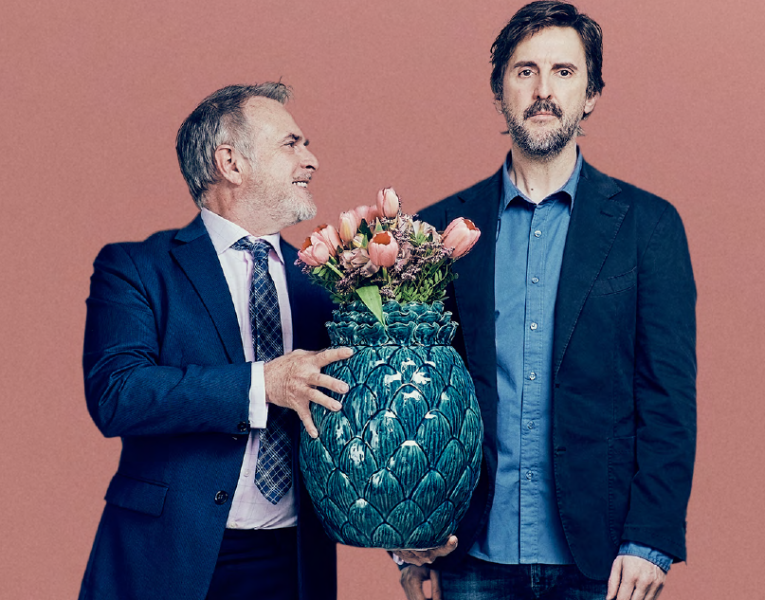
— On the poster, there's a vase with flowers very present. Can you reveal anything about it?
— Not really. All of this is part of the same structure, of the internal game and the architecture of the play. The vase and the flowers are a whole theme within the plot, so when we were giving it shape and image, we wanted to play with that element.

— Can you briefly explain what the play is about?
— 53 domingos is a look at the world of siblings. Why do they fight so much? With the person you were born with and lived with as a child, reproaches, jealousy, and competitiveness accumulate; things that can lead to a bad relationship. Sometimes these are conflicts that explode, and sometimes you pretend nothing is happening, but when you go home, you're affected. The play shows how a situation like caring for an aging father generates a meeting between siblings where everything ends up unraveling.
— The care of parents is the great trigger of the plot...
— Yes, it's the trigger for a very common situation in life, especially as you get older. Suddenly, it's considered that the father starts doing strange things —like showing his penis to the neighbor— and a decision has to be made. Then the usual arises: one sibling would put him in a residence, the other says no... It's the dynamic of all families, and with this excuse, the conflict is generated.

— The play talks about the responsibility of children and old age. How do you think we treat older people today?
— It's a very complex and difficult issue. I don't know if it has to do with money; obviously, if you have it, it's easier, but I think that when you're old, what you want is tenderness and the affection you've cultivated as a parent with your children. In families where there's a good atmosphere, older people are cared for more naturally, whereas in families where relationships aren't as good, that's where they suffer the most.
Comedy allows you to ridicule situations and see the absurdity of certain things.
— You approach family relationships through humor. Is there hope for reconciliation in the end, or what is the message?
— It's not that there's a specific message, but comedy allows you to ridicule situations and see the absurdity of certain things. From the outside, you think: "How can these people fight so much if they have no reason?". The goal is to put siblings in a conflict situation that, seen from the outside, is ridiculous.
— At the press conference, you explained that Candela Serrat's character acts as a narrator. Is she the link with the audience?
— Absolutely. She speaks directly to the audience, explains what's happening, and does so by breaking the fourth wall. She looks at it with humor and a bit of curiosity, as if saying: "How they fight and how envious I am of them!".
— In the presentation scene, a conflict is seen over something as small as a light bulb. Does the play use these anecdotes to make routine explode?
— Absolutely, just like in real life. In the end, big fights start over absurd details: who takes out the trash or, in this case, a light bulb.
The goal is to put siblings in a conflict situation that, seen from the outside, is ridiculous.
— The play has also been adapted as a film for Netflix. What are the differences between the theatrical and cinematographic versions?
— They are different languages. Cinema is at the service of the cameras. Although the basis is the same text or script, the work of the actors and mine as a director changes completely. I come from cinema and I'm learning to do theater; I precisely enjoy it a lot because the process is different.

— What do you like most about theater?
— The hours! They don't come looking for you at five in the morning, and when you want to stop for lunch, you stop. Cinema has an army-like scale that moves with a lot of tension. Theater is a more familiar and healthy process: you rehearse day by day until you premiere.

— In the press release, it is defined as a story of "family in modern times." What modernity will we see in it?
— You should ask whoever wrote it! I suppose it refers to the fact that it is a reflection on a current situation with which we can all empathize.
When you change language, the humor and resonance of the text change.
— What is the main change in this Spanish version compared to the one you premiered in Catalan?
— The big change is the language and the cast. When you change language, the humor and resonance of the text change. And when you change the actors, the play transforms. For example, Julián López and Pere Arquillué have very different energies as protagonists: Julián has a humor based on resignation and observation, while Pere is pure energy. As a director, you have to compensate for what each one brings.

— What has been your biggest challenge as a director in returning to this play for the third time?
— I thought the challenge would be to maintain the enthusiasm for a text I had already written, performed in theater, and adapted for cinema. But on the first day of rehearsal, those doubts disappeared, and I approached it as a new project. I really enjoyed rediscovering it.

— And as an author, what was the original challenge?
— The same one we all have when we write: the fear that what you do won't interest anyone, neither producers nor the public.
— Your career has been very linked to cinema, but you debuted in theater with Els veïns de dalt and since then you haven't stopped. How did this need to make the leap to the stage arise?
All my life I've had theater very close. Most of my actor friends do it and I always thought that someday I would have to dare, but it took me 20 years to take the step. When I finally decided with Els veïns de dalt, the response from the public and producers was so positive that I wanted to continue exploring this path. In addition, alternating cinema with theater works very well because it allows you to change register and work rhythm.
It's very nice to see people having a good time.
— To conclude: if you had to define 53 domingos in a single sentence for the audience, what would it be?
— That he will have a great time. I don't like watching my movies at all once they are made, but I do go to the theater. It's very nice to see people having a good time, to see that they have taken the subway, the taxi or the train and have paid a ticket to come and see you. Watching a play or a movie is stopping time in this world we live in, and I feel very grateful for this connection with the audience.
Add The New Barcelona Post as your preferred Google source for free
Stay informed with the latest news.