Climate change is one of the great global challenges, and its effects are already visible on the planet, in the form of extreme heat waves, urban floods, sea level rise, or prolonged droughts. In fact, in recent years, the metropolitan region of Barcelona ---which integrates 36 municipalities and a population of 3.3 million inhabitants--- has suffered the most severe drought episode of the last 200 years. An episode that led to the activation of different measures and restrictions by the Agència Catalana de l'Aigua (ACA), established in the different phases of the Pla Especial de Sequera to manage water scarcity.
Given this context, technological innovation emerges as a strategic ally to guarantee the sustainability and water resilience of the metropolitan territory. With this objective, the PERTE RESSONA project was born, when Aigües de Barcelona received, in November 2023, a competitive grant from the Ministry for Ecological Transition and the Demographic Challenge within the framework of the PERTE (Strategic Project for Economic Recovery and Transformation) Next Generation for the digitalization of the urban water cycle. The objective of this grant is to implement and execute PERTE RESSONA (REsiliencia y SOstenibilidad del ciclo del agua al área metropolitana de BarcelONA con el impulso de la transformación digital), a project promoted by Aigües de Barcelona in collaboration with the Barcelona Metropolitan Area (AMB) and the ACA.
With an expected duration of two and a half years, the project is deployed through nine interconnected lines of action that cover the entire water cycle —from capture to return to the natural environment—. With this comprehensive approach, the initiative aims to become a technological and strategic response to a reality that requires structural solutions to foster the water resilience of the metropolitan territory.
Of these nine lines of action, four correspond to the improvement of supply processes, which include advanced monitoring of wells, the implementation of a digital twin of the supply network ---that is, a digital replica of the entire network to be able to technologically simulate and predict the effects of any action---, the improvement of remote consumption reading, and the supervision of the hydraulic and energy efficiency of the supply network.
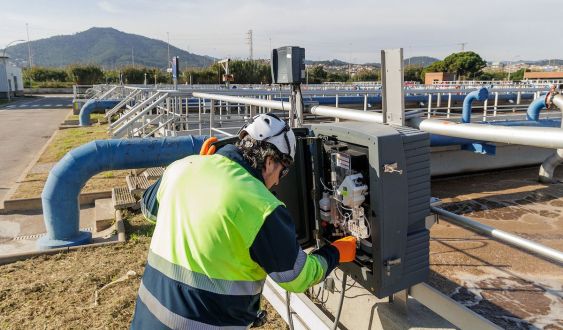
On the other hand, four measures are also being deployed to promote modernization and technological implementation in the field of sanitation, such as the implementation of the network's digital twin, the application of sensors in the network, in treatment plants and at discharge points, and the advanced management of the entire sanitation and regeneration process. Finally, the initiative also includes an additional action to facilitate the complete management of the water cycle, based on the centralization and treatment of all collected data to guarantee a more efficient and resilient service.
The scope of all actions, the commitment to technological innovation, and the complexity of processing the information generated by the contemplated actions, have positioned the PERTE RESSONA project as a strategic initiative to guarantee the resilience of the water sector in a territory with a structural water deficit such as the Barcelona metropolitan area. Likewise, the project has also received recognition from the Ministry for Ecological Transition and the Demographic Challenge of the Government, which has acknowledged its innovative, comprehensive, and multiplying nature.

A technological deployment that has been possible, in large part, thanks to a meticulous architecture of institutional collaborations and with the technological fabric; alliances that have not only made the project's financing viable but have also been key to its governance, fluidity, and effectiveness.
Add The New Barcelona Post as your preferred Google source for free
Stay informed with the latest news.
