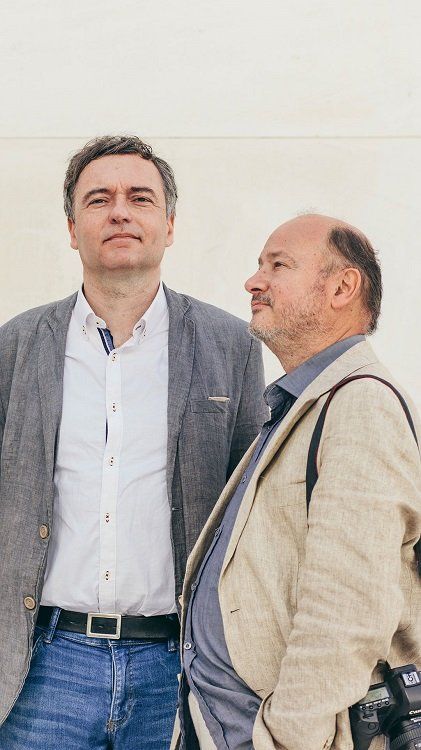
Kim Manresa, a renowned photojournalist hardened by a thousand wars and social conflicts, never imagined he would end up taking photos for a literature project. Nor did Xavi Ayén, a prominent cultural journalist closely linked to Barcelona's literary world, imagine he would travel non-stop to interview writers in their countries of origin. No, "Nobel Walks" was not born from a masterful plan, but from a small favor between friends.
Xavi Ayén – I asked Kim if he could get me a couple of manuscripts from authors in their original language for an education project in the world that I had in hand. I wanted those of José Saramago and Darío Fo.
Kim Manresa – I told him that, well, I wasn't going to bother a writer like that for one sentence, that we should take the opportunity to do an interview. And he said okay. In short, it kept getting bigger. The third was Kenzaburō Ōe, who was so happy that he recommended Günter Grass to us. The writers themselves recommended colleagues to us and everything started to roll.
ALMA – What was your goal when you visited them?
X. A. – Not to do the typical half-hour interview in a hotel talking about their latest book. To get into their everyday environment or into settings that appear in their works. Saramago took us to the places in Lisbon from his novels, Kenzaburō Ōe received us in Tokyo with his son, Svetlana Aleksiévich let us into her mythical kitchen…
K. M. – I wanted something very everyday. That's why I followed Xavi and the interviewee like an invisible photographer, without bothering them.
ALMA – When did you realize you had created something big?
K. M. – When it was exhibited at the Nobel Museum in Stockholm. The director told us how surprised he was by the monumental work that no one in the world had done before and that it was unrepeatable, because not even they themselves had had that access to the Nobel laureates.
ALMA – And how do you manage to get that access?
K. M. – It's a painstaking job. With Wole Soyinka, for example, we found out he was coming to a festival in Oviedo. So we went to Oviedo and told him we wanted to interview him in his hometown, in Nigeria. And once there, he took us everywhere.
X. A. – Doris Lessing was very old and never left home, her back hurt and she didn't even go to collect the Nobel. Her translator had given me her address in London and we showed up there. There are sensational photos with her, who opened the door in a bathrobe with the whole house messy like a book market.
ALMA – How did you get the only interview García Márquez granted in the last 15 years of his life?
X. A. – I was making a documentary about Carme Balcells, his agent in Barcelona, and she advised me to take him a suitcase with some Christmas gifts from her and that, once at his house, we would explain. His wife offered to help us. We waited two days in a hotel in Mexico without knowing what would happen and, when he finally called us, we still waited another hour in the lobby of his house. In the end, he came out reluctantly and asked us: "How much did you pay my wife?". Then we learned that he was happy.
ALMA – What is the best thing about this exhibition?
X. A. – That it is the only one where all 23 interviewees are seen (at the Nobel Museum there were only 12). That it has several levels of reading, depending on your references. Maybe you know why Gao Xingjian chose to take us to a painting studio, but if you don't know, you enjoy it just the same. And that the phrases on the wall do not come from books, but from things that the Nobel laureates told only us. That's why we feel it is very much ours.
ALMA – Which are your favorites?
K. M. – For me, Wole Soyinka. We went to Nigeria and, since I have many ties with Africa, we talked about everything but literature. He took us to his village, to the school where he studied as a child, which is now totally abandoned, and the photo was taken at his old desk.
X. A.– For me, Naguib Mahfuz. This man received a stab wound in '94, which damaged his sight, vocal cords, and hearing. Even so, he continued to hold his famous gatherings with his friends in Cairo but, instead of him commenting, now it was his friends who read him the news they cut out for him during the week, shouting into his ear. Not only is it a beautiful photo, but it has everything journalism should have.
ALMA – You have interviewed and photographed 23 Nobel laureates. Will there be more?
X. A.– Yes. If you notice, we have left four panels without a photo or text because, if we do any more between now and when the exhibition ends in September, we will add it. Also, this is a work in progress. We do not consider any author finished. As long as they are alive, we can meet them again and we can complete.
K. M. – I tell Xavi that now we should write the book of anecdotes: when they gave us armed guards, our plane escaped, a snowfall fell that cut us off, with Orhan Pamuk they told us they were going to kill us… Each character has a bizarre story behind them.
Interview: Ana Portolés Photography: Laia Sabaté
You can read more stories like these in ALMA, the social social network, a digital space dedicated to the social sphere that offers a new perspective on the present and future of society, from an optimistic and diverse voice, and all the initiatives promoted by the "la Caixa" Social Project.
Add The New Barcelona Post as your preferred Google source for free
Stay informed with the latest news.