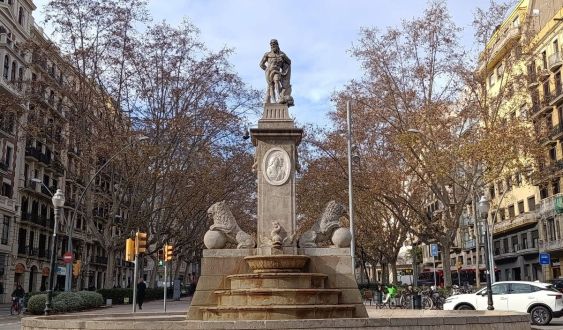
The Fountain of Hercules is one of those presences that go unnoticed by Barcelona residents, because it doesn't shout or compete, nor is much known about its artistic or historical value. Also because of its location in a common roundabout, inaccessible to pedestrians, of little daily and landscape relevance. And yet, it has existed for more than two centuries. Observing how Barcelona stirs and changes its skin, without the fountain being altered or demanding any special attention. Planted today on Passeig de Sant Joan (confluence with Còrsega), in a space of constant traffic, the mythological founder of the city seems to naturally resist the condemnation of being infinitely seen and, at the same time, never looked at.
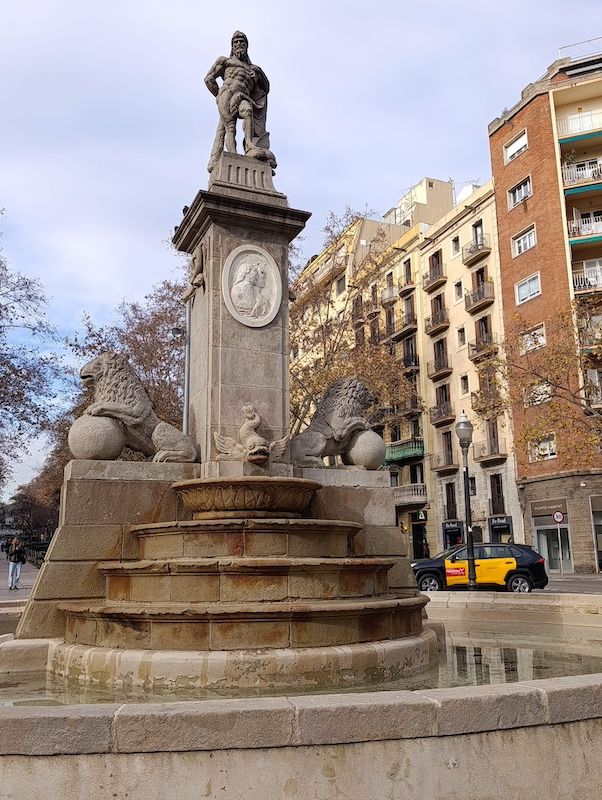
To invoke Hercules is to symbolically place oneself before Rome, or at least on the same mythical level. It is a way of saying that Barcelona is not a secondary city, or born (like some peninsular capital) by administrative decree, but that it has deep roots and also looks towards the Mediterranean. Legend had it that Hercules would have founded the city after losing one of the ships of his expedition (the famous barca nona), and this story appears especially in medieval and Renaissance chronicles. Hence, the source of the myth and the source of the fountain. Which, moreover, turns out to be the oldest ornamental fountain in the city.
It was conceived at the end of the 18th century, in the midst of the neoclassical explosion, but inaugurated in 1802, on the occasion of the visit of Kings Charles IV and Maria Luisa of Bourbon-Parma, when the city was still far from the nervous and dense metropolis we know today. Despite the traumatic defeat of 1714, Barcelona began to have no choice but to imagine itself modern, orderly and enlightened, and it did so also through classical symbols: the perfect body, controlled strength, heroic virtue. Hercules, with the skin of the Nemean lion over his shoulder and the club in his hand, embodied that aspiration better than anyone.

The fountain was originally located elsewhere, on the Explanada promenade, a space that then connected the city with the perfidious Citadel (and above that very central and dynamic Ribera neighborhood, already defeated and demolished). The Explanada was then a scene of mourning, as its name indicated in contrast to previous centuries, but also of strolling, exhibition, and sociability. With successive urban reforms, the fountain was moved more than once until, well into the 20th century, it found its definitive location. This coming and going has turned it (like so many other monuments in the city) into a silent witness to urban mutations—sometimes capricious and incomprehensible, it must be said. In fact, when the Palau de Belles Arts was built, the architect August Font made sure the fountain was not touched. It remained, therefore, in the gardens of this palace until it was moved to its current location in 1928.
There are details in the fountain (we insist: neoclassical style, like a kind of Renaissance of the Renaissance, or noucentisme avant la lettre) that still clearly explain this relationship between power, city, and memory. The medallions that decorated the pedestal, dedicated to the Bourbon monarchy, were removed with the arrival of the Republic. The body of the demigod, however, remained intact. On the pedestal that supports the figure, there is still today the oval medallion with the portrait of the aforementioned monarchs. The entire ensemble rests on a stone base located in the middle of a circular pond. The base contains two pedestals supporting two lions and, in the central part, a waterfall of water formed by four semicircular basins that pour water one over the other. The water flows from a small dolphin figure, while the lions also have spouts in their mouths. If it weren't for the small dimensions of the ensemble, the sculptures could impress or even inspire a certain respect. Hercules, here, rather than impressing, seems to apologize for existing and appears as something much less than a god. This is the problem with neoclassicists: sometimes they don't seem to understand that a myth needs, precisely, mythical pedestals and legendary lions.
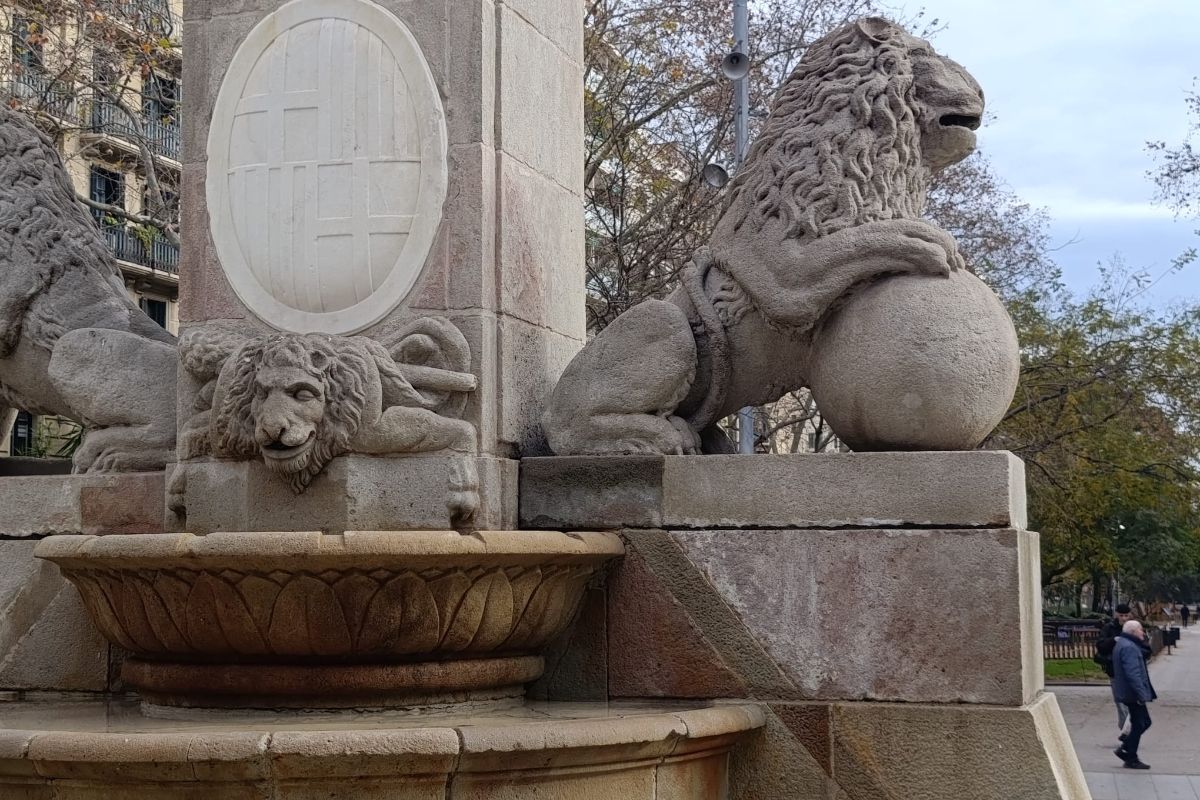
No, it is not a spectacular fountain. Nor colorful. Not even entirely monumental. It is certainly not a tourist icon, nor does it appear in guidebooks, nor does it demand selfies. Rather, it waits for those who stroll without haste (or those who cross it by motorcycle every day) to notice it, and perhaps connect the legend with history. In any case, given its construction date, this fountain has something of a promising phoenix: the city can always be reborn from the ashes. It must be that an ancient god, half human and half immortal, watches over it.
Add The New Barcelona Post as your preferred Google source for free
Stay informed with the latest news.
