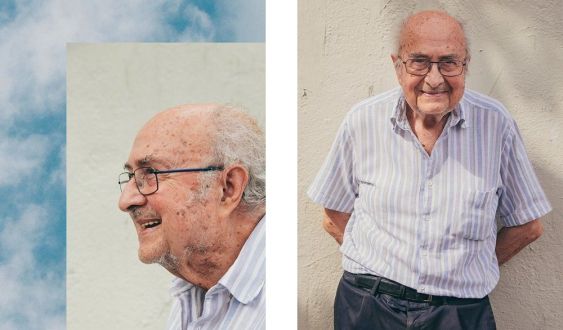
In an article from a few years ago, I wrote: "Not all people who suffer pain suffer, nor do all who suffer experience pain." What is suffering and how does it differ from pain? I'll give you an example. A pregnant woman going into labor knows she will have a hard time and will feel a lot of pain; but if what she expects is a desired child, the pain passes without suffering. On the other hand, when we face a situation we don't control, facing uncertainty, that's when suffering appears. Because we are human. We want to know the consequences things will have and, above all, to be able to make decisions about them.
Is that why it's so hard for us to accept death? Of course. Although this is seen in all aspects of life. For example, when you have a date with someone you like a lot and you're not sure if they will come. Until you see them arrive, you feel a very unpleasant uncertainty, because the evolution of the situation does not depend on you. In palliative care or in cases of serious illnesses, not knowing what will happen, not being able to make plans, and not managing to live life day by day can become very hard.
How to alleviate the suffering of someone in palliative care? Each person is different, so the only universal way to help is to listen: try to understand the other person, understand what they feel, what you can do to help them, and respect them fully, whatever their beliefs, their past, or their expectations. My way of thinking was greatly changed by a work by Eric Cassell, in which he explains that it is not the body that suffers, but the person.
And what is a person? It is not their body, nor their brain, their family, their social or emotional environment, or their roots. The person is their biography, it is a journey. A journey that begins when you are born and ends when you die (or when someone stops thinking about you once you have died). A journey that constantly changes and is unique. No two journeys are alike. This is the secret to approaching a sick person or someone at the end of life: realizing that they have unique desires and expectations and listening to them to adapt to them.
What does a program like Comprehensive Care for People with Advanced Illnesses from "la Caixa" Social Outreach Project contribute to Spanish healthcare? Years ago, I gave some conferences within the framework of the program, so I know firsthand people who are working in related palliative care units. The truth is that I believe it has helped a lot, it has opened doors that were closed and that it was important to open. We need a large dose of listening, observation, love, and sharing with other people this incomprehensible world in which we find ourselves. I am about to turn 88 and I know that I will leave this world without having understood much...
But you haven't stopped trying. That's beautiful. Yes, there is also poetry in death. I would say there are two good ways to approach it. One is by giving thanks for the life one has had. Like the British neurologist and writer Oliver Sacks, who died a couple of years ago. He had terminal cancer and shortly before dying he wrote an open letter in The New York Times thanking for all the beautiful things that had filled his life. The other way to face death is by learning. Because, as long as you have the capacity for it, learning never ends. The philosopher Bertrand Russell said that we are in the world for two things: on the one hand, to expand knowledge through science and research; on the other, to expand love and understanding among people. And in both, there are no limits.
Is happiness the absence of suffering? It's not that simple, rather I believe it has to do with feeling a little out of the world at a given moment. As if you were eternal, and time and everything else didn't matter. It's a feeling of being at peace, that everything makes sense, even if you don't understand anything. But you are immersed in the world and in others. For me, that is happiness. For another person, it can be something different.
You are also a great film buff. In fact, for years you have been compiling films that can help overcome grief together with Dr. Beatriz Ogando. What is it about cinema that can help us face suffering? It facilitates empathy, it helps us understand others. There is an extraordinary film: Amour, by Michael Haneke. It helps you empathize with two people who love each other, who have lived their whole lives together, but she falls very ill, he takes care of her until he can't resist anymore; finally, he kills her out of love and then commits suicide. Without going any further, last week something similar happened in Spain. There are cases in which people see nothing but suffering and helplessness. I recommend Soltando Amarras, a recent book in which Colombian neuropsychologist Eugenia Guzmán talks about the different ways of dying.
Since suffering is so subjective, does palliative care staff have a way to evaluate it? A good indicator can be asking the patient about their perception of time. Because, if time feels long to them, something is not working. If you are not comfortable, the minutes are eternal.
There is a privilege that doctors, lawyers, or teachers have; deep down, all human beings. Sometimes, you are in a public place and a stranger approaches you and says: "You surely won't remember me, but years ago you said some words that changed my life." And you don't remember what you said or who the person is or when it was, but whatever it was, you created a magical moment in which a few phrases or a gesture coincided with all the complexity of that person's needs.
So, even if palliative care staff sometimes don't see results, they should not despair. Because almost always we ignore what word, attitude, or gesture can positively influence the other. That is why we must always, always, keep trying.
Interview: Patri Di Filippo Photography: Laia Sabaté
You can read more stories like these in ALMA, the social social network, a digital space dedicated to the social sphere that offers a new perspective on the present and future of society, based on an optimistic and diverse voice, and all the initiatives promoted by the "la Caixa" Social Project.
Add The New Barcelona Post as your preferred Google source for free
Stay informed with the latest news.