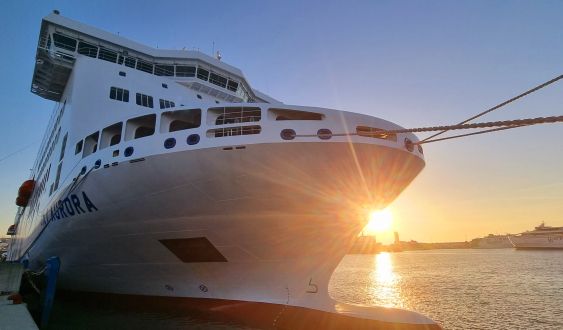
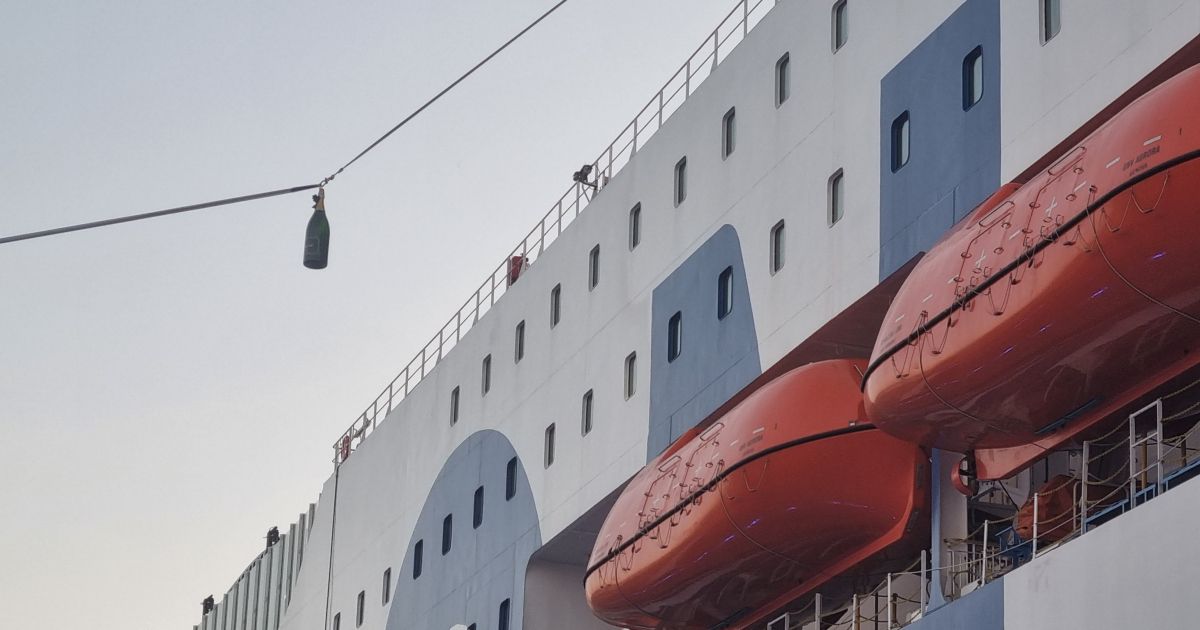
It is the 84,653rd scale in the statistics of the Port of Barcelona. A number that doesn't say much, because in fact it is just another arrival through the north entrance... although in reality it is not. It is an inaugural visit that has not been given much fanfare or promotion in Barcelona, because its christening took place last Monday in Tangier (and we attended it), with a party in the style of everything the MSC group does: they throw the house out the window and celebrate by demonstrating their power in the maritime sector. The oldest ritual of the sea was not missing: the breaking of a huge bottle of champagne against the hull of the Aurora, with all the solemnity and roar that a ship of this magnitude deserves.
The GNV Aurora arrives in Barcelona today discreetly at dawn: it docks at the Ponent Pier at five in the morning, coming from the North African city, already on a commercial voyage, and sets sail at half past nine for Genoa. An inaugural voyage in which there is no time to lose, with a ship already working at 100%.
But this passage through Barcelona without excessive publicity has more weight than it seems. Our city generates 30% of the traffic on the Genoa–Barcelona–Tangier Med line. In other words: practically one out of every three passengers, cars or motorcycles and one out of every three cargo units on this route passes through here. This fact makes Barcelona the key traffic hub of the entire network of connections between Morocco, Spain and Italy, and explains why GNV has decided to place precisely here its two newest, largest and cleanest ships in the entire fleet.
Pulling the red thread
To understand why this line has so much history —and so much future— we have to go back to 1953 and a movie: Roman Holiday, starring Gregory Peck and Audrey Hepburn. In one of the last scenes, when Princess Anna receives the accredited press in Rome, a journalist next to Peck introduces himself saying: "Julio Moriones, La Vanguardia, Barcelona".
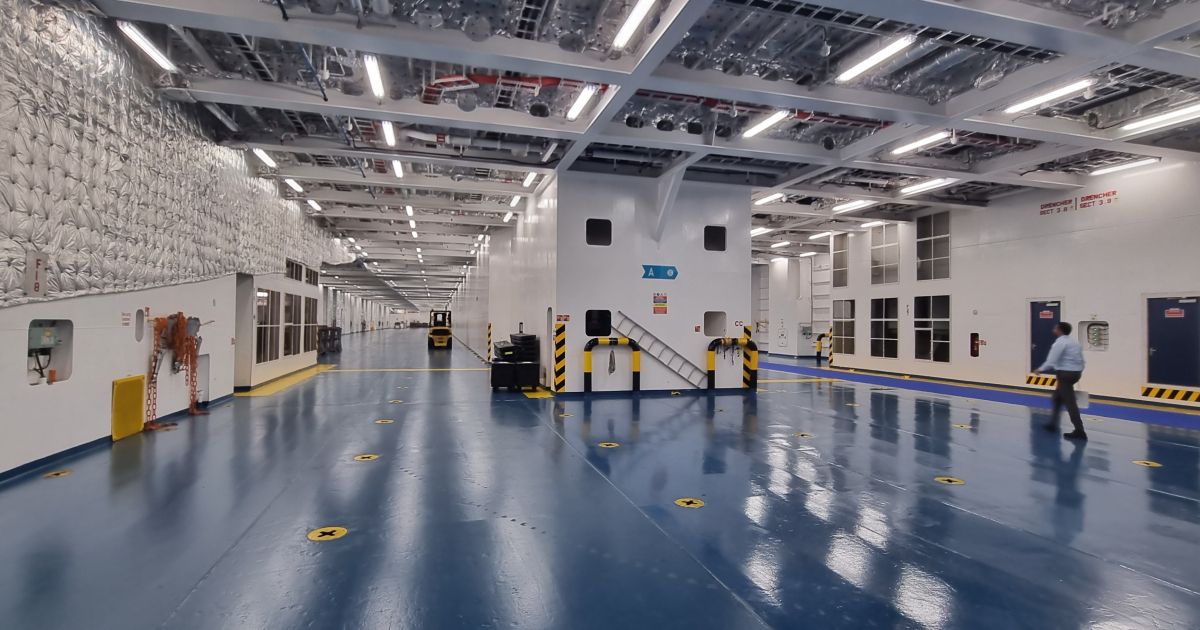
If Peck played a fictional journalist, Moriones was the real correspondent for the Barcelona newspaper in Italy. And as such, he covered a very prominent news story years later: in the spring of 1968, he traveled and explained the inaugural journey of the Canguro Bianco, an Italian ferry that for the first time connected Genoa and Barcelona. The Canguros were innovative ships, named as such because their hold-garages loaded cars and trucks between the two ports. A touch of modernity for transport between Italy and Spain, in which Barcelona was a pioneering port.
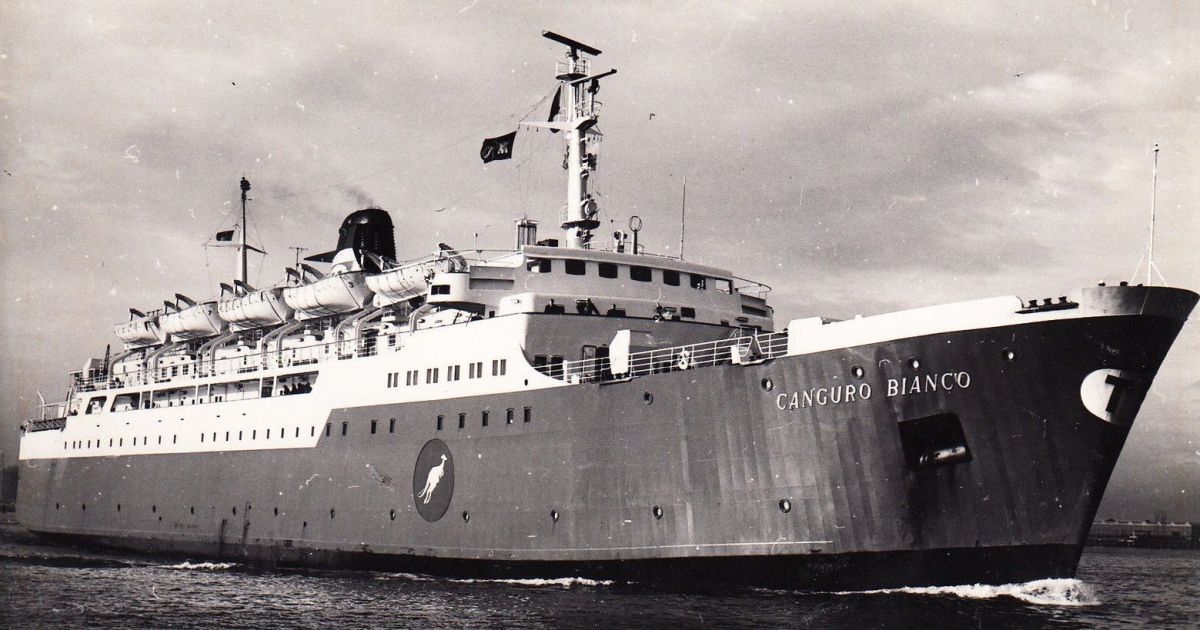
Those kangaroos were the "highway over the sea," a service that the Italian shipping company shared with the Spanish Ybarra until the early 80s. Then it disappeared, until Grandi Navi Veloci, a new company, revived it in the late 90s. Genoa–Barcelona: a legendary line for the current GNV, which upon being acquired by MSC became the giant of regular ship transport that it is today.
The Aurora
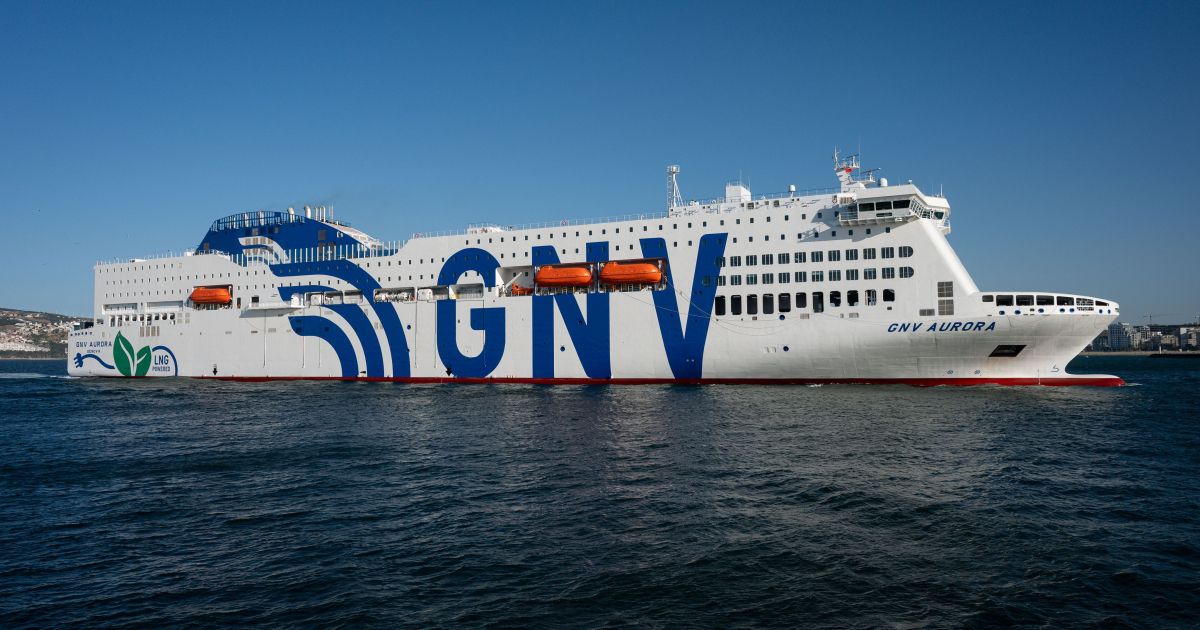
Today the new chapter arrives. The GNV Aurora is the second vessel in the fleet powered by liquefied natural gas and the last of the first series of four ordered from the Chinese shipyard Guangzhou Shipyard International. A singularity in the European ferry industry, where orders to Asian shipyards are still uncommon: until now, China mainly built cargo ships, but the country's shipbuilding industry is making a remarkable qualitative leap towards passenger vessels, which are technically much more demanding. The Aurora is, in a way, a symptom of this change.
With a length of 218 meters, more than 1,700 passengers, and 426 cabins, it is one of the largest ferries in the Mediterranean. In July, the GNV Virgo, with identical characteristics, will be added to complete the reinforcement of the route.
The environmental commitment is notable. LNG propulsion allows for a reduction of CO₂ emissions by up to 50% compared to previous generations, minimizes nitrogen oxides, sulfur, and suspended particles, and complies with IMO Tier III regulations, the strictest internationally. When in port, both ships connect to the shore power grid via cold ironing, shutting down their own generators and eliminating direct emissions in the port environment.
In a city like Barcelona, with an open and demanding debate about the environmental impact of maritime traffic, this detail is not minor and, with the Port electrifying its docks, these ships justify their technology.
Barcelona, strategic hub
The CEO of GNV, Matteo Catani, has highlighted that Barcelona is a reference port in Europe in terms of LNG availability. A recognition that went beyond protocolary praise: the growing energy capacity of the port positions it as a first-rate maritime hub in the western Mediterranean, with a role that will increase.
The underlying context reinforces this. GNV has been operating in Morocco for almost twenty years, with nearly six million passengers transported and more than 465,000 in 2025 alone. The deployment of the new ships is part of the logistical and infrastructural leap the country is experiencing, accelerated by investments linked to the 2030 FIFA World Cup, which Spain, Portugal, and Morocco will jointly organize. In this scenario, Tangier Med (the largest port in North Africa) has a growing strategic value. And Barcelona, its most important European stopover, also.
GNV's fleet renewal plan until 2030 has a total value of 1.3 billion euros and foresees the delivery of four more new ships starting in 2027, one every six months. The Aurora and the Virgo are just the beginning.
And Barcelona, discreet but faithful, will be at every stopover.
Add The New Barcelona Post as your preferred Google source for free
Stay informed with the latest news.