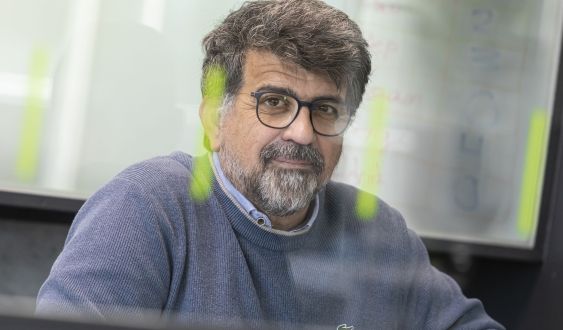
We can no longer speak of artificial intelligence as a distant horizon or a speculation typical of science fiction. On the contrary, AI has burst strongly into our lives and into the way we communicate and access culture. It is an inevitable revolution, and this is how consultant Genís Roca, president of the Fundació Accent Obert and expert in business transformation processes and digital culture, defines it in his latest book.
The Digital Revolution is a publication that stands as a critical yet humanist reflection on the multiple facets of this emerging technology. In a week dedicated to literature, it is worth pausing to get to know this new language with which we communicate in the society of artificial intelligence.
— How would you define the society of artificial intelligence?
— I prefer to speak of digital society, because ultimately artificial intelligence is just another turning point. In practice, we are talking about software: computer programs, digital technology. It is true that the software we have seen in the last 30 or 40 years was quite primitive until now.
— What was that software like? How did those computer programs work?
— An algorithm based on logic. For example, the logic could be the Spanish accounting plan. You have the invoice, you apply the logic, and the program classifies it according to the accounting plan. Now, in addition to logic, there is a history of information. Thus, in addition to classifying the invoice, it can detect a trend.

That is, now we have software, a program, capable of applying an algorithm, capable of applying mathematical models against a history of information, and capable of doing it in real time. In history books, artificial intelligence will be just another step in the progress of software.
— It's just one more step, but its impact is enormous.
— That's right, because our lives depend on digital technology and computer programs. Artificial intelligence is one more episode in the digitalization of society, but it is an important episode. We have put a turning point—an upgrade—to the entire management system of humanity.
— What exactly do we mean by digital society?
— Digitalization has allowed us to discover a new language. Humanity is capable of expressing reality with ones and zeros. We had learned to express ourselves with writing, with painting, with music… but with ones and zeros we can express and process everything. Even a mood: London Underground cameras anticipate suicidal intentions by people's movements on the platform.
This new language, moreover, allows us to store information much more easily than before. Before, we couldn't read everything. A library couldn't contain everything that had been published. Now we can access any publication in the world.
Therefore, we have invented a language that can express any aspect of reality, store it, transmit it to any place on the planet, and apply a mathematical and analytical language to that reality. And this transforms society.
— How does it transform it?
— It transforms power systems: who can do things and who cannot. In the industrial revolution, control of the means of production organized power, economy, and territory. Now it is information.
— Today it seems anyone can do everything. There are books written by four hands with AI.
— Absolutely! Many! So much so that Amazon has had to change its regulations and prohibit the same author from publishing more than three books a day. That means there are authors capable of producing, with artificial intelligence, much more than three books in a single day.
"Socrates believed that writing made us dumber, because if you could write it down, you no longer needed to remember it"
— But do we want to read books that haven't been written by people?
— We have done that many times, reading books by someone famous that we knew had been written by a third party. In fact, Socrates wrote nothing. Everything we know about him is because Plato, his disciple, explains what Socrates taught him. All the text we have from Socrates is Plato quoting him.
In one of these texts, in Phaedrus, Plato explains that Socrates was convinced that, to properly educate a person, it is essential to develop memory. He believed that writing made us dumber, because if you could write it down, you no longer needed to remember it. And if you don't remember it, memory atrophies.
— The transition from oral tradition to writing.
— Of course. There was someone who knew the Iliad, complete. But someone, at some point, wrote it. I don't know Homer's Iliad, for example, but I can read it. And I can also read eight million books. What for Socrates could be a danger, I see as something positive, as an opportunity.
"The problem with the internet is that it flattens cultures"
— It's the same question we ask today about AI: does it make us dumber or more capable?
— My theory is that those who had a tendency to be dumb will be dumber. But those who had a tendency to be sharp will be much sharper. These technologies empower you and put you in front of a mirror.
— Isn't delegating writing to ChatGPT a danger to the art of writing?
— I'll answer you with questions: were artists who made collages less artists? If you use artificial intelligence to do this interview, or to write a text or a book, will the piece have less value? Isn't the author still the one who chooses the approach, what to incorporate into the text, and when to use the technology? What are we valuing? The process or the result? In many jobs, what matters is the result.
Until now, the expression of creativity was restricted to people who mastered a technique. Now we live in an era where more people can express their creativity.
— And they can express it, moreover, in many different ways.
— Absolutely. Federico García Lorca today would not make poems, but reels. Or whatever. He would use technology to express himself. It's not about mastering a technique, but about using technology to express oneself.
"We need biases to survive as a culture"
— What position does Catalan hold in this era of artificial intelligence?
— The problem with the internet is that it flattens cultures. The internet destroys cultures. And, therefore, my culture —from a corner of the Mediterranean— is threatened. And it's not the only one, you know? French, British, or Russian cultures are also threatened…
— Why does the internet flatten cultures?
— Because the internet is a common bag and 70% of the content is in English. The content of Catalan culture perhaps represents 0.5%. If I ask the internet for a soup recipe, it won't give me a Catalan soup right away.
We have complained a lot about biases, but we need biases to survive as a culture.
— Should digital society, then, preserve these cultural biases?
— Yes, but first you must identify them. With Google, we have it relatively easy: the search engine searches the "fishbowl" of the internet and shows us results appropriate to our search. If we claim content in our language, we know that it will be made with our cultural biases, because our language defines our culture. In Catalonia, we have that luck; British culture, for example, does not, because English is spoken all over the world.
If by talking to Google we manage to make some results respect the language, our culture is already saved in the digital realm.
— ChatGPT speaks Catalan!
— Yes, the problem is that it answers us in Catalan, but in elaborating the answer it has not taken into account anything of our culture. The answer has been elaborated with a dataset from Wisconsin; it is not an answer elaborated by someone with a Catalan cultural perspective. And for the first time, our language misleads us.
— And how do we make AI incorporate our cultural bias?
— It is necessary for the dataset to contain cultural context and for this to be part of the prompting, automatically. We need a dataset of Catalan culture. And not only so that we are more at ease, but because, in the world, sometimes it is necessary to ask questions to specific cultural contexts. A publicist from New York who prepares a campaign for Italy must be able to ask an Italian cultural context, even if he is not Italian.
That is why digital society demands new institutions that defend us in the digital context, as Accent Obert does. Before, who defended me as a Catalan speaker against Google? And now, against ChatGPT?
Add The New Barcelona Post as your preferred Google source for free
Stay informed with the latest news.