[dropcap letter="A"]
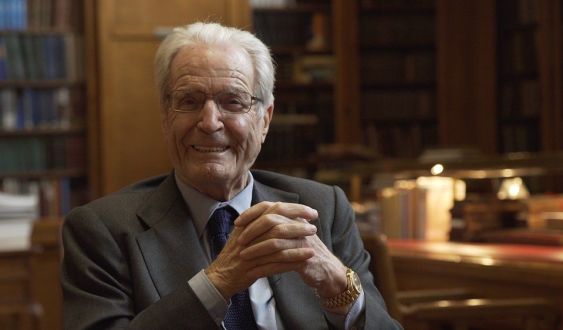
ntonio Garrigues Walker, a prestigious jurist, politician, and president of one of the most important law firms in the world, has spent a good part of his life crossing the professional line of laws and business to let himself be carried away by his more artistic impulse through theater, poetry, and painting. As a playwright, his latest work appeared in January 2017 in La Revista de Occidente with the title El saber de nuestro tiempo, but his vocation as a dramatist dates back a long time. The first one he notes is A los políticos and is dated 1958. He totals fifty-two in all, and a good part of his literary production has reached its maximum expression on stage, with performances by amateur theater groups directed by himself for friends and family. Many remember the exclusivity of mythical performances in Sotogrande, but some have passed through more significant stages such as La Abadía, the Círculo de Bellas Artes, the Gran Teatro de Huelva, or the Tívoli in Porto.
The characters Garrigues creates are from a comic opera. And with his playwright's pen, he does not shy away from the themes that truly matter to him. In El saber de nuestro tiempo, he gives voice to a tormented poet, wounded by sadness, and an admirable prostitute, to debate the problem of the apparent disintegration of capitalism.If something defines his entire career, it is his strict vocation for public service, exercised for so many years from the private sphere. This is how he also shows himself in his latest drama, with characters so sad, tormented, and torn that they shipwreck and drown in their solitude. All of them have, in the end, the ambition to transcend, with their bitter testimony loaded with tons of irony, to change the world a little. Fortunately, when Antonio Garrigues is himself, he shows himself to be affable and always finds a way out of unease. Always, in the end, an open door.
Luis María Ansón says, having followed him almost every August – when the theatrical premiere arrives – that this poor man has had to dedicate himself to other things in life. To making money, he specifies. But that he has the talent of a playwright. His characters are from a comic opera. And with his playwright's pen, he does not shy away from the themes that truly matter to him. In El saber de nuestro tiempo, he gives the floor to a tormented poet, wounded by sadness, and an admirable prostitute, to debate the problem of the apparent disintegration of capitalism. To a young Syrian refugee and a European leader responsible for migratory issues, to discuss migration and refuge. And, finally, to a woman (a robot with an essentially human base), and an ordinary man (unemployed and without a future), to discuss scientific and technological advances.
Antonio Garrigues visited Foment and was himself. Without interposed characters. Convinced that the market economy must generate fewer negative effects and reduce inequality.
Master of lawyers, he is in his work the result and sum of so many other authors: Arnaud, Ionesco, Beckett, Buero and Sartre. Humor traps the anecdote until it falls and sinks into the furrowed brow of reflection on love, power, glory, life and death.The literary exercise of confronting, from the theater, the great questions that persist in the human being until they knock him down and make him believe and feel insignificant, Garrigues resolves with roaring humor. As if he allowed himself in his writings to take liberties for which there is no place in law and the professional activity of a jurist and great businessman. Master of lawyers, he is in his work the result and sum of so many other authors: Arnaud, Ionesco, Beckett, Buero and Sartre. Humor traps the anecdote until it falls and sinks into the furrowed brow of reflection on love, power, glory, life and death. Nothing anodyne, it stirs emotions, and its protagonists – a bit jaded and world-weary – angrily show their will to transform everything that comes their way, even if they disguise it with apparent disinterest. The most natural thing is to believe that behind all of them, acting as a ventriloquist, is Antonio Garrigues Walker.
One cannot ignore his political vocation, which stems from his sense of responsibility for all public matters and the collective good. He has chosen to participate in all of this from business and the practice of law, with law as the raw material. And for this reason he says: "the legal profession is not just knowing the law, it is also knowing how it is applied and even knowing that even if one has a right, one can also renounce its application." A matter of nuances.
"We all have faith in the democratic system and accept that democracy is not a system that allows everyone to agree, but rather allows us to live with disagreement. How? I do not contemplate any system other than dialogue"Because in fact, it is he who is interested in, concerned about, and occupied with the great themes of humanity and, therefore, and of course, this includes Spain. This is how he concludes: "we all have faith in the democratic system and accept that democracy is not a system that allows everyone to agree, but rather allows us to live with disagreement. How? I do not contemplate any system other than dialogue. Is it possible to live in disagreement if not by talking? I believe not. The rejection of dialogue, in principle, I do not accept. I cannot accept it because it would be denying faith in the democratic system. Spain has problems, but no more than other Western countries. I personally believe that we have fewer and that we are in a better position to face them."
Add The New Barcelona Post as your preferred Google source for free
Stay informed with the latest news.