
What began as a used clothing selection workshop has become the leading state-level group of social enterprises in employment aimed at people in vulnerable situations. Founded in 1992, the Formació i Treball Foundation has served 46,843 people throughout its 30-year history through labor insertion projects, with an average of 4,000 people served annually in the last decade.
With a team of more than 700 people, the entity has supported its growth by diversifying its activity, and always with the aim of generating resources for its self-financing. "We are a foundation with a social soul, with an entrepreneurial spirit," defends its president, Jordi Alberich.
Conversing with The New Barcelona Post, the businessman also highlighted that the entity has always worked to self-finance, often "turning waste into business." The entity began by collecting old clothes and furniture to repair and sell them or to recycle them, and has been expanding its areas of activity in multiple directions, ranging from the restaurant sector to laundries. However varied they may be, all of them have one element in common: "These are activities in which it is feasible to incorporate people into the labor market."
The foundation's premise is that "the only way to achieve one's own life project, sustained by oneself, is through work""Where there is a gap that does not require complex preparation, the foundation will be there to provide employment to vulnerable people," Alberich proclaimed. In this sense, the entity's professionals have "the intuition and the success" to find new lines of activity that fit the foundation, in which users get employment and acquire knowledge to perform their functions but also in guidelines and habits linked to the workplace.
This intuition in favor of diversifying its activity has led the foundation to grow to exceed 35 million euros in turnover and to have facilities such as a 30,000 square meter textile treatment warehouse in Sabadell. The plant represents a strategic commitment by the foundation in the face of the change in the textile sector model due to regulatory changes at a European level, and will create 250 jobs for vulnerable people in insertion itineraries through the entity, co-directed by Marina Arnau and Xavier Puig.
Not forgetting the "ditch" in moments of euphoria
The origin of the foundation dates back to the "moments of euphoria" that Barcelona experienced in 1992, not only with the Olympics, but also due to the situation in Europe after the fall of the Berlin Wall. In this situation, Cáritas and the Borrell and Ribas families "rightly saw that the wealth being generated was not reaching everyone and that many people could be left in the ditch." With this reflection, they combined to combat this reality with a premise: "The only way to achieve one's own life project, sustained by oneself, is through work."
The entity started with this basic vision, and with its promoters Manuel Ribas and Antoni Borrell at the helm. In these three decades, it has gradually expanded its range of activity and has been extending and diversifying it, promoting more than 25 economic activities organized into three divisions: textile, food, and services. The textile division has evolved and grown to make the entity the leading textile waste operator in the State, through more than 1,700 containers and more than thirty second-hand clothing sales points in Catalonia, which in 2023 generated 423 jobs for vulnerable people.
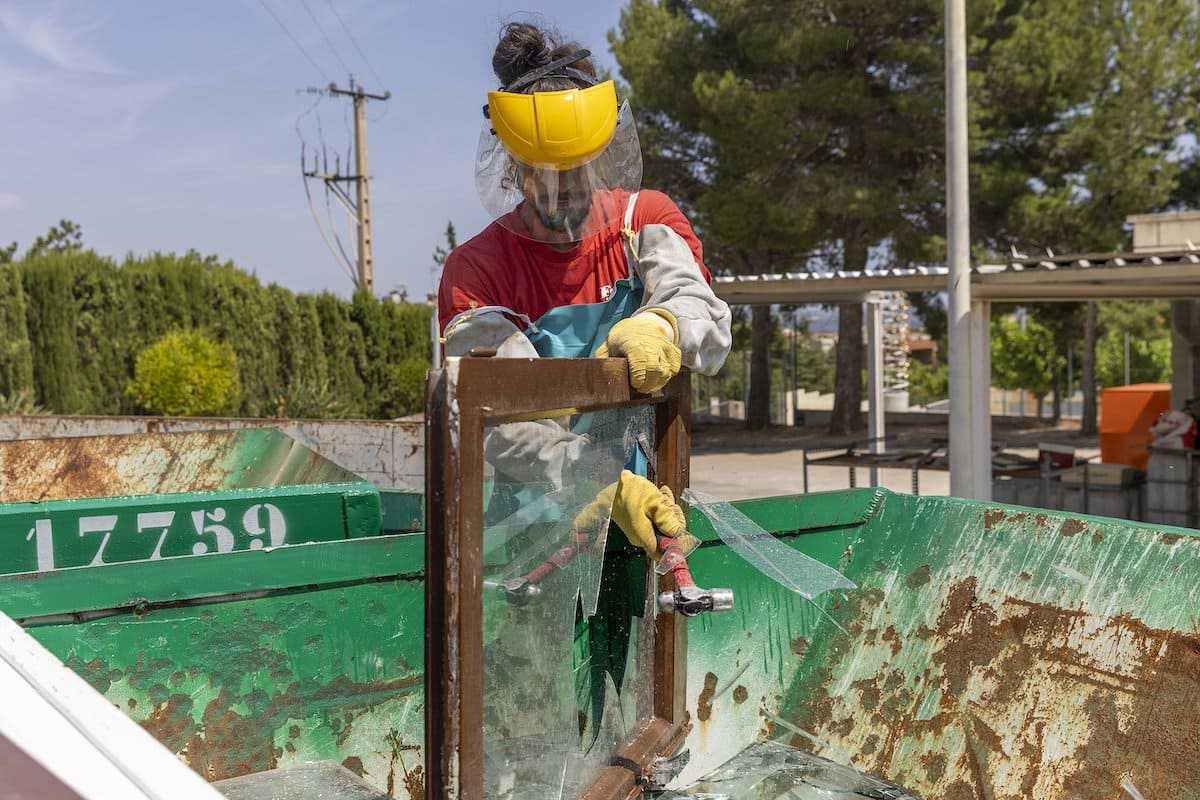
It was in 2012 when the foundation launched into the food division: it started with one school and now has seven restaurants and catering services, driven by the desire to maximize food recovery and reuse. The services line has also experienced exponential growth and has expanded to include everything from cleaning and renovation services to projects such as an industrial laundry, a composting treatment plant, and forest cleanups. The entity's forecast also includes continued growth, especially in ecological and sustainable activities, such as the solar panel installation and maintenance service it recently launched.
All of this in a context of growing demand for services linked to its current activity, such as the recovery of clothing to turn it back into raw material. "A huge world is opening up in textile recovery, and we have a leadership position in this sector, which will allow us to incorporate many people into the labor market," predicts Alberich.
In this way, the entity plans to continue growing as an effective instrument in the insertion of people into the labor market. But it aspires to go further, as Alberich reveals. And that is that the entity aspires to "participate in the battle of ideas" and to play an active role defending a model that hybridizes capitalism with the will that "no one is left behind," according to its president: "Our obsession is to demonstrate that, with a social soul, one can compete and be as competitive as anyone else."
Add The New Barcelona Post as your preferred Google source for free
Stay informed with the latest news.
