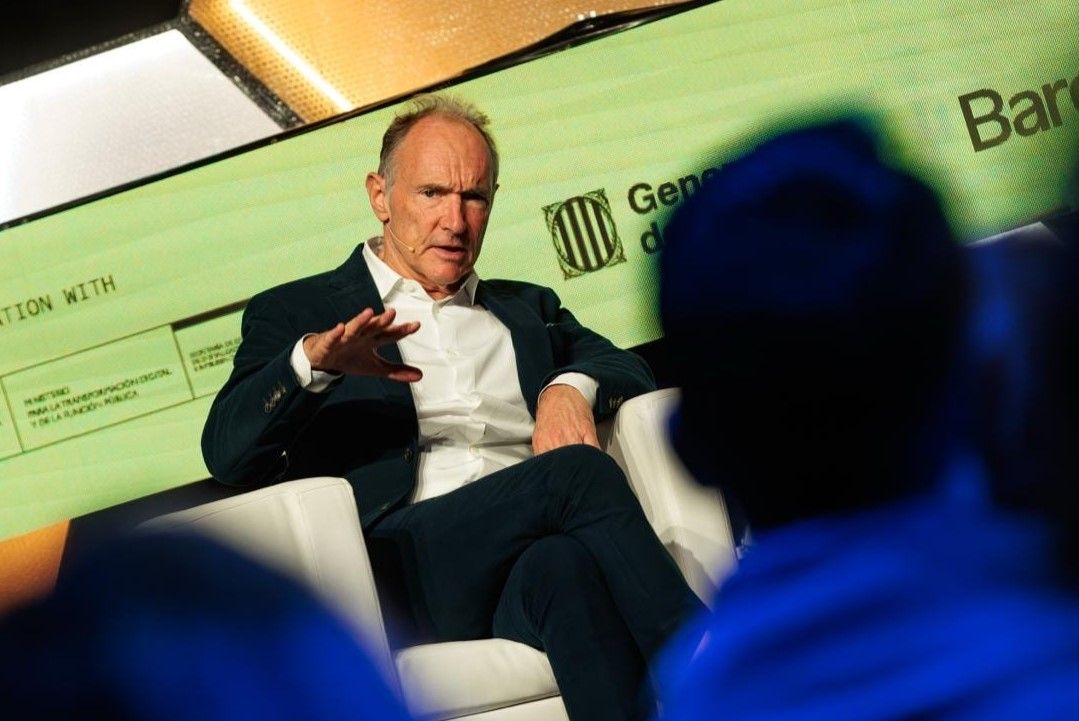
1. Internet as a collaborative space
"The Web was born at CERN (European Organization for Nuclear Research), an extremely collaborative center," Berners-Lee recalled. His initial idea was simple: the Web was meant to become CERN's internal communication system, an institution where scientists from all over the world worked and needed to connect and share information. But he soon realized that his revolution could transcend the borders of the European research center and benefit everyone. Thus, the World Wide Web was born.
Before the Web, the Internet allowed file exchange, but it was an extremely complex environment reserved for technicians. As Berners-Lee explained: "you could get a file from the other side of the world, but to use it you had to handle complicated programs and enter commands difficult to memorize. You couldn't move freely; you had to know exactly where you were going and type the exact address."
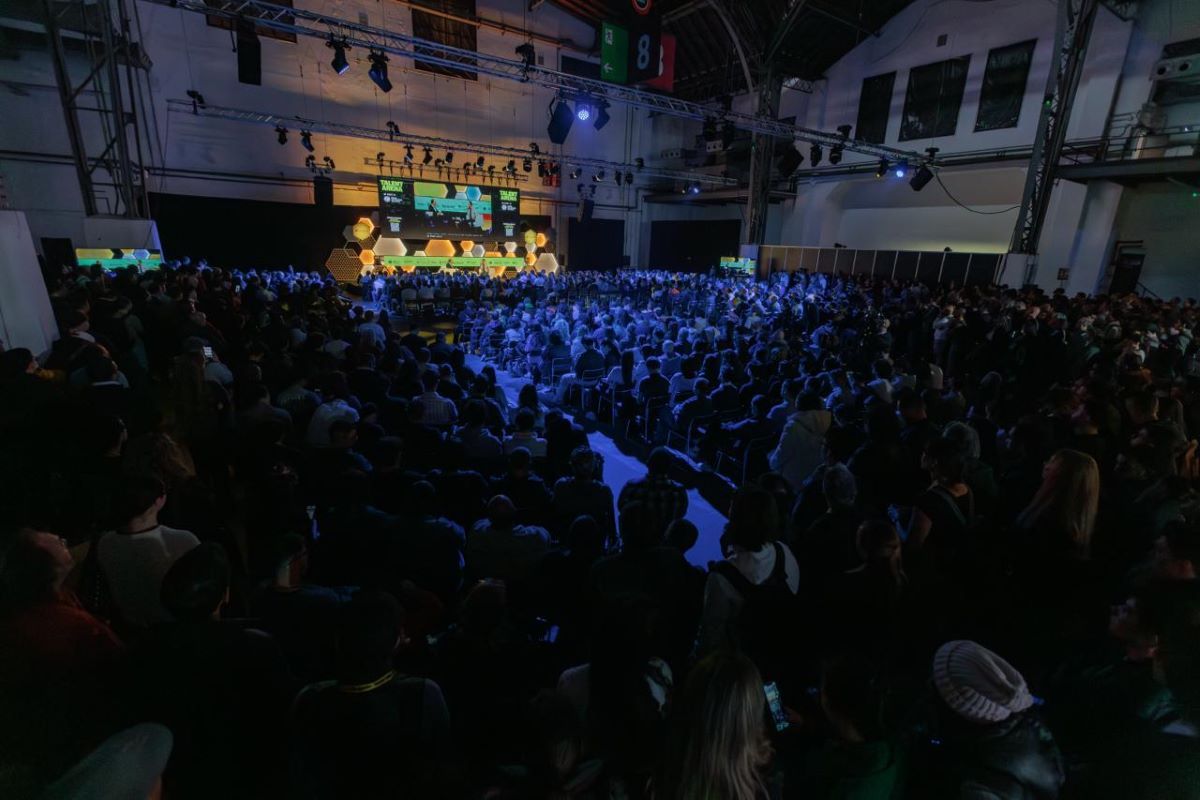 Tim Berners-Lee took the stage at the Talent Arena before an audience of more than 500 developers. © Talent Arena
 His solution was simple and revolutionary: apply the concept of "click" on links ---which already existed in devices like CD-ROM---, extending it to the entire network. Thus, the Web became a large global CD-ROM, accessible to anyone. Berners-Lee understood that releasing this technology to the public domain was not only possible, but necessary for the Web to be truly useful.
2. Open source applications and free standards
In contrast to alternatives like Gopher, a similar system being developed by the University of Minnesota that could become a paid tool, Berners-Lee released the Web system. Later, he founded the World Wide Web Consortium (W3C), an organization through which competing companies like Apple and Microsoft collaborated to establish common standards, ensuring that all browsers spoke the same computer language: HTML.
"If you are designing a social network, you can choose between inspiring and empowering users or contributing to systems that harm them"
Thus, the Web grew in a unified way, demonstrating that cooperation can be more powerful than competition. Decades later, Berners-Lee states that it is the developers working on collaborative and open-source technologies who make him maintain hope in humanity and technology, despite some of the misuses that have arisen on the Internet.
3. Less addictive social networks
Berners-Lee has also warned about one of the great risks of the Internet: "Most of the Web seems positive to me, but some elements that have been created disappoint me, such as the addictive algorithms of social networks." The engineer, who was also awarded the Turing Award in 2016 for his contributions to computing, which began as spaces to connect friends and family, like Instagram, transformed into systems designed to maximize connection time and generate dependence.
 Berners-Lee has applauded Australia's regulation to restrict social media for minors under 16. © Aina Martí / Albert Segura (ACN)
 His advice to developers has been forceful: "if you are designing a social network, you can choose between inspiring and empowering users or contributing to systems that harm them." That is, between designing applications like Tiktok or like Pinterest. For Berners-Lee, "ethics must be the red line: if you know that your system can foster toxic dynamics, rethink its design." The British engineer has also celebrated legislative initiatives such as the one promoted by Australia, prohibiting minors under 16 from using social networks, a regulation that Spain is also considering replicating.
4. Technologies that protect user data
In addition to the addictive use of social networks, there is another issue that particularly worries Tim Berners-Lee: the protection of personal data on the Internet. To address this problem, the engineer has promoted Solid, a project that seeks to give users back control over their information.
Instead of data being scattered across the servers of large tech companies, Solid proposes storing it in "pods" —personal digital wallets— managed by each individual. As Berners-Lee himself explains: "The application asks you: 'Where do you want to save this data?' And you can answer: 'Save it in my personal online data store, in my pod.' Subsequently, other applications can access them only if you give permission." The data, thus, does not belong to large tech companies, but to people.
"Ethics must be the red line: if you know that your system can foster toxic dynamics, rethink its design"
Based on this technological foundation, Berners-Lee is also working on new tools such as Charlie, an artificial intelligence assistant that, unlike other chatbots, operates exclusively with the information that the user decides to store in their own pod. Thus, if someone asks what sneakers they should buy, Charlie does not offer a generic recommendation but, always with prior authorization, analyzes the available personal data to offer personalized advice.
5. For technology to make the world a better place
"We are not at the end of times; the Internet is a constant cycle, and we are living another chapter of this process," Berners-Lee concluded. Although in this chapter of Internet history technology presents risks, such as addiction or the violation of personal data, it can also be a tool to build a more just and humane world. Especially thanks to the new generations of developers, whom Berners-Lee has encouraged to build "collaborative, creative, and compassionate applications."
 The conference was moderated by BBC journalist Spencer Kelly. © Talent Arena
 "Imagine the world you want and build it." Thus concluded the British engineer his conference in front of more than 500 developers, both local and international, reminding them that innovation not only transforms technology, but also people's lives. Every line of code and every project has the power to make the digital world a better, safer, and more humane place.