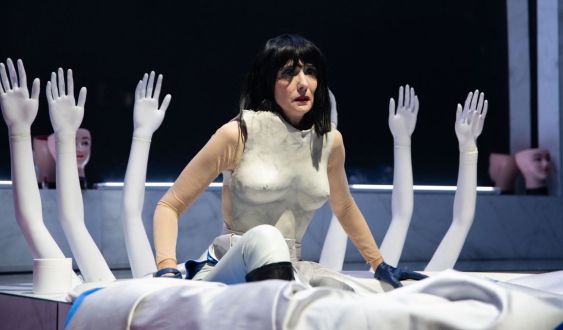
Rakel Camacho presents The Bitter Tears of Petra Von Kant at Teatre Romea, an adaptation of the mythical play by Rainer Werner Fassbinder which, years later, was adapted into a film achieving great success with both audiences and critics. In Barcelona, the piece returns to its original version: on stage, with live actresses and dramatic tension as the backbone of the narration.
But, on this occasion, Camacho has opted for a change in the ending of the original work: she offers us a less hopeful conclusion than the one Fassbinder created, in which she chooses to show the loneliness we can encounter when we stop being "mannequins" and choose to be humble, honest, and authentic people in life.
Rainer Werner Fassbinder, the genius behind this fiction
The author ofThe Bitter Tears of Petra Von Kant, Rainer Werner Fassbinder, was a prolific German artist who worked asplaywright, film and theater director, and producer.He is considered one of the most important representatives of the new German cinema of the 60s and 70s, and his favorite theme is that ofhuman emotions, represented above all in love, friendship, identity, and relationships between people.His career began in the world of theater; in fact, in his first ten years, he produced more than 30 plays, among which his own titles stand out, such as Gotas de agua que caen sobre piedras ardientes (Tropfen auf heisse Steine) or, the one currently being presented in Barcelona, Las amargas lágrimas de Petra von Kant (Die bitteren tränen der Petra von Kant). This is also an original work by Fassbinder that, theatrically, was directed by Peer Raben. It achieved great international acclaim thanks to its portrait of romantic heartbreak at the hands of a woman who tells us about loneliness, domination, and passion between women.
In 1972, Fassbinder himself brought it to the cinema. For the adaptation, he chose to change his artistic style: he moved from his early influence by the Nouvelle Vague to a trend that avoided sentimentalism in favor of a more intellectualized and distanced type of cinema. To do this, he applied the precepts of the German playwright Bertolt Brecht, who cultivated a type of theater that moved away from spectator empathy to present distanced stories where intellect prevailed.
This is how the film Las amargas lágrimas de Petra von Kant (1972) became his first international success, thanks to its modern and daring filming style, which recreates an anti-naturalness that distances the viewer from the character. The goal? For the audience to be able to judge the story without sentimental manipulations.
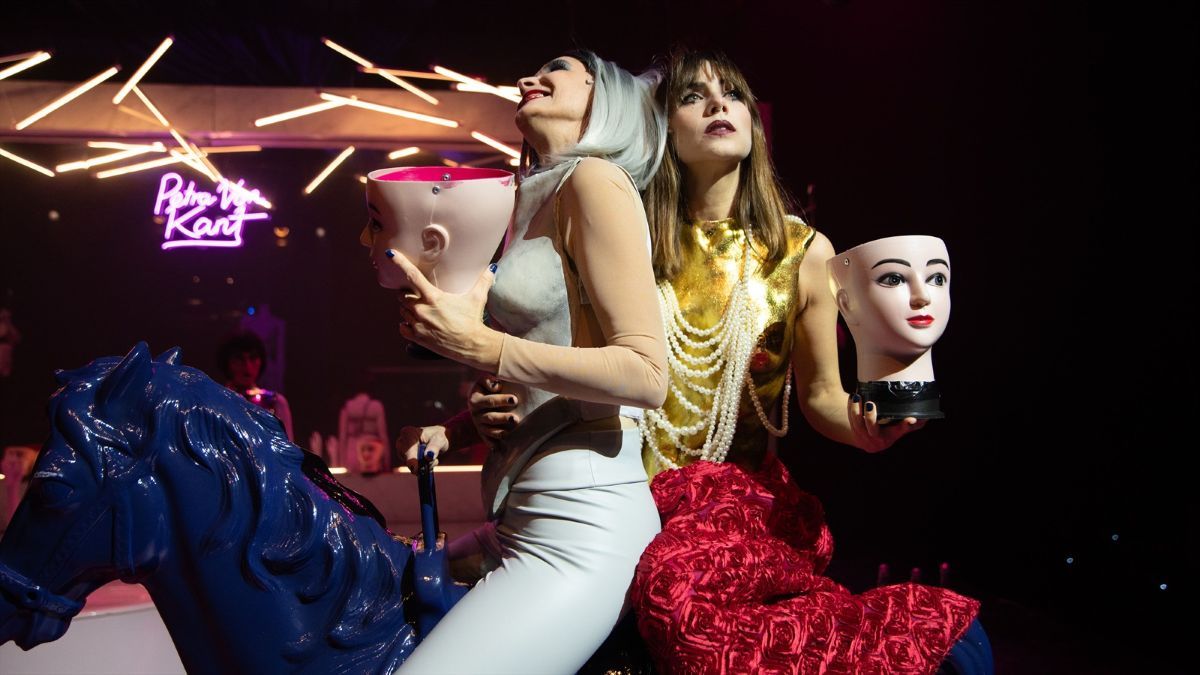
The version now arriving at Teatre Romea
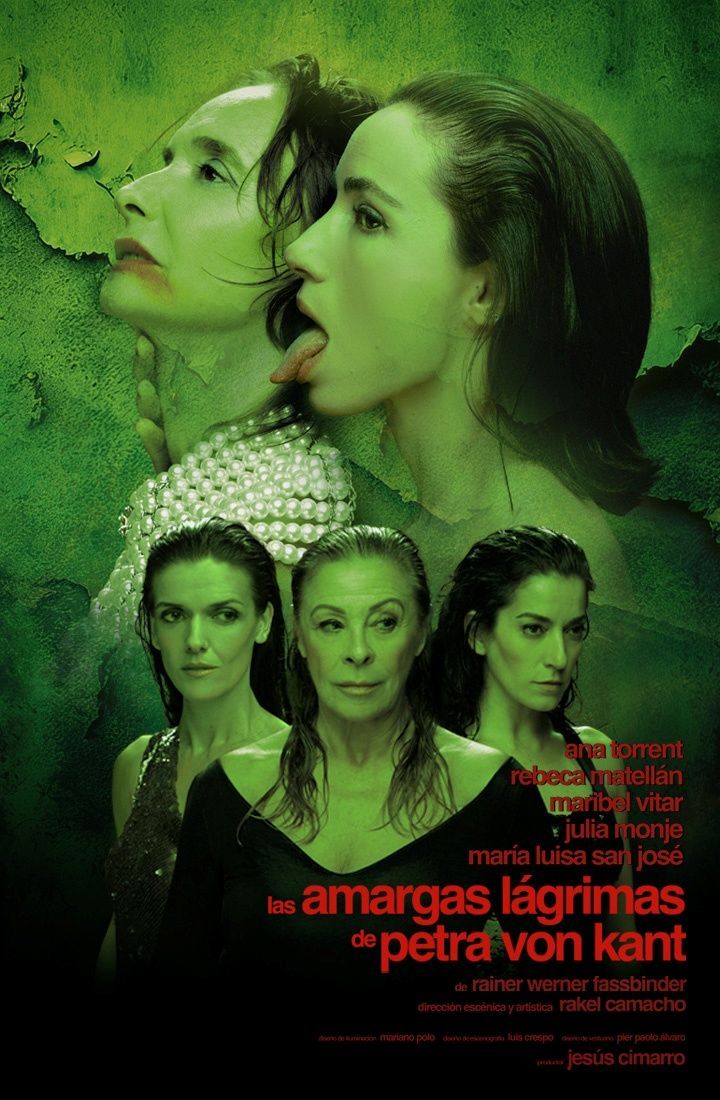
Rakel Camacho is the director in charge of adapting and reinterpreting this great European work, with a refreshing and modern touch.Starring Ana Torrent(actress who became known for her role in the movieThesis), this play tells us the story of Petra von Kant, a very successful fashion designer who has separated from her husband. She lives with Marlene, her secretary (played byJulia Monje) who spends the entire play in absolute mutism until, at one point, she recovers her voice and delights us with a sweet song that caresses our ears.But Petra's life is cut short when, one day, she meets Karin (Rebeca Matellán), a young woman of humble origin who, in the designer's world, is like a diamond in the rough: a girl not yet corrupted by the material, by "the mannequin," and who has authenticity as her banner.
https://www.youtube.com/watch?v=uZq7mw4Y1GY
A world of appearances
The staging we see at the Romea is, from the outset,very peculiar. It has an aesthetic that is pleasing to the eye: it takes us into the house of a fashion designer who lives, literally, among mannequins. And here there is avery interesting double reading: on the one hand, his craft; on the other, the "mannequins of life". It is a reflection of how we live in a superficial world where we all wear wigs, makeup, and spectacular clothes to cover the void.Everything is luxury, horses, and exaggeration, until the counterpoint appears: a girl in leggings and with a basketball, Karin. The protagonist becomes engrossed because this young woman represents everything opposite to her world; she is a real, authentic person. From that moment on, the designer begins to obsess over her, wants to possess her, and uses her money and influence to conquer her. We also see this relationship in the wardrobe: Karin begins to be dressed like a mannequin and, in fact, in Marlene's arms, she becomes an inert being, without expression, without energy. When she covers her with jewels and luxurious fabrics, the girl is reborn with another energy, with another demeanor, letting herself be intoxicated by superficiality.
While Karin begins to dress in appearances, the protagonist takes the inverse path and "undresses": she goes from large dresses to an almost transparent suit and flat sandals. In the end, she is left alone, naked, on stage, without wigs or jewels, seeing her life of luxury as totally empty.
The solitude of awakening
The background ofThe Bitter Tears of Petra Von Kantit's brutal. It explains that when you reach that "awakening" and realize how banal the pose is,you can be left alone.This message is perfectly reflected with Marlene's attitude, the housekeeper: it seems she loves her, but in reality, she is in love with her success, with her image, not with her for real. And the thing is, in the end, if you only build relationships based on the "mannequin," when you show yourself for real, people leave.An impeccable staging
The most outstanding aspect of the theatrical adaptation of Fassbinder's piece is its scenic presentation.We are in Petra's room,a space where mannequins abound, where the mirror (and vanity) occupies the entire back of the stage and where exorbitant luxury is part of its ecosystem: horse sculptures, an enormous bathtub, glasses in the shape of human heads…Luis Crespo's set design is spectacular and, in addition to being aesthetically very striking, it is totally aligned with the message of the play. The set design explains what happens, helps us connect with the content of the story, draws it, outlines it, and enhances it. Without this staging, the play would not be so interesting.
The same happens with the costumes designed by Pier Paolo Álvaro and Roger Portal. Clothes that evolve with the characters, that from the first moment announce one of their messages (love and rage) and that complement the protagonist's journey in a way we rarely see in theater. The costume, here, is not an addition: it is the story of the protagonist herself and the rest of the characters.
A protagonist too restrained
The play shines for its staging, its music, and impeccable costumes. However, the protagonist's role mars the final result. It is known that Ana Torrents is an exceptional actress, so this very slow and restrained interpretation seems to be a deliberate choice by the direction. However, that a slow and serene tone does not quite fit;in the end, a feeling of emptiness remains in a work that, otherwise, would be well-rounded. In fact,the transformation of the protagonist is hinted at by the costumes and symbolism, not because she transmits it to us.The result is an interpretation that fails to project itself or fill the stage. There is a great contrast every time the rest of the cast enters the scene; the supporting actresses overflow with an energy, naturalness, and mobility that, by comparison, highlight the protagonist's rigidity even more.
Are we prepared for the solitude that comes after authenticity?
The solitude that comes after authenticity
The Bitter Tears of Petra Von Kantit is a work with a very striking message: it reminds us that you can have a full closet and a house full of luxuries, but if there is no real person under the clothes,the final silence is sad and lonely.You leave the Romea thinking about how many mannequins each of us has in our living room and what would happen if tomorrow we decided to take off our wig and jewelry to recover our authenticity, without artifice. Are we prepared for the loneliness that comes after authenticity? That is the doubt that the play leaves floating in the air.
Add The New Barcelona Post as your preferred Google source for free
Stay informed with the latest news.