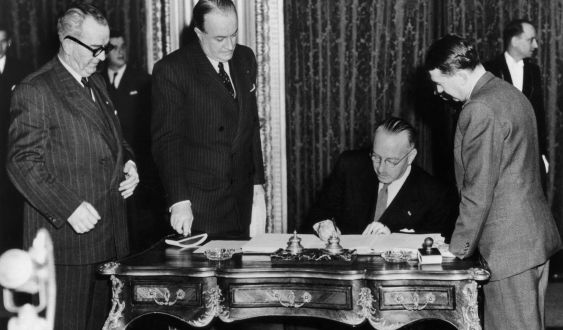
If Schuman, Monnet, or Adenauer had been present when the sixtieth anniversary of the signing of the Treaties of Rome was commemorated on March 25, 2017, they would possibly have been deeply moved by the degree of development of current Europe, observing the present by looking back to assess the distance covered and the community of destinies forged by the States of the European continent in little more than half a century. In sixty years, we have gone from 6 to 28 member states, from three European communities to the European Union, from a Europe divided by the Iron Curtain to the reunified Europe of the post-Soviet era, from the peoples of Europe to European citizenship, from the common market to economic and monetary union. The most Euroskeptic visions of the European integration process, those of before and those of now, fail to erase the extraordinary nature of the European enterprise as a way of reorganizing relations between States after the hecatomb of the Second World War; the undeniable transcendence of the European Union as a new-minted politeya; at once supranational and intergovernmental, communal and cooperative; a political organization that, without being a federation and being much more than a confederation, tends towards the economic integration and political union of its members with the aim of maintaining peace and ensuring the prosperity of the European continent.
All this despite, and also thanks to, the crises suffered. The history of united Europe precisely proves the catalytic effect of moments of critical juncture. The Schuman Declaration of May 9, 1950, a foundational text that laid the groundwork for the Treaty of Paris establishing the European Coal and Steel Community in 1951, was received and went down in history as a restorative balm, a declaration that allowed the sealing of Franco-German reconciliation through the creation of a structure of modest scope in terms of competencies —being limited to coal and steel—, but symbolically crucial by providing a supranational formula that allowed overcoming and re-legitimizing the European nation-state after the world conflict.
After the initial desolation caused by the British decision to end forty years of shared history, it can also be glimpsed that Brexit, far from diluting European construction, will reinforce its cohesion and the fundamental Franco-German axis.And so, successively, from the beginning to the present, like a moving pendulum, the great stages of the European integration process replicate the same sequence. The biggest qualitative leaps in the history of European construction find their roots in previous critical moments; adverse periods that have spurred it on while also serving as a catharsis. The two Treaties of Rome of 1957, founders of the European Economic Community and Euratom, served as a catalyst against the failure of the European Defense Community of 1952; the Single European Act, which transformed the Common Market into the Internal Market in 1986 while institutionalizing and formalizing in a single legal instrument —hence the name "single act"— the Political Cooperation Mechanism (EPC) of 1970 reactivated, with shock therapy, integration after twenty years of freezing as a result of the empty chair crisis of 1965 —France's abandonment of community meetings to block decisions by qualified majority— and the Luxembourg Compromise of 1966, which was the veto based on national interests. The Maastricht Treaty, which provided for the creation of the European Union and a citizenship associated with membership in the Union, in addition to transforming and declining the old EPC Mechanism into the Common Foreign and Security Policy and Cooperation in Justice and Home Affairs, finds its raison d'être in the fall of the Berlin Wall, the implosion of the Soviet bloc, the war in the former Yugoslavia, and Germany's repositioning in the new world order. In the same vein, beyond monetarist theories, the adoption of the single currency must be related to German reunification, just as the adoption of the Stability Treaty and the progress made in banking union since 2012 must be interpreted in light of the economic and financial crisis that began in 2008. After the initial desolation caused by the British decision to end forty years of shared history, it can also be glimpsed that theBrexit, far from diluting European construction, will reinforce its cohesion and the fundamental Franco-German axis.
In short, sixty years of common trajectory demonstrate not only the extraordinary resilience of European integration in the face of cyclical historical challenges, but also the driving force exerted by adverse conditions on the very development of the process. European crises have not been the end of history. Rather, they have contributed to reaffirming the unique character of a united Europe. To return to the origin, to define the idea of Europe, to pronounce on the nature and aims of its political organization, in short, to carry out an ontological exercise on the European being and becoming. Crises have served all of this, to value the present, anchoring the gaze in the memory and consciousness of the past.
Add The New Barcelona Post as your preferred Google source for free
Stay informed with the latest news.