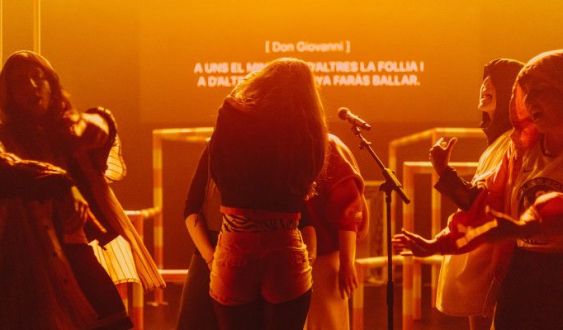
The myth of Don Juan does not entirely belong to the past. Cabonsanroque's proposal at the Teatre Lliure illustrates how much and how it continues to operate in contemporary times, as an immemorial foundation of masculine desire and a mirror of certainly questionable conquest narratives (like the very notion of conquest). Mil tres, say cheese starts from that continuity to attempt its dismantling. The number, seemingly arbitrary but very resonant in the language of Mozart's opera, refers to the list of women seduced by the eponymous protagonist in Spain alone. This data is received by a wide-eyed Donna Elvira -Spanish herself- as an answer to the thirst for revenge that makes her pursue the seducer, after being taken from the convent and then abandoned. The famous aria "Madamina, il catalogo è questo" -235 years after its composition by Wolfgang Amadeus Mozart and Lorenzo Da Ponte and conveyed through Leporello- finds an unexpected echo in Bad Bunny's confessed compulsion. That ominous figure is completed in the show's title with the request that the reggaeton artist conveys in Tití me preguntó –"say cheese"- so that the person involved is well portrayed, and thus can transcend in the credits alongside a string of girlfriends, with their respective origins, as in the Mozartian catalog.
The subtitle of this production, The Resurrections of Don Giovanni, makes explicit the continuity of a paradigm with a complicity not without criticism: from the eighteenth-century catalog to the contemporary first-person account, there is a displacement of form, but not of structure, in which the male still wants to be located at the epicenter of libidinal management. "Today I have one, tomorrow another, hey / But no wedding", sings Benito Antonio Martínez Ocasio. More ridiculing than bureaucratic in Mozart's case, the record of the most international Puerto Rican is rewritten in the Lliure from a perspective that challenges the spectator, inescapably thanks to the language of Cabosanroque. The collective founded by Laia Torrents and Roger Aixut in 2001 deploys a dramaturgical device halfway between sound installation and expanded theater, where the accumulation of signs and the fragmentation of discourse does not seek so much to articulate a closed narrative as to generate a field of tensions. After fifteen years working with scenic mechanisms without human presence, this artistic duo now introduces six performers to question the legacy of a myth that is sensed to be more obsolete than ever, but which persists in society in the form of moth-eaten nostalgia, resentment towards women who refuse to be objectified.
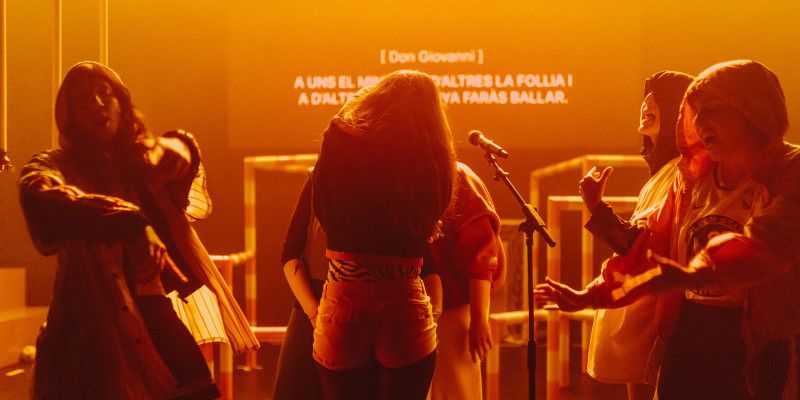
"Cabosanroque introduces six performers to question the legacy of a myth that is sensed to be more obsolete than ever"Interpreted entirely by women -sopranos Lisa Willems and Adriana Aranda, singer Sandra Monfort, pianist Irina Soriano, percussionist Naia Membrillera and clarinetist Mar Esteban Martín- the piece opens with scarcely naive questions, which function as a conceptual framework. As they wander in an open space, in a park with basketball and soccer balls, and bars similar to those used for calisthenics -strength exercises with one's own body weight- fundamental questions can be read on the stage screen. What does it mean to participate in the Don Giovanni being a woman?, how is violence -subtle or explicit- embodied in a repertoire that historically tends to aestheticize it?, where does seduction end and predation begin?, what forms of masculinity shape the myth of Don Juan today?, does any woman equate to that figure? An answer to this last question is offered even before the beginning of the work, in that liminal, ambiguous, and fruitful space-time where fiction and reality become indistinguishable; when all the performers claim to be "Don Giovanni," interrupting the game among themselves to address the audience -one by one- with deliberate haughtiness. This exchange of identities suggests a logic in which the subject does not precede discourse -as Julia Kristeva explained- but rather constitutes itself in its own enunciative circulation, adopting the mask of its convenience.
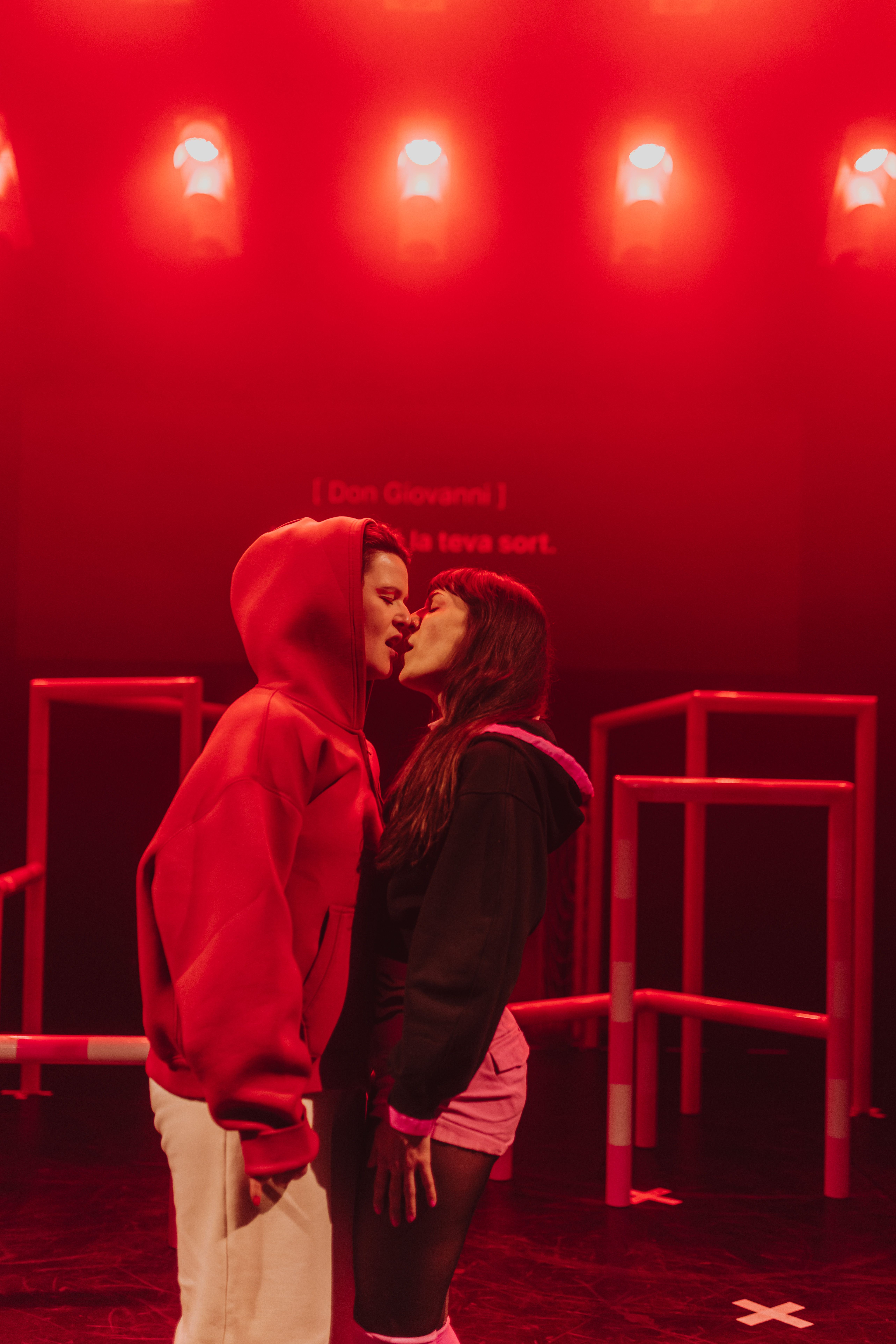
As one character or another, in any case the creators will sing and interpret some of the most memorable passages of the work, convincing both in the challenging and strident register, and when a beautiful consonance prevails. It is striking that, at the beginning of the performance, with the dramaturgical mechanism set in motion, emphasis is placed on a very specific scene from Mozart's opera: the famous duet "Là ci darem la mano", in which Zerlina -a peasant woman about to marry Masetto- is seduced by the insatiable aristocrat, being invited to have a snack or watch Netflix in his humble abode. A duet here converted into a paradigm of abuse despite its naïve sweetness. The scene will reach an uncomfortable point, due to its degree of augmented reality, when YouTube videos appear of a Spanish tenor -internationally known- singing that same aria alongside young sopranos, and the protagonists of the work turn their backs on us to contemplate them in silence: the gesture of fiction ceases to be read as such, to suggest a practice of seduction that crosses the boundaries of the professional, suspiciously aligned with voices of denunciation that in recent years have transcended as harassment, and which the tenor could not but admit (offering apologies that hardly repair the moral damage).
Cabosanroque's production at the Lliure is not limited to reinterpreting the myth of the seducer; it formally shifts the question -even if many melodies of Mozart's genius are enjoyable, up to the aria "Notte e giorno faticar" that the robot-vacuum cleaner ironically intones without words, as Wendy Carlos once did in her electronic versions of Bach and Beethoven. Where the Lliure's production stands most firmly is in the musical aspect. The "strange sound scenography" -with the clarinet in an almost narrative role or the moments of solo piano coexisting with contemporary sonorities- recreates an unsettlingly organic cosmos. It is there that the experiment breathes: when it doesn't explain, it simply sounds with a greater or lesser degree of distortion, fidelity, or transformation. The tension between the lyrical and the urban possibly constitutes the most fertile discovery of Mil tres, say cheese. The precision and commitment of the young performers, at the Lliure, maintain the pulse of the proposal even when the discourse disperses, both terms being unexpected: much more musically interesting than expected, but also somewhat repressed -at a narrative level- in the illustration of the criticism initially wielded.
"Mil tres is no longer a closed figure, but the metaphor of an opening in the search for a paradoxical fullness, which today escapes due to its appearance of accessibility"The inclusion of Tití asked me forms one of the most important, though also, in some way, frustrating, axes. The connection is pertinent, but the work barely explores it: the song appears as a nod, without fully problematizing the coexistence between masculine deconstruction and the accumulation of desire, and without mentioning other musical proposals that offer nuances of this objectifying tendency. In Bad Bunny's own work, fissures emerge that complicate this imaginary: "I can sleep with anyone / but I don't want to wake up with just anyone," she confesses inUnforgettable Dance, thereby introducing a distinction -not minor- between desire and loving bond. A precision absent in Don Giovanni's accumulative impulse, with the performative recognition, which shifts the figure towards an awareness of the damage perpetrated or suffered, and the need for therapy: "Sorry for being me, hey / and not being the man you deserved / I might mature, but in another life" (A Summer Without You). Late awareness -one might think- that perhaps does not break the pattern, but undoubtedly absent in the consistency of the compulsion of the genetic myth. We recall Don Giovanni's reply, after Leporello's naive request: "Leave women? Madman! They are more necessary to me than the bread I eat and the air I breathe."
About possible worlds and absences of reality
Perhaps it would have given depth to the Lliure's proposal to make the ambivalence of the bad bunny scenically; incorporating not only the memorable catalog but also these cracks -between desire, bond, guilt, and postponement of change- that eventually appear in the contemporary archetype. Developing a plot parallel to the opera would have allowed for a clearer perception of the tension between the principle of desire -as law- and the freedom that the change of regime inaugurates by horizontalizing relationships, and which perpetuates into postmodernity as reciprocity in reification (intuitions found in Debord, Lipovetsky, or Sloterdijk). A fertile line remains open in this sense: that of the expanded catalog in the digital era. If in the Don Giovanni original accumulation is masculine and unidirectional, today the logic of seduction is generalized, in perfect connivance with the consumerist dynamic. "Dating apps" enable with a patina of false originality the "round of princesses": more or less fictitious profiles that follow one another, choices that accumulate, gather dust or disappear. In short, desire converted into an interface, which avoids contact with -to use an expression from Matrix, which Žižek used in a work - "the desert of the real." The logical consequence is a normalized form of libertinism, as the marquis had fantasized, which tends to erode the singularity of the bond."I would like to fall in love / But I can't," Benito still sings in Tití me preguntó. And it is that Sadian utopia -a desire liberated from morality, but of obligatory fulfillment, infinite in terms of possibilities- dilutes the reality of the bond with commitment: love is necessarily displaced by the logic of free circulation, which whispers that there will always be someone "better" or, at least, someone new ("An unprecedented f***er," reasons the Puerto Rican). Don Giovanni replied to Leporello that being faithful to one woman constitutes true injustice, as it would be equivalent to "being unfaithful to all the others." An argument that from Stuart Mill's utilitarianism would seem to be full of reasons: more happiness for more people would be preferable for him. That is why "1003" is no longer a closed figure, but the metaphor of an opening in the search for a paradoxical fullness, which today escapes due to its appearance of accessibility. Objectification is no longer just external: it has been internalized with the search for external validation, which provides the seal of quality to the -disposable- consumer good that one has become, feeling more existent through the desire of the other.
However, this "distribution" conceals a striking inequality. Several studies show that, in heterosexual dating apps, women accumulate hundreds of likes -if not thousands- while their selection tends to concentrate on the same 20% of the male pool. From this, two conclusions are derived -of pure arithmetic, as Sade liked-. On the one hand, this group of "chosen ones," which concentrates the bombardment of attention, tends little to confine itself to a relationship, which feeds the perception of the validity of the Don Juanesque paradigm. On the other hand, the majority is displaced to a position closer to that of Leporello than to that of the seducer, waiting to be chosen: "with so many loose women, there will be one even for me," mutters sotto voce Don Giovanni's counterpart in the final scene of the first act (the masked ball). Then, in the second, he will be forced to disguise himself as his master and will attempt -with jocular pathos- the re-seduction of Elvira. When she tells him "I am all fire," he will reply "and I am all ashes."
"Objectification is no longer just external: it has been internalized with the search for external validation"One thousand three, say cheese seems to rely on a viewer who recognizes and assumes the critical referent, but does not quite foster an autonomous system of legibility. Although the power of the material is there, the value of what persists when the original referent is lost is not entirely clear. Certainly, the device works thanks to the diversity of musical performance, magnetic in its contrasted registers, but it weakens with the stage representation, after displaying an intertextuality as evident as it is simplifying. No plot emerges that embodies the initial questions, or shows its critical nature from the action, thus losing the opportunity to dramatize the conflict and explore with greater sophistication the relationship between urban music -often sexist, indeed- and the universe of Don Giovanni, much more complex. This resignation leaves an unknown: what does one receive who does not know opera in depth, or the mentality of the era in which it was created? The doubt is whether this openness is deliberate or not; whether the void enables criticism, or whether the absence of development entrusts everything to the interpretive filter wielded at the very beginning of the performance. A counter-discourse that at this point does not require justification, but which in its fixation risks sounding dogmatic and thus clipping the wings of free thought, turned into an easy slogan, like papier-mâché.
Moralistic Coda
Notoriously satisfied with the performance -as most of us spectators were on opening night- a woman shared the following observation with her companion as we approached the exit: "a few years ago I went to the Liceu to see Don Giovanni and I had to leave halfway… so sexist." Beyond the protagonist's abuse of power, unfortunately representative of historical inequality, the work shows in men and women to what extent, through the law of desire, one is potentially capable of anything - one of the messages of the more current than ever Eyes Wide Shut- although fortunately only a few take that coherence to the criminal extreme. As in Così fan tutte, or in the Dangerous Liaisons, already in the 18th century, the hedonistic tendency proved applicable to both genders, especially among the classes that could afford the free management of affections. That said, it is obvious that the biological predisposition to pleasure does not exempt from its responsible management. Not in vain Kant -in this case, Sade's counterfigure- observed in the same century, in the second version of his categorical imperative, the need to treat individuals not as means but as ends in themselves, a critique that philosopher Martha Nussbaum updated in her Objectification.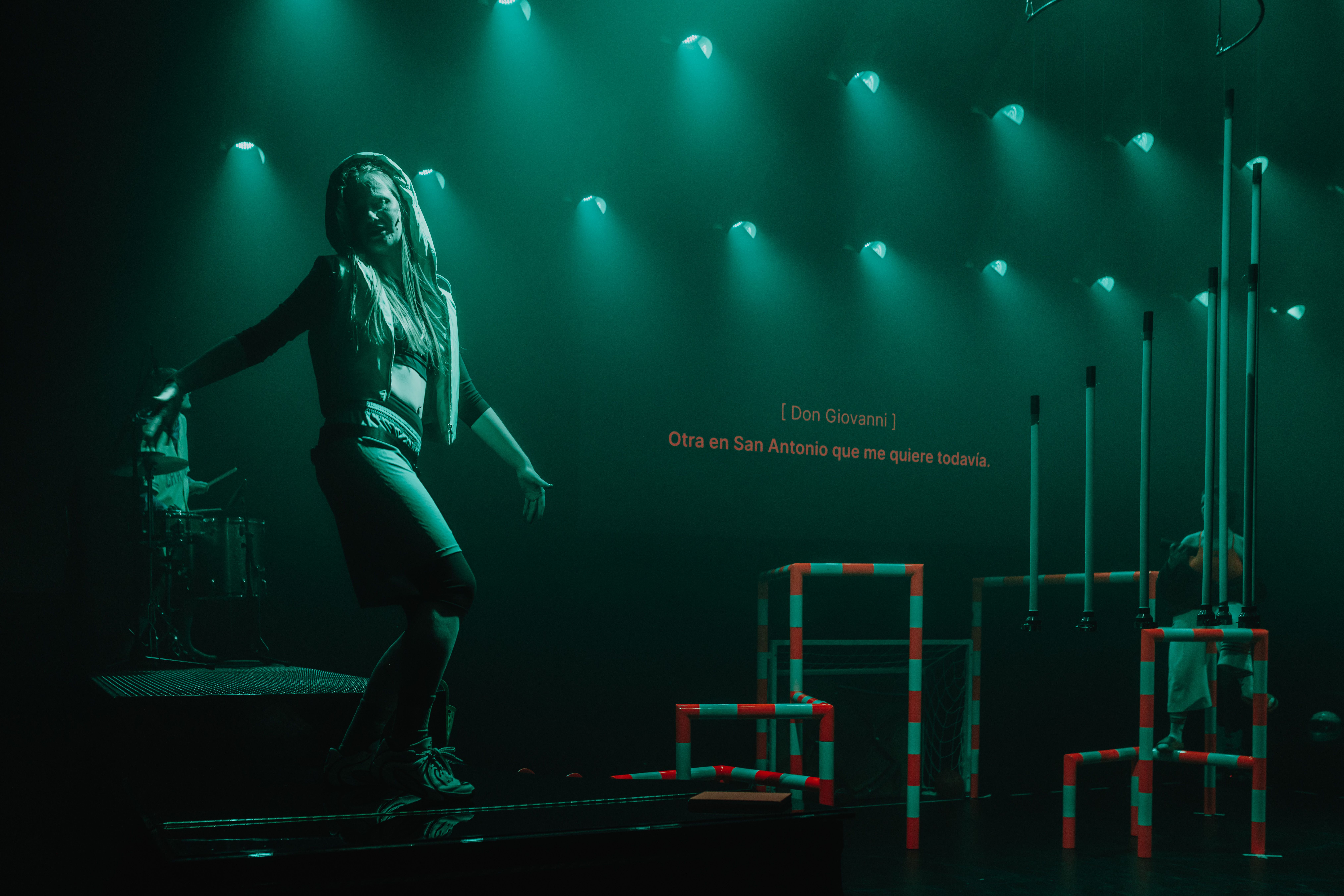
Let's conclude by emphasizing that reading Don Giovanni as a purely misogynistic artifact seems hardly pertinent. In Mozart's universe, women -especially the most vulnerable- often embody a moral intelligence that overflows their male counterparts. We find this in other fundamental roles, such as Susanna in The Marriage of Figaro or Despina in Così fan tutte -indescribably more ingenious than her equivalent Leporello. Thus, what Don Giovanni stages is not so much a celebration of the logic of conquest as the representation of a reckless enterprise: an affront to the human race, uncontrollable and compulsive -unacceptable from the point of view of ethics- rather than an apology for libertinism. Even if the work participates in the Sadean notion of desire as a "natural" imperative, the libretto -born from a fusion of different versions of the myth, such as those by Tirso de Molina and Molière- does not content itself with perpetuating power structures. Its success among the Romantics, the following century, would be found, quite the contrary, in rebellion against the established order, in favor of a paradoxical freedom: to follow only that law of desire, with a consistency attractive to some, but inhuman to all.
Add The New Barcelona Post as your preferred Google source for free
Stay informed with the latest news.
