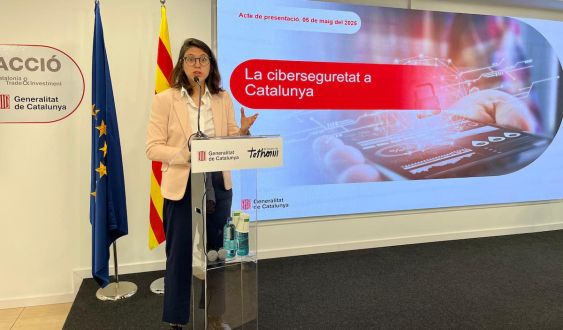
Given the rise of cyberattacks, which increasingly affect everyone from individual users to large companies and institutions, cybersecurity companies have proliferated in recent years. The sector is growing in Catalonia and now concentrates a total of 577 companies specialized in preventing and protecting against cyber threats, 7.9% more than the previous year. This is according to the report Cybersecurity in Catalonia, prepared by Acció and the Agència de Ciberseguretat de Catalunya.
These Catalan companies have also closed 2024 with a record, invoicing around 1,473 million euros, a figure that represents an 18.7% increase in their business volume compared to 2023. In fact, more than half of these companies exceed one million euros in turnover and more than a quarter reach 10 million euros annually.
The vast majority of these companies, more than 90%, are dedicated to the protection and prevention of cyberattacks, as well as to the identification of users and devices that maliciously try to access systems and data, and to the early detection of anomalous activities within a system. On the other hand, 35.5% of these companies also work to respond to threats and system recovery after a cyberattack, to recover affected systems and data.
More than 82% of these companies are small and medium-sized enterprises, while 10% are startups. The study also highlights an increase in foreign cybersecurity companies that choose Catalonia to invest and set up, since 16.9% of cybersecurity companies are subsidiaries of foreign companies.
The growth of the sector responds to the growing need for companies and institutions to face these threats, as 2024 has closed as a record year for ransomware attacks, those whose purpose is to hijack data from companies and individuals. According to estimates, these crimes have increased by 11% globally and Spain is among the ten most affected countries in the last three months. In fact, the Agència de Ciberseguretat de Catalunya, which protects the information systems of the Generalitat and its areas of action, had to deal with more than 3,370 cyberincidents in the last year, a 26% increase compared to 2023.
The document points out that the sectors most vulnerable to cyberattacks are energy, transport, banking, financial market infrastructures, health, drinking water, wastewater, digital infrastructure, ICT service management, public administration, and space. The economic cost of dealing with cybercrime exceeds 9.5 trillion euros, according to the document's calculations.

Although artificial intelligence is positioning itself as an essential tool for cybersecurity companies, and more than 42% of Catalan companies develop solutions against cybercrime incorporating AI, it also poses a challenge for the sector. "With the application of artificial intelligence, scams will become increasingly plausible, sophisticated, and effective," warned Laura Caballero, director of the Agència de Ciberseguretat de Catalunya.
To address this problem, the institution points to the need to hire more specialized professionals. According to the study, Catalonia lacks about 13,500 professionals to prevent and combat cyberattacks. Currently, Catalan companies in this sector employ more than 10,000 employees, 12.8% more than the previous year. The director of the Agència de Ciberseguretat de Catalunya highlighted that the shortage of professionals is a global challenge, as it is estimated that around four million new workers specialized in digital security would need to be hired worldwide.
In Catalonia, 14 degrees, master's, and postgraduate courses in cybersecurity are offered, and there are 45 study centers that offer 62 vocational training courses in this field. On the other hand, the Agència de Ciberseguretat de Catalunya has also launched the Ciberacadèmia, an initiative that aims to "accelerate the number of available professionals," according to Caballero.
Add The New Barcelona Post as your preferred Google source for free
Stay informed with the latest news.
