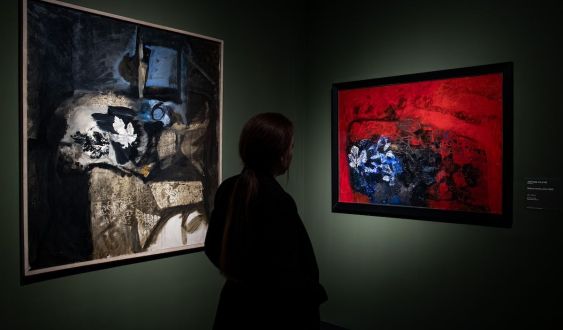
Painter, engraver, and sculptor, Antoni Clavé was born in Barcelona on April 5, 1913, and died in Saint-Tropez (France) on August 30, 2005. He is considered one of the great figures of 20th-century Catalan and Spanish art. He studied for two years at the Barcelona School of Art in 1930 and began his career as a film poster artist. He lived in France in exile during the Civil War until 1956, where he worked as a theater decorator and exhibited in Perpignan in 1939. His works, influenced by Édouard Villard and Pierre Bonnard, placed him in the so-called School of Paris, as also happened with Picasso, Miró, and Saura.
His painting began to take the path of abstraction from 1950, where he worked in theater and ballet, characterized by the use of mannequins on stage and gaining renown in the world of scenography. As he developed as an artist, his figures began to lose contour and precision, forms became less defined, and the stroke and a personal conception of color, as well as the use of textures, gained presence.
Such was his development as a set designer that he collaborated as art director and costume designer on the film Hans Christian Andersen (1952) by Charles Vidor, a work for which he was nominated for an Oscar.
Before his final transition to abstraction, Clavé paid homage to El Greco several times in the 60s, focused on Baroque authors, and replicated the image of the gentleman with his hand on his chest on several occasions. In the 70s, he used collage and invented papier froissé, a technique in which crumpled paper is used and spray is printed.
His first retrospective was at what is now called the Centre Georges Pompidou, formerly the National Museum of Paris, in 1978. In the 80s, he dedicated a series to Picasso, whom he met personally in 1944. In 1984, one hundred of his works were exhibited at the Venice Biennale representing the Spanish Pavilion, and he was awarded the Gold Medal of the Generalitat.
A total artist is presented before us, someone who traversed multiple disciplines, many of them disparate or seemingly opposed.The exhibition Antoni Clavé in capital letters, commissioned by Aude Hendgen, the head of the Clavé archives in Paris, and José Felix Bentz, co-founder of Palau Martorell and president of the Reial Cercle Artístic,it is the first major exhibition dedicated to the painter since 1996.The exhibition, which can be visited until November 16, arises from the initiative of the Joan Gaspar Gallery, the Clavé Archive and the support of the Generalitat, the City Council and the Diputació de Barcelona, and has two venues: the Palau Martorell and the Reial Cercle Artístic. The works exhibited in the Palau de la Generalitat can also be visited with the opening of the Clavé rooms, inaugurated in 1993, which consist of nine large-format paintings and four sculptures.
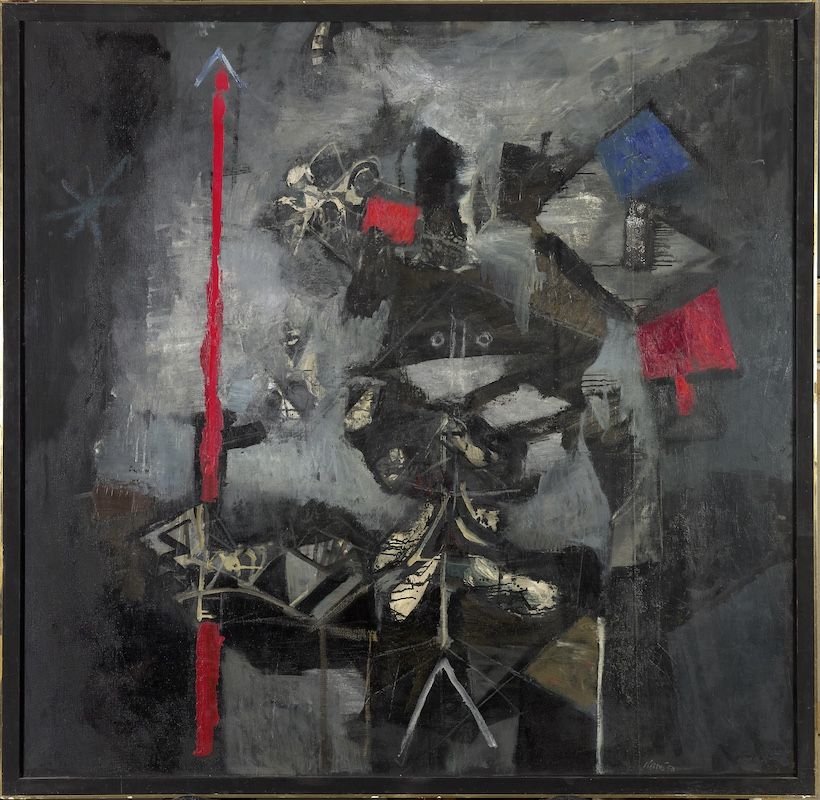
Antoni Clavé produced a body of work that is a witness to his time and an exponent of expression and personal inquiry. With painting as its central axis, the artist constantly experimented with materials and embraced everything from set design, costumes, props, to engravings, posters, fabrics, and sculpture.
The exhibition highlights the influence that the cities in which he lived had on the artist: Barcelona, Paris, Tokyo, and New York. The thematic sections are 5: Barcelona, 1930s; Paris, Venice, and Barcelona; Tokyo, Osaka, and Hakone; and New York. Places that made him grow and helped create the idea of the universal character of his works.
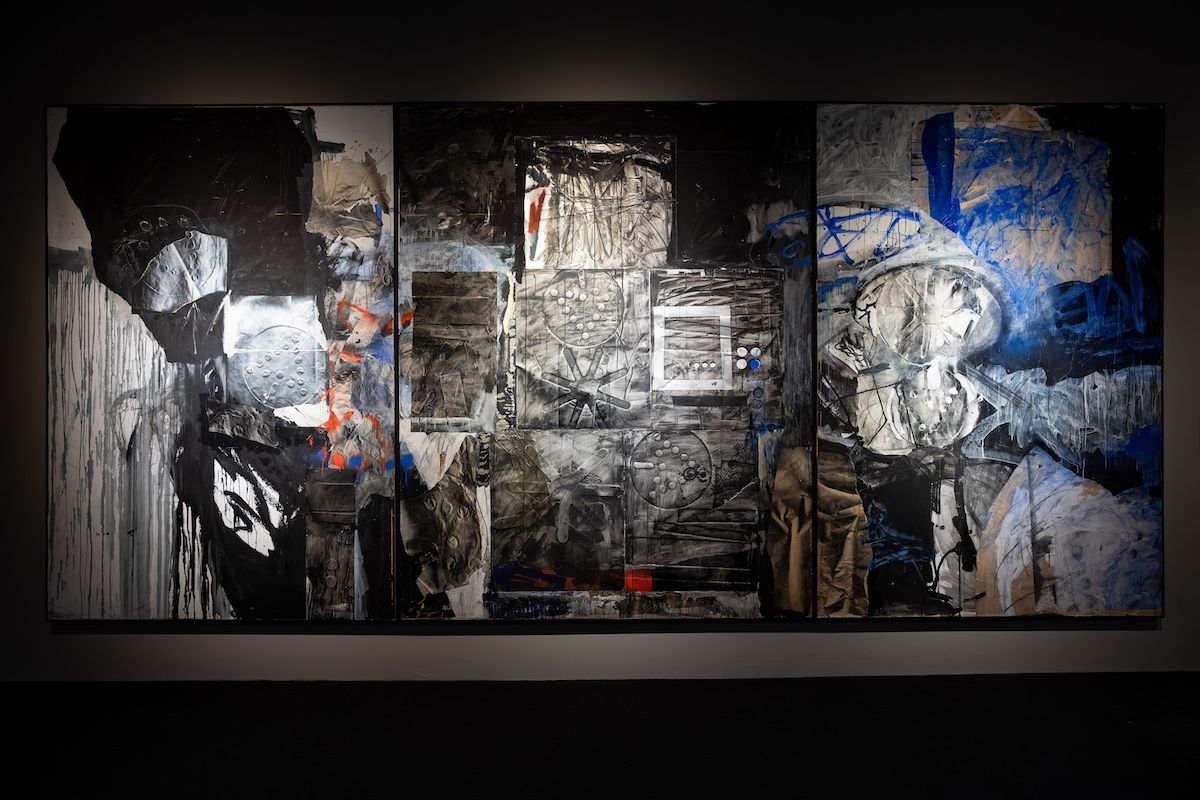
Clavé always stood out for his quality and his ability to reinvent himselfThe retrospective is understood by the curators as a return home for the painter. It is worth noting the Triptych of the City Hall, painted on the occasion of the Olympic Games and which has only left the headquarters twice, this time and in 1997, and the tributes to Picasso, El Greco or Gaudí, thus settling a kind of historical debt with the artist.
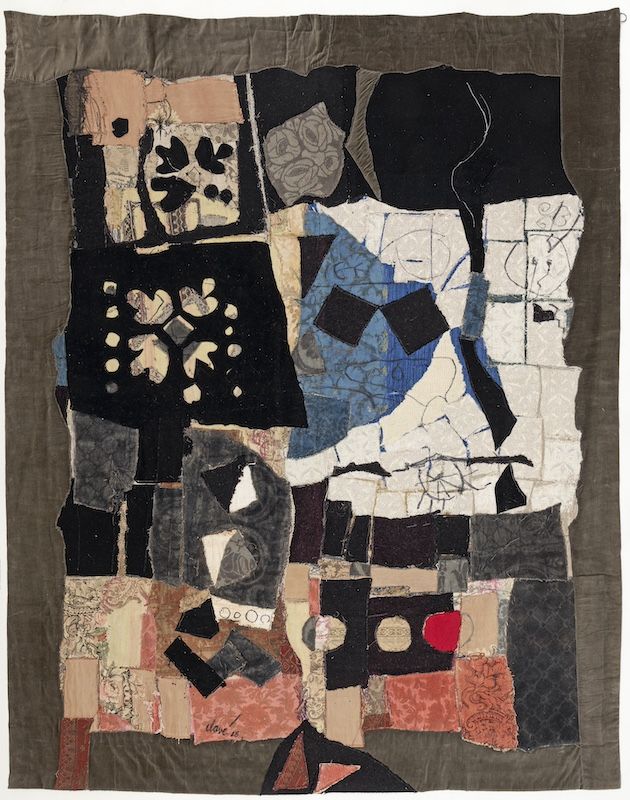
His figurative period and his poster work are more than unprecedented for the general public, as is his textile work on Antoni Gaudí and Catalonia. A Antoni Gaudí (1968) is a monumental tapestry that encapsulates the very essence of modernism and evokes, with its undulating forms and collage, the most organic elements found in Parc Güell.
In France, Clavé stood out for his Rois, and in the exhibition we can also see a large part of the works from the Spanish Pavilion at the Biennial (1984), with works about F.C. Barcelona, a club Clavé followed and which allowed him to maintain a connection with his homeland in exile, as well as the common use at the time of blue and crimson colors and the colors of the Senyera.
Clavé, personally, considered himself a lucky man, nothing moreHis trip to Tokyo and Osakaprovided the artist with new perspectives regarding the emptiness and fullness of his paintings. From this period, the first canvas acquired and cataloged by Macba in its collection, 001, stands out. From Japan, Clavé brought back the use of Chinese ink combined with oil and thecollage, and its seriesReturn from Japan.
In 1989, he traveled to New York, where we can observe clear reminiscences of Basquiat in his work. There is a great influence of modern urban art and graffiti. The series that accompanied the trip was called Seen in New York.
Clavé, personally, considered himself a lucky man, nothing more. He firmly believed in chance and fortune and considered that, only thanks to it, he had been able to exhibit and develop a career as a painter. He left decisions and the textures of his works to chance. The drops of paint that slid down the canvas, the transparency of a glued paper, or the precision and definition of a stroke. Clavé used chance to create, risk as a motor, and accident as a virtue. He used wood, cardboard, clothing, and bronze to manufacture his pieces and always believed in the transformation of materials but not in the transformative power of art.
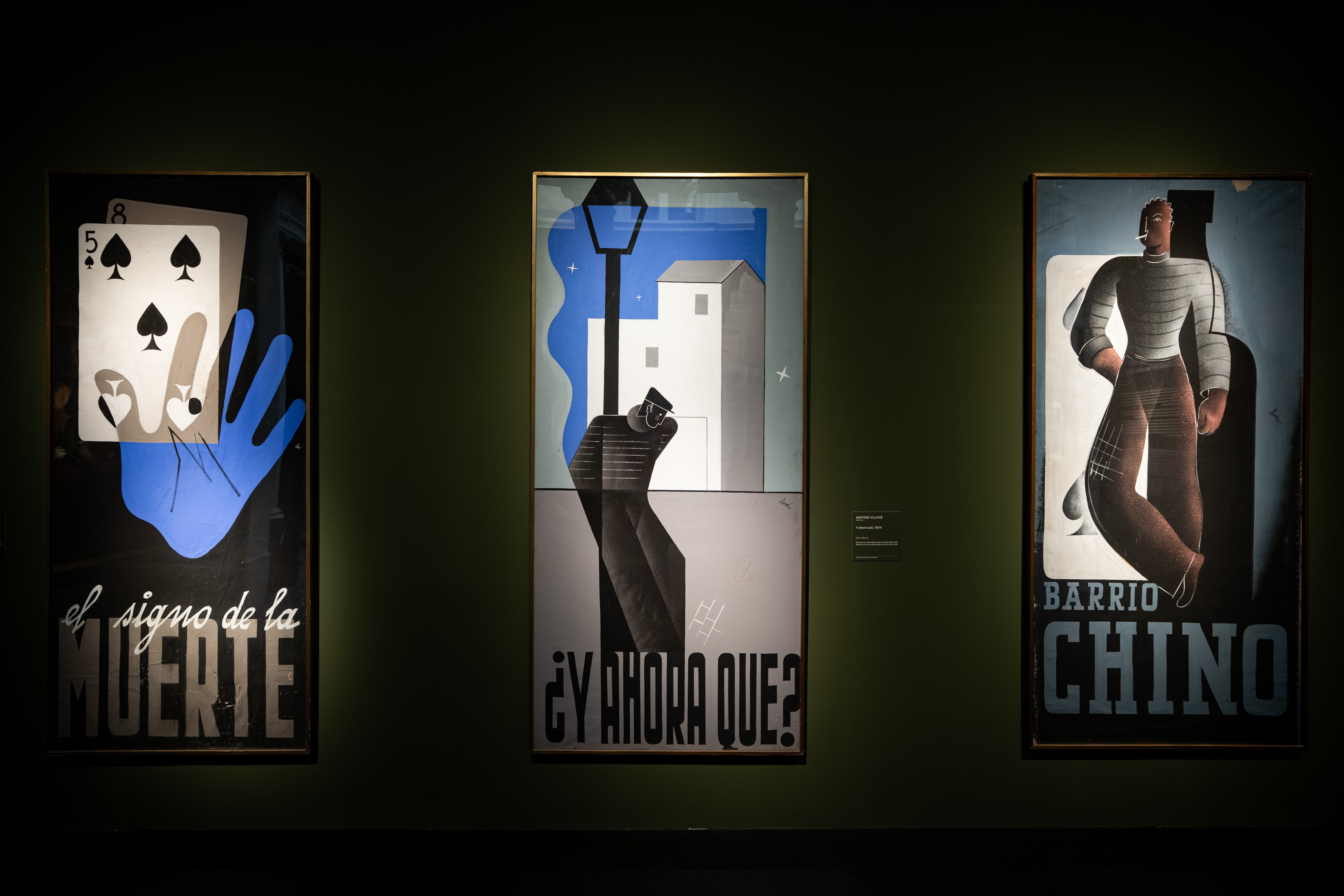
The cinematographic posters he painted were original and without possibility of reproduction. Painted with glue and made on wrapping paper, they gave the painter an unrepeatable sense of freedom. Clavé could be inspired without limitations by the film's title, synopsis, and an aesthetic between art deco and German expressionism, without having to put the faces of the actors and actresses, or respond to commercial or promotional demands of any kind.
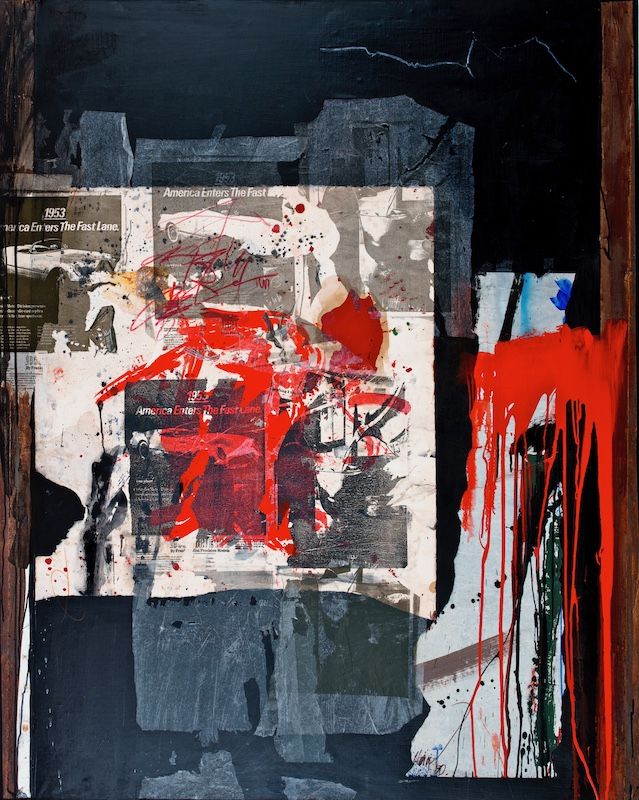
He paid homage to Picasso, specifically, to his blue period, and to Zurbarán, with a marked use of muted and dark gray and blue tones. The French always considered him a very Hispanic artist, and took as reference his scenographies for Bizet's Carmen or for representations of Lorca's works. Clavé, on the contrary, always identified with the French pictorial and referential tradition, feeling himself an example of the good treatment and reception of his works by France compared to the reception in Spain, as had also happened to many of his abstract contemporaries.
The use of deep reds and dark colors like black linked his work in the eyes of the world to the portrait of a dark and black Spain, stained by the red of spilled blood. In his canvases, we can identify tragedy, pain, and bitterness, but the painter always showed himself contrary to that idea and was grateful. Clavé defined himself as someone who liked to live well.
Antoni Clavé was a kind and calm person, with a relaxed image, with a bushy mustache and hair combed or disheveled, swept back. He was a painter who always fled from the representation of the cursed artist from a romantic point of view, and who did not believe in transcending death or living in posterity. His art itself, and his conception of it, did not fit with the idea of the misunderstood artist; he never considered himself as such. In his opinion, the enigmatic and the misunderstood were outdated and not a sign of his time. His biographer, the writer Ferran Canyameras, described him as "a solitary man, an artist with his own style, outside of fashions and trends. Others err on the side of theory; he has always learned in silence."
Add The New Barcelona Post as your preferred Google source for free
Stay informed with the latest news.