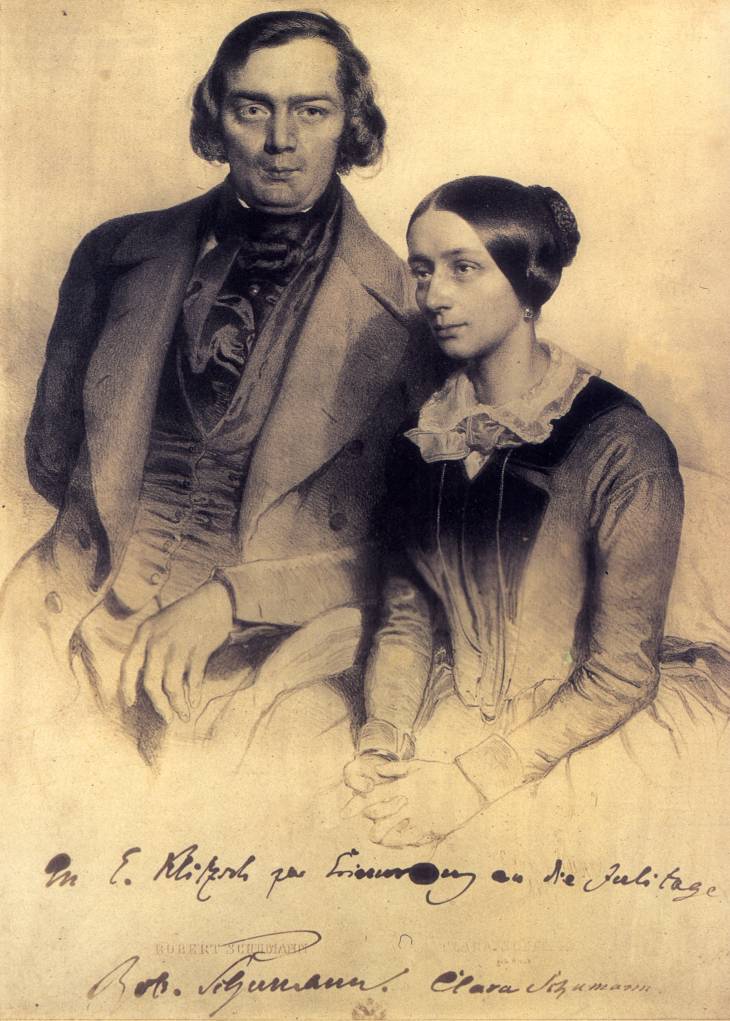
[dropcap letter="C"]
Clara Wieck Schumann (née Clara Josephine Wieck. Leipzig, 1819 - Frankfurt am Main, 1896) was a German artist who dedicated herself to both composition and piano performance and was widely recognized by her contemporaries. Sadly, today her name does not belong to the usual repertoire of the most crowded concert halls, nor to the curricular repertoire of music schools.
Clara's family always lived from music, first from the concerts given by her mother, Mariane Tromlitz Wieck, a recognized and admired pianist, and later from the fame as a pedagogue that her father, Friedrick Wieck, received through his wife. Clara's mother was known for her interpretive talent on the piano, but also for her singing and piano lessons, which gave her an autonomy unusual for young women of the time. In 1823 Mariane left home, leaving behind her three children and her furious husband, to return the following year after having cultivated her fame throughout Europe. According to Saxon law at the time, in case of divorce, fathers had full custody of the three eldest children. Therefore, in 1824, when the divorce between Friedrick and Mariane became official, Mariane had to abandon her children; Clara only enjoyed her mother's company until she was five years old.
[subscribe_newsletter_esp]
In an environment deprived of feminine warmth, Clara began to compose mostly chamber music and, like the child prodigies of the time, was taken on tour through the great European courts and admired for her fantastic technique. In 1840 she yielded to the wishes of a young Robert Schumann, who tended to depression and did not have many financial resources, and married him. Father Wieck, who was not at all in agreement with his daughter's decision, firmly opposed it, a fact that pushed Clara to take her case to court, which ruled in her favor. As a result of this paternal separation, Clara reconnected with her mother, with whom Robert had a very good relationship, and Mariane was able to assist her daughter as a mother and grandmother.
"A woman cannot wish to compose, no woman has ever been able to do it. Why should I be the first?"The institutionalized misogyny of the era, which is currently believed to be overcome and accepted, was a constant obstacle in the lives of women (young and not so young) who possessed extraordinary talent, and therefore it is not difficult to guess the emotional relationships Clara must have maintained with the men around her on an intimate and professional level; in fact, one of the composer's most well-known quotes is "I had once believed I possessed creative talent, but I have dismissed the idea; a woman cannot wish to compose, no woman has ever been capable of doing so. Why should I be the first?", a poignant reflection that frames the thinking of an era and that we will never see written in masculine calligraphy. Despite Clara's troubled thoughts, her professional career ended in a way that many would consider brilliant, as a piano professor at the Frankfurt Conservatory of Music.
The historical figure of Clara was rediscovered by musicologists in the 1990s, mostly influenced by so-called "cultural feminism," and quickly included within the German classical canon to which figures like Johannes Brahms, her contemporary and intimate friend, belong. Despite Clara Wieck Schumann's evident historical, cultural, and musical importance, current concert hall programming continues to overlook this figure who, in life, surpassed her husband and life partner's fame, being the one who performed his works due to his fragile health, and the person who provided the necessary economic resources for the family unit to survive. Furthermore, she received the admiration of some of her most renowned contemporaries, such as Brahms, Chopin, and Mendelssohn.
In our pressing present, when young women demand equal pay, stand up against abuse and constant undervaluation by colleagues, friends, historians, and musicologists, it is no longer valid for such transcendental composers as Clara Wieck Schumann to remain part of the realm of shadows. The work of the historians who dedicated a large part of their academic lives to recovering her from dusty shelves and drawers has not been in vain. It is time to include Clara, prominently, within the contemporary history of music.
Add The New Barcelona Post as your preferred Google source for free
Stay informed with the latest news.