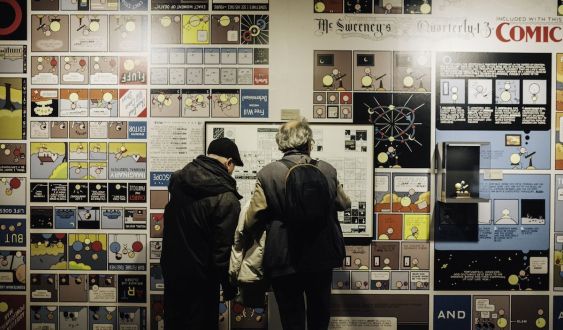
Chris Ware is considered an author of his time. Heir to the postmodern aesthetic initiated by Art Spiegelman or Françoise Mouly, especially for his work in RAW magazine, Ware explores the full expressive potential of comics, the narrative ambition of a great novelist, and the worldview of an essayist concerned with humanism, and the movements and relationships that affect the soul.
Born in Omaha, Nebraska, in 1967, he considers himself a writer in panels, not a cartoonist, since childhood. Compared by the specialized press to authors of the stature of Nabokov or Tolstoy, Ware has digested and internalized all the classical language and narrative tradition of comic history, especially that of American comics. His universe is emotional, reflective, at times absurd and cynical, halfway between comedy and tragedy; his works address themes such as racism, abandonment, loneliness, consumerism, and the consequences of a capitalist system and its policies on daily life.
A lover of old buildings, and critical of the most entrenched formalism of modern architecture, the author delves into the similarities between the construction of a building and the design of a page, as well as the articulation of the story and the temporal projection of the events to be narrated. In this way, a specific reading order is established on different media such as advertising posters, large newspapers, comic-books, comic strips, game boards, maps, etc.
Chris Ware is one of the most innovative and expressive authors in current comics. His panels address human existence with unusual depth for the medium. At times, he doesn't seem like a cartoonist; his way of thinking and his extensive ironic advertising texts resemble the discourse of an essayist critical of consumer society.
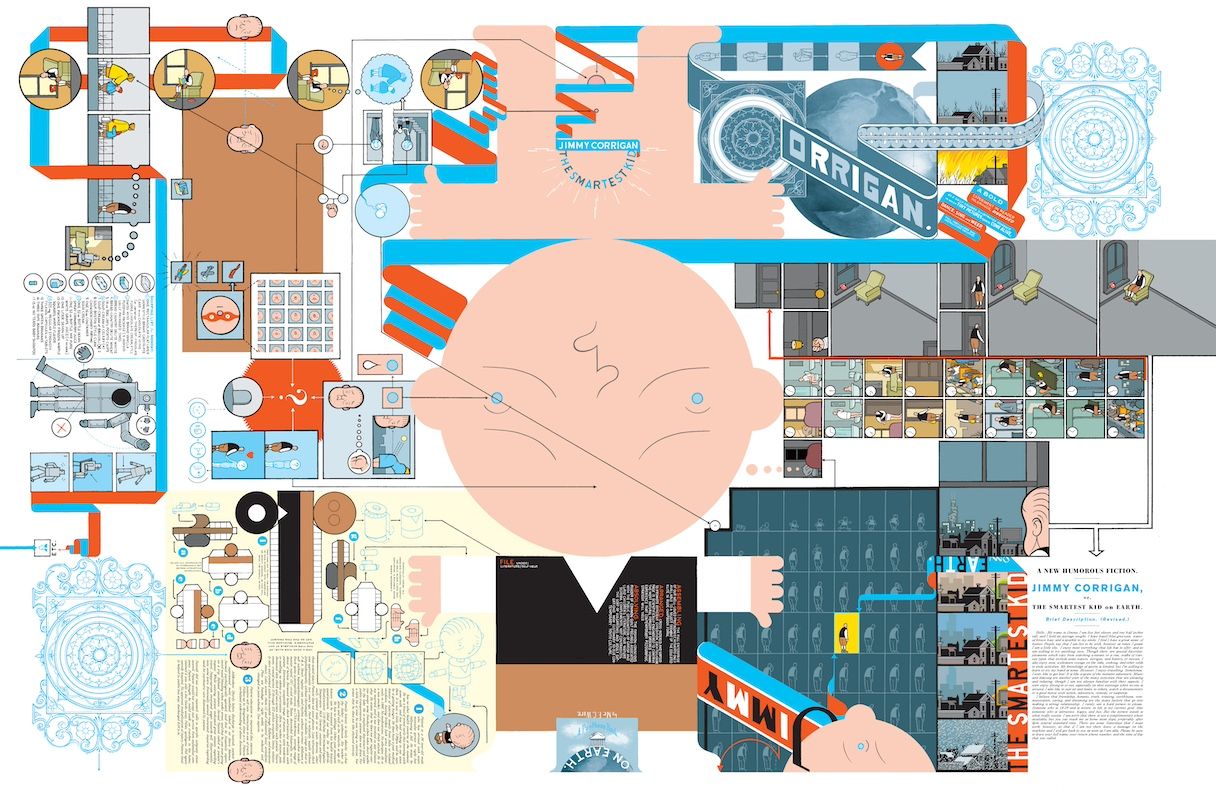
Known for works such as Jimmy Corrigan, the Smartest Kid on Earth and Building Stories, Ware shows unconditional empathy for his characters and a strong moral conviction. In his work, there is a more humanist than political stance, despite starring on the covers of The New Yorker magazine offering a polarized point of view, populated by solitudes, with the desolation of the post-pandemic era, and with an evident wear and tear around personal relationships and communication, also around new technologies, throughout the American territory.
For Chris Ware, drawing is thinking, because he structures his thought in a complex way, with nuances and ambiguities. Under his pencil, the comic becomes a perfect medium to establish patterns, rhythms and structures that function in the author's private imaginary. Drawing is thinking, because drawing connects us with thought and memory.
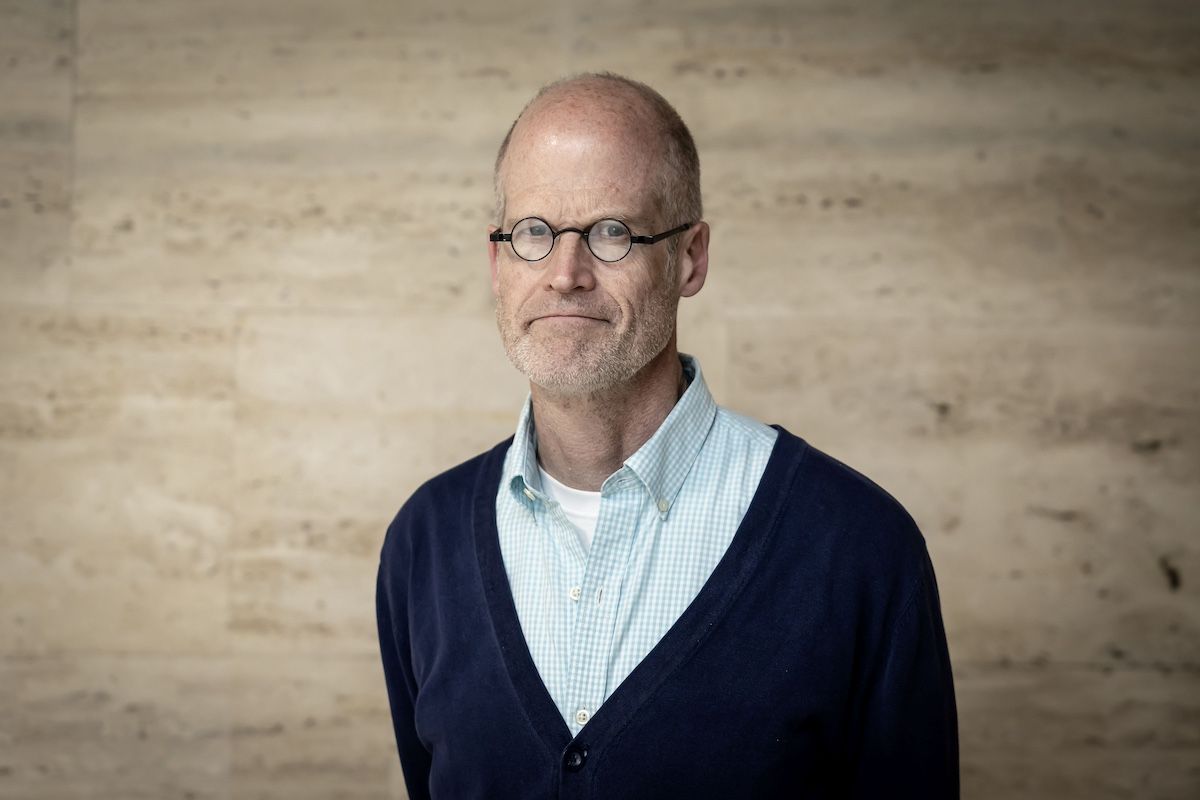
Ware adopts Goethe's definition according to which architecture is "frozen music," an expression that serves as an aesthetic excuse for him to stop actions, resume an expressive time, much closer to cinematic time, and play with it, stretching or shortening it, through the repetition of panels, the constriction of cells, their concatenation, and creating a rhythm, a cadence that slices actions into perfect portions.
Starting from classic comic references, especially from the 1930s, it can be said that he uses a classic style to tell something modern. In this return to the origins, through simple forms and figures, indebted to the comic strip, he manages to transmit a narrative and formal freedom that almost completely neutralizes this classicism. His comics activate the reader's gaze, fusing design, typography and architecture, endowing the page with musicality and rhythm that become a true ethical resistance on the part of the artisan, the author himself, against a world in constant transformation, and with the inevitable ghost of digitalization always present.
Chris Ware is strongly influenced by architecture, specifically that of Chicago, the city where he resides, Ragtime music, and authors such as Crumb, Cliff Sterrett's Polly and her pals, Frank King's sketches, especially Gasoline Alley, George Herriman's Krazy Kat drawings, and Rodolphe Töpffer's Historie d'Albert, considered the father of comics for his pioneering creation of satirical illustrated books in the mid-19th century.
His pages project apartments and flats, fire escapes, emergency exits, and elevators. The panels are constructed like buildings that contain emotions and fit the characters into a kind of matchbox from which they cannot escape.
Ware gives as much importance to environments as to objects, characters, thoughts, and emotions. He thus unfolds a reflection that always tries to capture the subtleties and complexity of his entire existence. Through flat geometric figures, circles, squares, rectangles, and triangles, the author shows us a hierarchy of canonical figures of a solid, unmovable, constant, repetitive, and inevitable system, the monotony of a capitalist system that manufactures in series.
His characters distill a certain sadness. There is a philosophical pessimism and humor as an escape route from that repetitive and unified world. There is routine, emotion, nostalgia, alienation, and loneliness. His style suffocates his figures in the panels, crushes them, traps them irremediably, and submerges them in repetitive routine. The author himself repeats the patterns and puts himself in the act of repetition, as if he too were part of that chain of strip production.
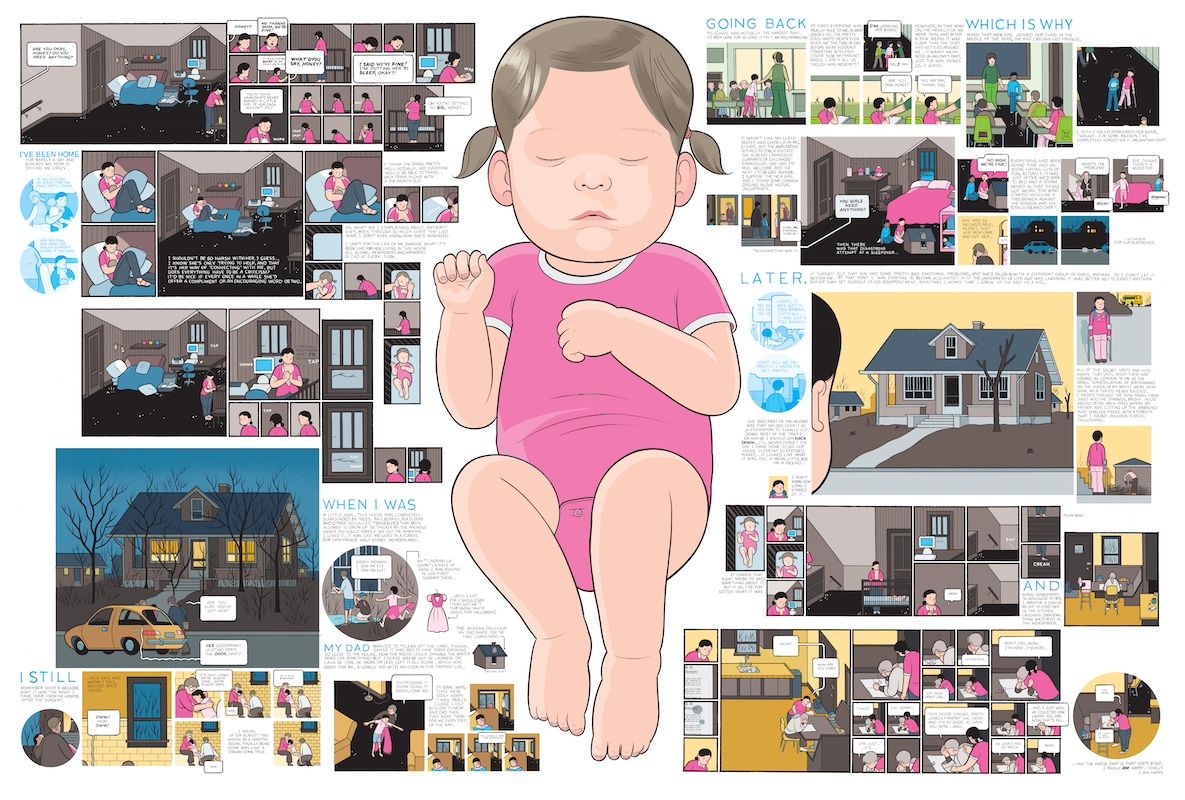
He stops time in them, giving the reader time to empathize with the characters, to think and feel like them. His sequential and endless panels are reminiscent of slides and film frames, of zoetrope images and the origins of the seventh art.
Ware constructs pages as constellations of images, mental maps that unite concepts in a non-linear, but organic way, as if they were branches of a tree, in the case of Jimmy Corrigan (2000), genealogical. In this work, Ware reflects on his own biography and his father's abandonment, establishing complex flashbacks that build a complex emotional map that works better and is more expressive than a diary or a photo album. In Rusty Brown (2009), the snowflakes, which grow symmetrically, are the perfect metaphor for the construction of his panels. Straight lines that grow from the center, forming perfect geometric figures that are born from nature itself.
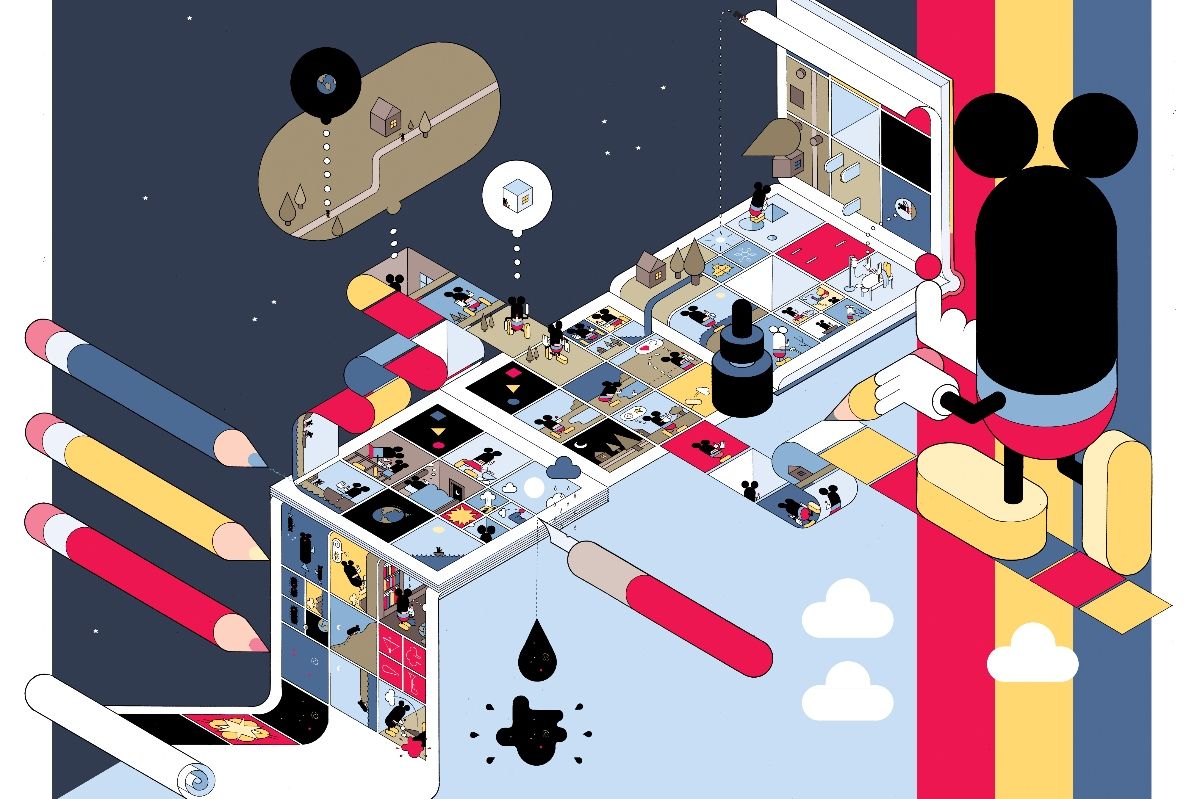
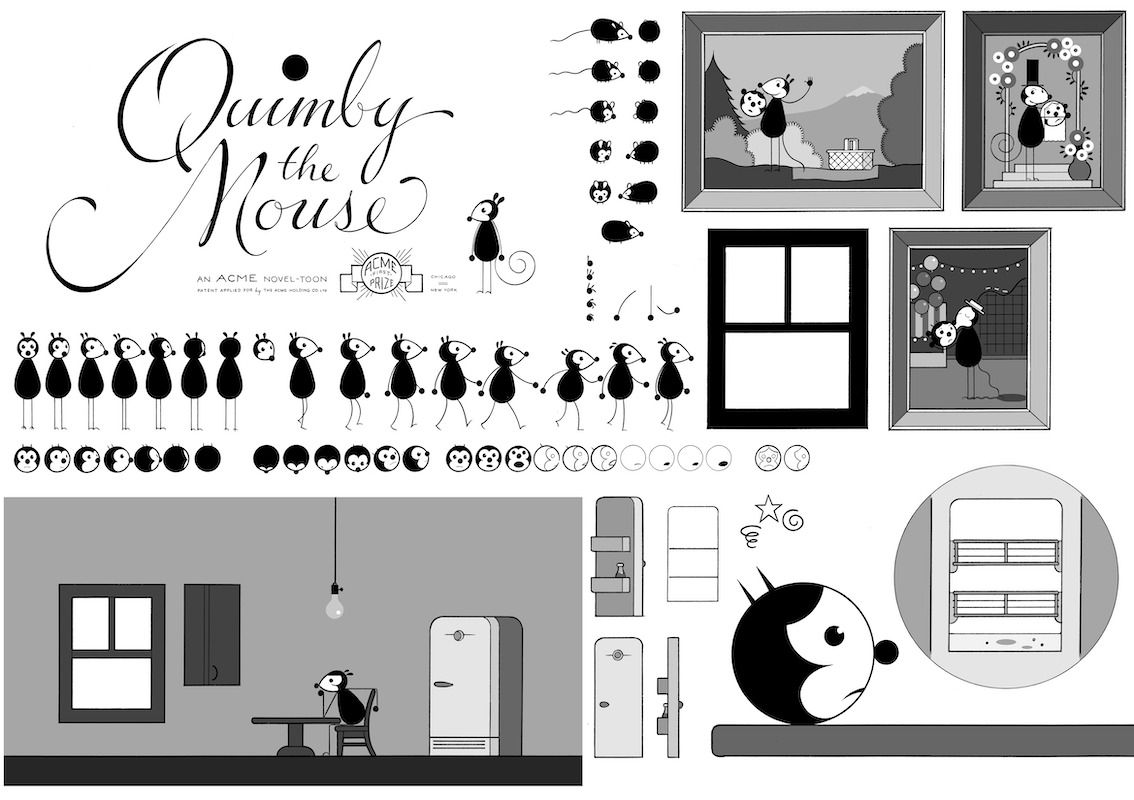
In Quimby the mouse, the author pays clear homage to Herriman's classic strips and to slapstick music and cinema. Cruelty and tenderness are shown in an effective black and white that establishes a certain external darkness that contaminates the actions, sometimes also dark, of his characters.
In the project Pedantry & Pedagogy (2018), Ware is a direct step away from abstraction. His colorful mice, which play, once again, with the collective imagination of Disney or Warner, show a kind of cubism, with fold-out buildings, in which we see their interior in layers or vignettes, as if they were cut-out paper figures. The total liberation of narrative, perspective, forms, and reading order proposes an experience inspired by his years as a professor in Chicago and by Kubrick's 2001: A Space Odyssey, where he aims to leave the reader with the uncertainty of a non-linear and unconcluded experience.
Permeable to injustices, Ware changes his style during the pandemic, with the covers of The New Yorker, where he proposes a less organized, less rectilinear stroke, more focused on photography, and without as much symbolism or geometric figures. He starts from images of empty cities and elements without use or meaning: traffic lights illuminating empty streets, traffic cameras watching us, discarded masks everywhere... Elements that bear witness to humanity's passage through tragedy.
Curated by Jordi Costa, head of exhibitions at the CCCB, the exhibition offers a chronological journey through Chris Ware's work through original pieces, short films, videos, objects, figures made by the author, and books, emphasizing one of the greatest particularities of this very special author, his innovative, original, and personal language.
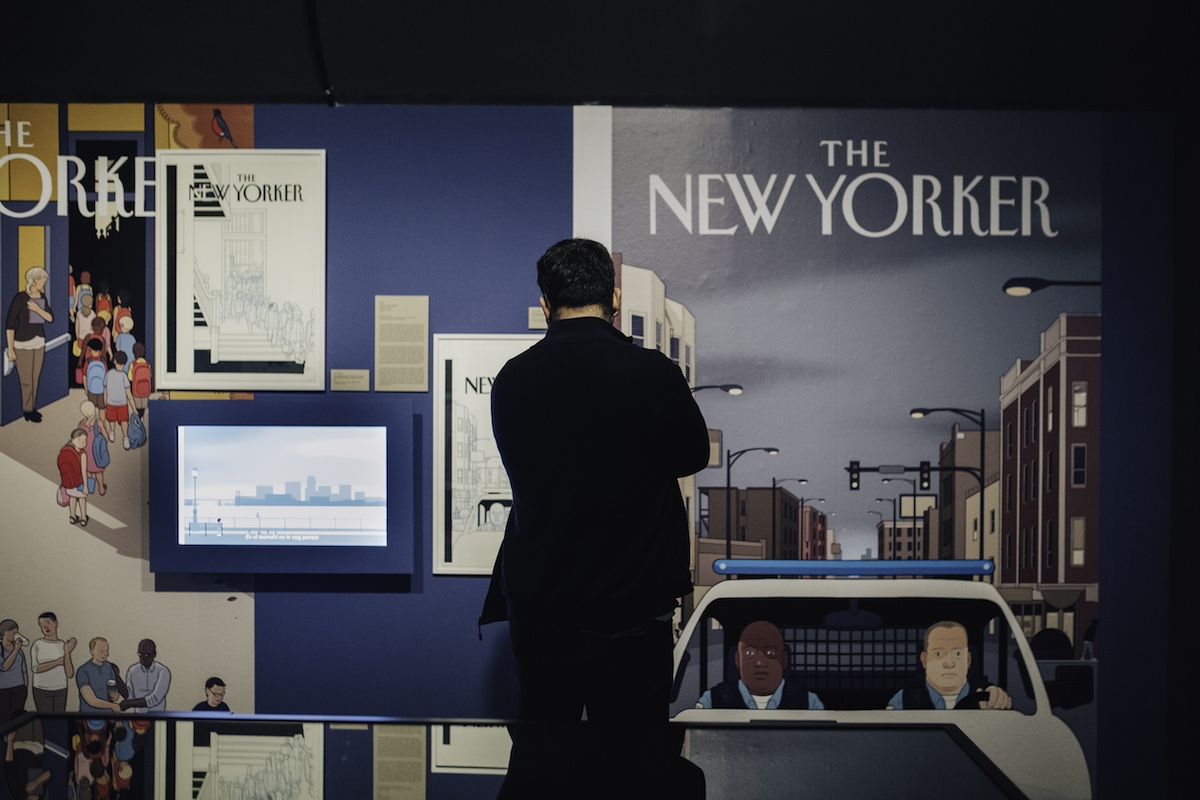
The exhibition is an expanded adaptation of Building Chris Ware, presented at the Angoulême International Comic Festival (2022) and of a touring nature. The exhibition is complemented by a program of parallel activities, such as Ware's participation in the next edition of the Kosmopolis Literature Biennial in October, the space We Build a Barcelona Comic Strip, coordinated by the La Gossa comic school, and the workshop Thinking in Images, with cartoonists Cristina Daura, Nadia Hafid, Sergi Puyol, and Marc Torices.
Produced by the CCCB, Ficomic, and Galerie Martel, it can be visited until November 9. With this exhibition, the center returns to the world of comics after Graphic Constellation (2022-23), once again asserting comics as one of the most primordial languages of contemporary culture.
Add The New Barcelona Post as your preferred Google source for free
Stay informed with the latest news.