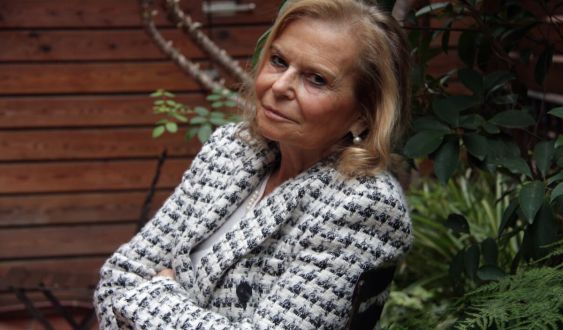
Despite the fact that Carme Riera (Palma de Mallorca, 1948) does not like November, it is usually a good literary month for the writer. 50 years ago, Te deix, amor, la mar com a penyora, her first book, was published. Now, it will once again mark her agenda with the arrival in bookstores of La paz de los sueños felices, published by Bruguera in Spanish and by Edicions 62 in Catalan. To round it off, this same month, L'Arxiduc, an opera for which she wrote the libretto, with music by Antoni Parera Fons and staging by Paco Azorín, will premiere at the Teatre Principal de Palma.
In La paz de los sueños felices, a story for adults illustrated by Silja Götz, Riera once again reclaims the figure of mermaids, after doing so in La veu de la sirena (Edicions 62), published in 2015, also under the same format, with which she "put to the test" Hans Christian Andersen. "Mermaids attract me a lot," confesses the writer. Perhaps because she is "islander and maritime" and cannot live without the sea, perhaps because she wants to change the image people have of these creatures, historically represented as attractive, seductive, dangerous women. "I have worked on late 19th-century literature, when they were considered femmes fatales," she continues. Their songs drove the always clueless and innocent sailors who crossed their path mad, often lost forever. They were always the bad ones; no one ever thought about their negligence.
Although that malevolent figure changed with Disney's The Little Mermaid, Riera wanted Nisa, her protagonist, without sexist overtones, to be a young mermaid who wants to see the world and, following the birds, flee home and see the world. Like the mermaids Odysseus encountered in The Odyssey, the character in La paz de los sueños felices has wings and not a fish tail. But if Ariel in The Little Mermaid exchanges her fish tail for legs, Nisa will wonder what is better, having wings or arms. Matriarchy, with an island full of mermaids where mermen can only visit a couple of days a year for reproductive tasks, female desire, and motherhood are other themes that appear in the illustrated story, influenced by oral tradition and Mallorcan folk tales.
The author Carme Riera wrote her latest book in the midst of the pandemic, according to her Catalan editor, Pilar Beltran: "She had a great time: she was able to live an adventure and go very far despite being confined." "I hope readers have a good time too," Riera added. Her new book comes after Carmen Balcells, traficante de palabras (Debate, 2022), the unauthorized biography she wrote about Carmen Balcells, as she recounted in the latest new session of the cycle The New Barcelona – Moments Estel·lars. Riera was lucky enough to be liked by the hypnotic literary agent, who represented her throughout her prolific career.
Add The New Barcelona Post as your preferred Google source for free
Stay informed with the latest news.
