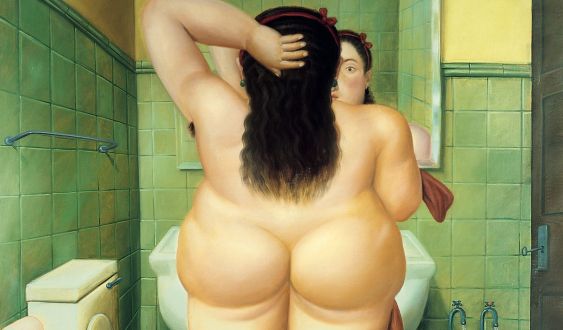
Facing Botero's work means delving into the stereotype and clichés that have accompanied his paintings from imprecise perspectives and from a European, classical, and even colonizing viewpoint. In the eyes of the general public, Fernando Botero is the one who paints fat ladies (and fat gentlemen, which seems to always be forgotten). His figures project outside the common aesthetic canon and do not fit the hegemonic representation that the human body has had throughout the history of classical art.
We could talk at length about the necessity of representing non-normative bodies in art. A necessity that stems from models to be reclaimed, closer to references that painting has had in other times, such as Rubens, Lucien Freud, and countless figurative painters who took the path of expressionism. Under that prism, the body of the woman (and man) is painted as a continent without content, and these paintings focus on the virtue of the flesh, on the profane nature of bodies and their imperfections, and on the nuances and beauty, or not, of that voluptuousness. In Botero's case, this is a mistaken approach, as he never seems to want to reach those heights with his canvases.
Fernando Botero paints thick people with inexpressive faces. They are frontal figures that often look at the viewer. At first glance, one might think they are hieratic, inexpressive, empty, simple sphinxes, and at the same time exaggeratedly inflated, swollen, chubby... However, according to the painter's account, he only paints volume and considers himself the painter who especially works on that quality of composition, unlike most. And he does so from an explicit sensuality and a particular pictorial vision or style that is easily recognizable, exportable, and marketable.
Continuing with the literature linked to his art, Fernando Botero assures in interviews that his style stems from chance, when once, preparing to paint a mandolin, he decided to make the central hole smaller than usual, thus achieving a resonance with the body of a woman and casually discovering the exuberance of those forms transferred to the flesh. A flesh that evokes opulence, femininity, and suggestive curved lines. Volume as an exaltation of life.
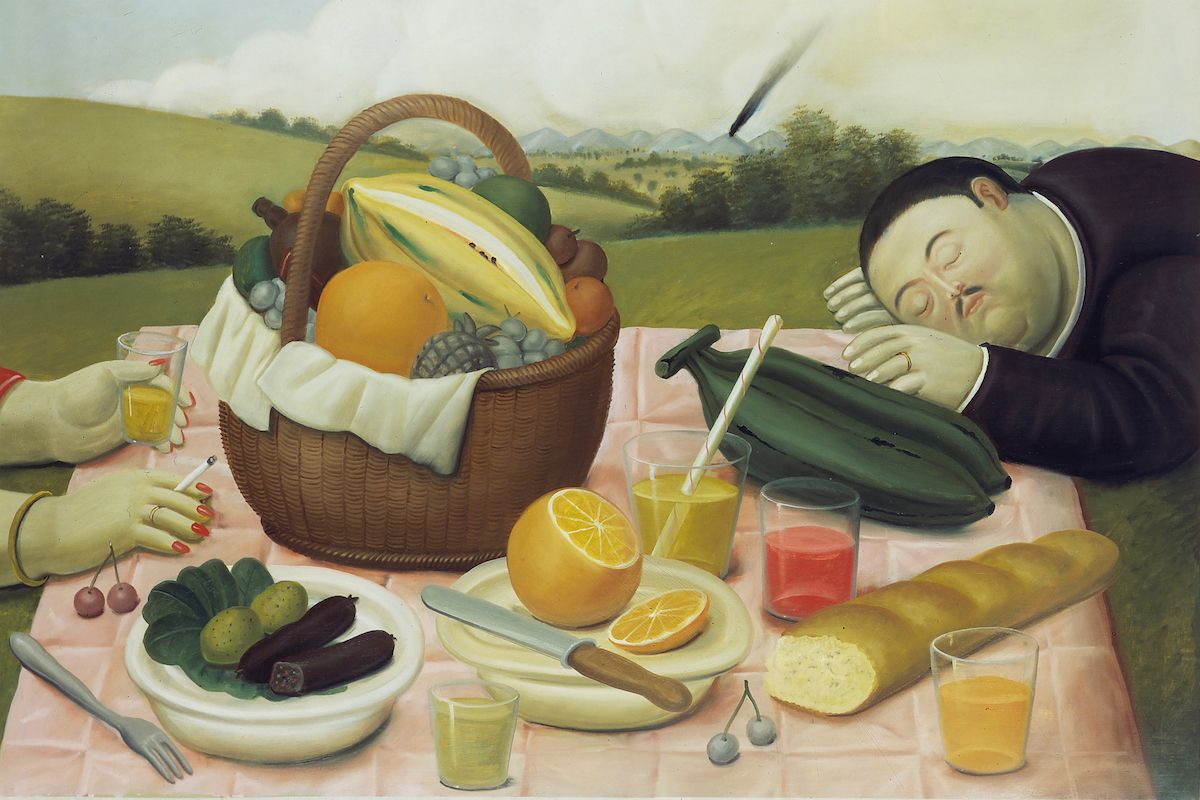
One can observe, also, that this use of volume and composition is found in each and every one of the figures that the painter places in the space of the representation. There is the same opulence in a rock, a mountain, a still life, a hat, a table, a lime or a palm tree. This very particular work of volume has come to be named "Boterism," which is something like the exaltation of volume in the way Fernando Botero does or would do it. At this point, we can speak of a signature that becomes universal, recognizable and that, undoubtedly, already belongs to the great collective imagination. When this happens, the figure of the artist is automatically elevated to the levels that Picasso reached with the Picassian, Dalí with the Dalinian or Goya with the Goyaesque.
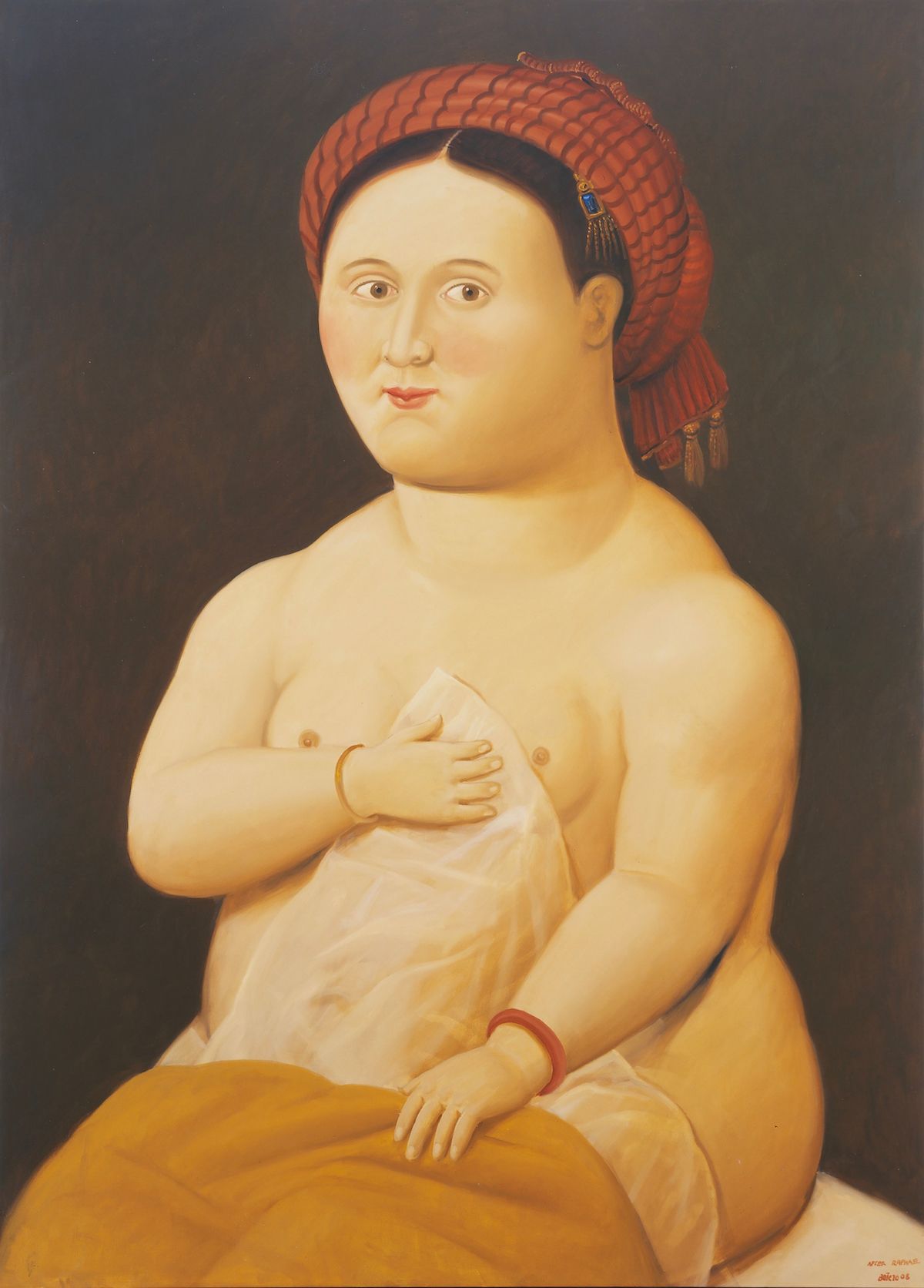
If we move away from the romantic vision of the artist and his narrative, we will find, perhaps, the truth of some beautifully crafted paintings, no doubt, but in which much more conflict is intuited than can be appreciated at first glance. Botero is a figure inseparable from his native Colombia, an absolute icon in Latin America and a key, controversial and admired character, who hides, beneath his art, a deep love for his country, for his culture and for his history.
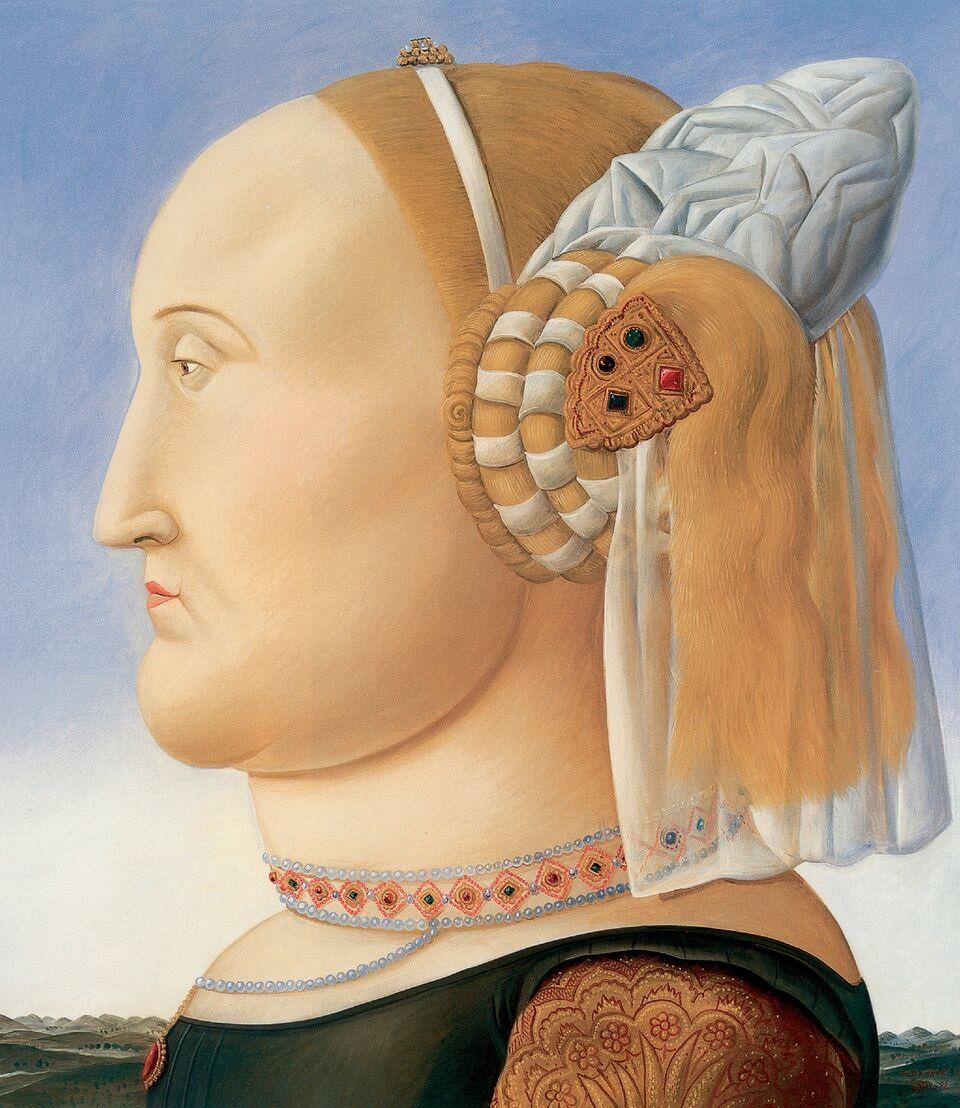
There is, then, a clear identity conflict in Botero's paintings and sculptures, just as there is in many aspects of Colombia's history and culture.Fernando Botero was born in Medellín on April 19, 1932. His mother was a seamstress, and his father died when he was four years old. He enrolled in bullfighting school with his uncle at twelve, and began exhibiting at nineteen in Bogotá. Obsessed with Picasso, he travels to Barcelona and later, to Madrid.He enrolls in the Royal Academy of Fine Arts of San Fernando and visits the Prado to soak up Velázquez and Goya. Strongly influenced by Piero della Francesca, he travels to Florence and begins to idolize the Renaissance painters of theQuattrocento.
Painter, draftsman, and sculptor, he exhibited in the great capitals of the world, notably the Metropolitan in New York, the Hirshhorn in Washington, the Reina Sofía in Madrid, on the Champs-Élysées in Paris, and in the Piazza della Signoria and the Palazzo Vecchio in Florence. His sculptures have been shown in Paris, Berlin, New York, Chicago, Buenos Aires, Madrid, Los Angeles, Jerusalem, Washington, Lisbon, Sao Paulo, Miami, Venice, Florence, Singapore, Tokyo, Hong Kong, Saint-Tropez, Moscow, and Saint Petersburg. In 2000, he donated most of his art collection to the Banco de la República in Bogotá and the Museo de Antioquia in Medellín, creating the Botero Museum, the Antioquia Museum, and Botero Plaza. He lived in Paris and Monte Carlo, where he passed away at the age of 91 on September 15, 2023.
His art is defined by being a perfect cross between his culture and European colonial references. His paintings and sculptures are rooted in the pre-Columbian and indigenous art of Colombia and all of Latin America. Botero's work draws from archaeological remains, traditional sculptures, totems, masks, mythological beings, and animals, with inexpressive faces, forward gaze, and figures with forms closer to the vessels, jars, and statues created by indigenous people than to the classical figure of woman and man.
Botero became involved and integrated into European art to take part in it, to be one of them, one of the universal artists he so admired.We can observe a conflict between native America and old Europe, between the process of decolonization and the empire that dictates judgment about an art accessible to the eyes of a European public, but which has nothing to do with Western canons. There exists, then, a clear identity conflict in Botero's paintings and sculptures,just as it exists in many aspects of Colombian history and culture.
Through his particular symbolic universe, a vindication of the regional that becomes universal is revealed. Botero became involved and integrated into European art to take part in it, to be one of them, one of the universal artists he so admired.
In the eyes of the Western market, Latin American painting tends to be a second-class art in the 1950s, especially if we understand the emergence of American abstract art versus figurative art, with names like Pollock or Rothko. Thus, Botero seeks recognition within a classist market, where being accepted habitually confronts authenticity. The art market usually likes what it finds exotic and striking, it surprises itself by finding indigenous art close in form and beauty, and which, in turn, is an art so distant in its content and meaning. An example of this feeling would be the figure and what has been created around Frida Kahlo.
There is a racist point of view in the economic power of art, something that we also know exists in other social strata. From this perspective, we must demand a profound decolonization of ideas and symbolisms, as well as a better interpretation of works, and a different and adequate fit for them. That an art is easy to sell in Western eyes does not mean that we should betray its nationality or whitewash its origin. There is a tendency to trivialize regional art and it is easy to end up promoting an idyllic image of colonization.
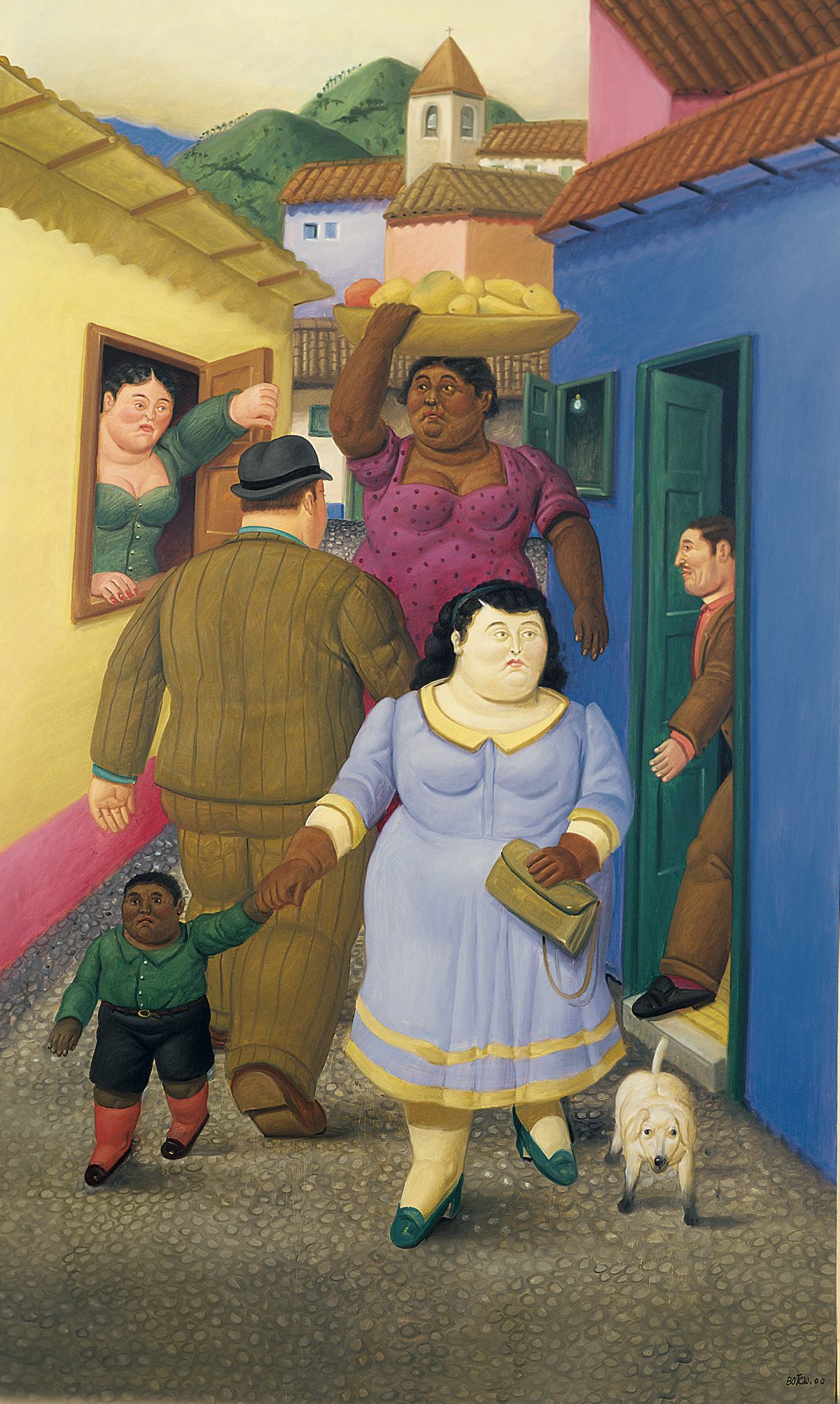
Botero's figures have not been raised under the Renaissance aesthetic canon, they borrow composition and technique, but never the meaning, therefore, they must be valued in a different way. Botero's references are artisans, decorative mural painting, protest murals, political paintings on the walls of houses and buildings. His naive, flat aesthetic, with vivid colors, clearly refers to popular art.
Unlike his contemporaries, Botero decided to look towards Diego Rivera and his own, to flee from the avant-garde, to defend the mestizo, Colombian art and its origin and, despite having the best studies on art, to openly declare himself self-taught. In his elements, jungle landscapes, reddish lands, colorful houses, fruits, fog coexist, all with a saturated chromatic range. It seems at times that the painter makes a mural or a still life of the people and customs of the country. We can consider that the history of Colombia is captured in Fernando Botero's paintings.
Botero makes the common people protagonists, he does not personify and he relies on collective memory.His themes range from rural costumbrismo, to gender violence, to images of massacres, to drug trafficking, to the world of the circus and the world of bullfighting. All these images, however crude they may seem, are idealizations without drama. Like a beautiful memory displayed without expressiveness. These paintings seek roots in the land, document history, and generate more tension, if possible, when dealing with real violent events in which the figures, always hieratic, transmit more to the viewer and look at them.Botero's figures make you a participant in their narrative. There is tension between social classes in his canvases, a tension between the quality of the work and what is considered solely decorative art.
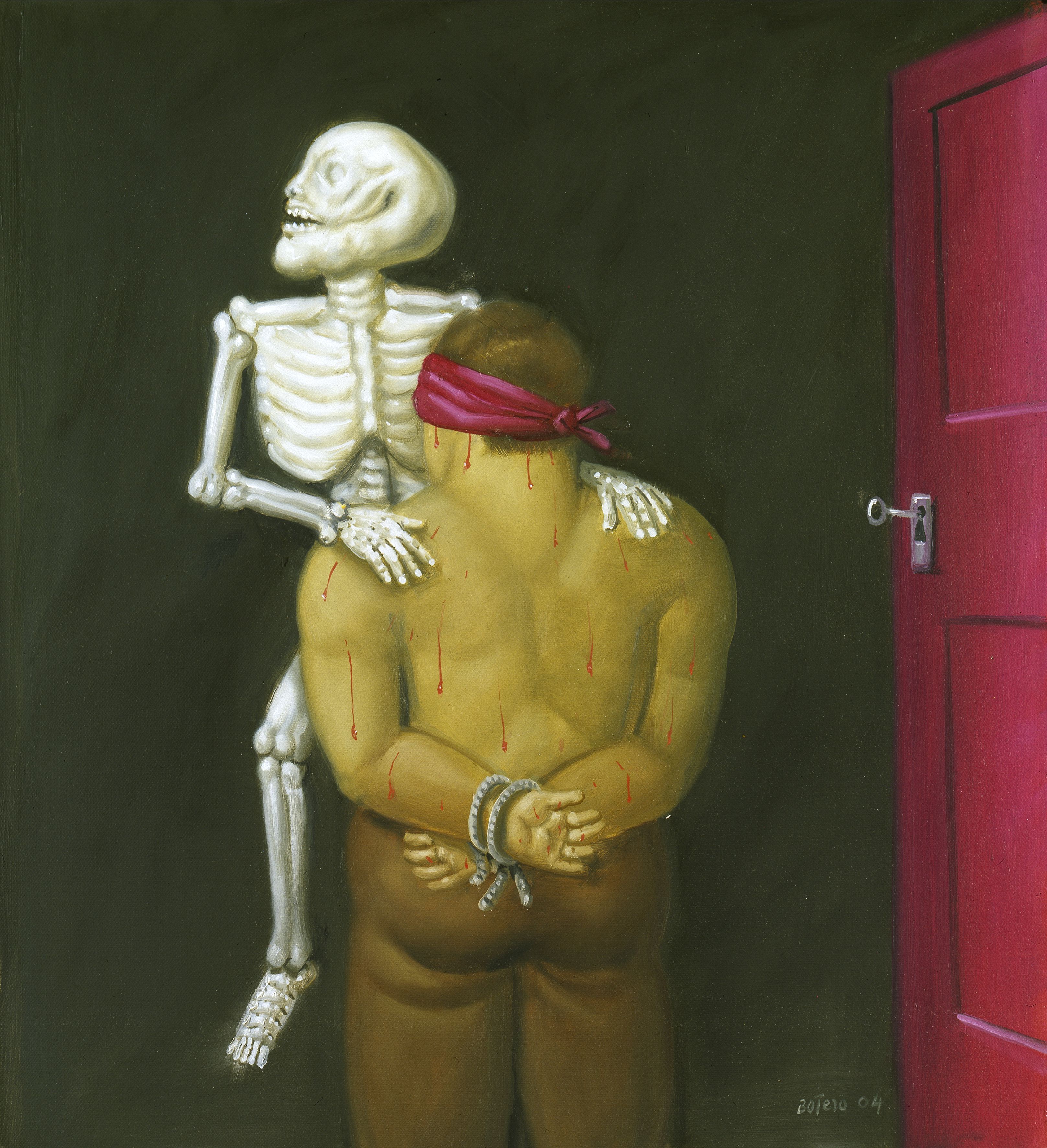
Botero makes ordinary people protagonists, he does not personify and he relies on collective memory. One more vindication, that through this idealization, through the naive and the dreamlike, his origins and culture are dignified, converting his history, that of his country, into something universal. An example of this is the series dedicated to the tortures of Abu Ghraib that the painter began in 2004. In an evident analogy with the history and abuses of power in Colombia, Botero denounces that this event, in the same way, can happen anywhere in the world.
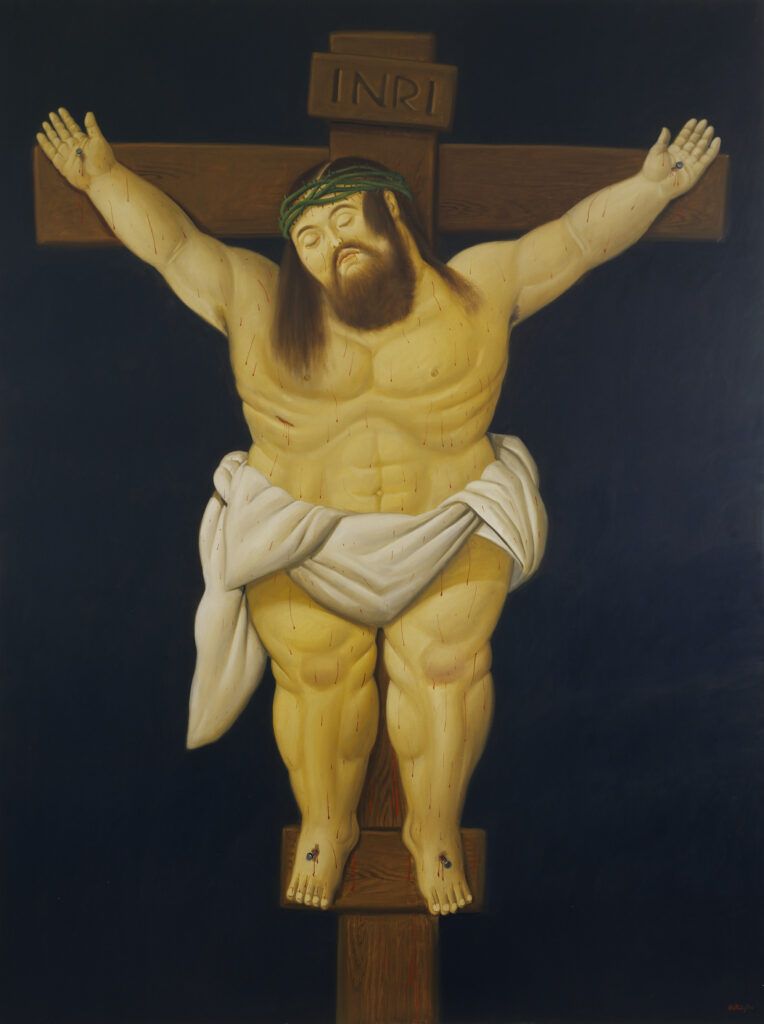
There is also space for caricature and humor in his painting. The recreations of great works of art, recognizable to the general public, bring his painting closer to what we would call popular while parodying European painters. Demystifying their value, their accessibility, and their unattainable character, Botero vindicates his origin and places it at the level of the classics. This altruistic and committed character led him to donate a large part of his artistic heritage to his country in order to make his work accessible and for his fellow citizens to enjoy it, placing Colombia in the art world thanks to the exceptional collection held by the painter.
Botero's sculpture is understood from traditional craftsmanship and as an inevitable extension of his painting. They recall archaeological figures in an even clearer and more direct way. His statues and totems are the living physical representation of the figures he projects on the canvas. In Barcelona, until now, we could only visit the famous and gigantic bronze cat on the Rambla del Raval, an iconic figure of the city that was acquired by the City Council in 1987 without a clear location. Botero's Cat wandered through different spaces of the city for 16 years until settling in its current location.
Fernando Botero: A Universal Master is produced and organized by Palau Martorell and Arthemisa in collaboration with the Fernando Botero Foundation, and features Clear Channel as a partner. The exhibition, which can be visited until July 20, is curated by Lina Botero and Cristina Carrillo de Albornoz, and features 110 works, many of them unpublished, from private collections, including sculptures, paintings, oils, watercolors, sanguines, charcoals, and pencil drawings.
The exhibition is divided into ten themes, highlighting La Menina, according to Velázquez and Homage to Mantegna, a piece that remained unpublished for more than 40 years and was discovered by Lina Botero through Christie's in a private collection in the United States.
Add The New Barcelona Post as your preferred Google source for free
Stay informed with the latest news.