
"I studied Philosophy because I have always had more questions than answers, but the truth is that I used philosophy in bars and immediately started working in the field of sociocultural management." Bego Arretxe laughs loudly as, leaning on the bar, she sips the first mouthful of beer, "the only alcoholic drink I like, apart from the occasional shot of tequila or mezcal, reminiscent of my time in Mexico."
The afternoon is getting interesting at the Bar, facing the final stretch of its last hour before giving way to the night. Borderline, by her beloved Thin Lizzy, plays in the background. "It's the band of my life, and the one that runs through the plot of the book," she explains about No creas una palabra (Catedral), her debut novel that explores the silenced memory of a Barcelona about to succumb under the Olympic dream. The B-side of an anti-authoritarian and voracious city, full of forbidden enthusiasms, lost dreams and rampant R&R. The portrait of a generation "that had all the numbers to fall by the wayside, which is why I consider myself a survivor." And she remembers all those who did not make it out of those exciting, vital, yet devastating days: "AIDS, overdoses... as Edorta Arostegui of the Flying Rebollos says, a time when we boiled to live, and also died.'"
Bego Arretxe remains immersed in that fervor for a life that she is unable to conceive "without reading, without music and, now, without writing." A consultant and trainer for sociocultural organizations, she has time to lead her own creative writing workshop. "My mother was a great reader and my siblings and I have turned out the same. In fact, as a child I already wrote stories and these, like reading, were my refuge, letters were my home."
Proud aunt of four nephews and nieces and considering herself "good people, a good person," now, in addition to the presentations of her book, she is working on a new novel that, like the recently published one, has been on her mind for a long time. "In fact, I spent five years with No creas una palabra, but I had been maturing the idea since I was in Veracruz."
Her home was also on the other side of the ocean
In 2006, fed up with her job coordinating civic centers, "and realizing that I was doing more for the defense of public services from a private company than the public entities themselves were doing," the parishioner went to Chiapas. There she worked for an association that supported unjustly imprisoned people. "I am proud to have supported all those forgotten people, whom no one paid attention to, who often had no one in the world."
From there she moved to a Human Rights center, remaining in San Cristóbal de las Casas for five years, "which is like dying, because you realize that in your city life goes on without you, that no one needs you, but at the same time it gives you enormous freedom, because it frees you from an image you had created of yourself and that no longer sustains you." That's also where she reconnected with that home that, for her, was the act of writing. "I signed up for a writing workshop and suddenly I felt embraced again by that sense of home that letters give you. And I realized that that was what I really liked. What I really wanted to do in life!"
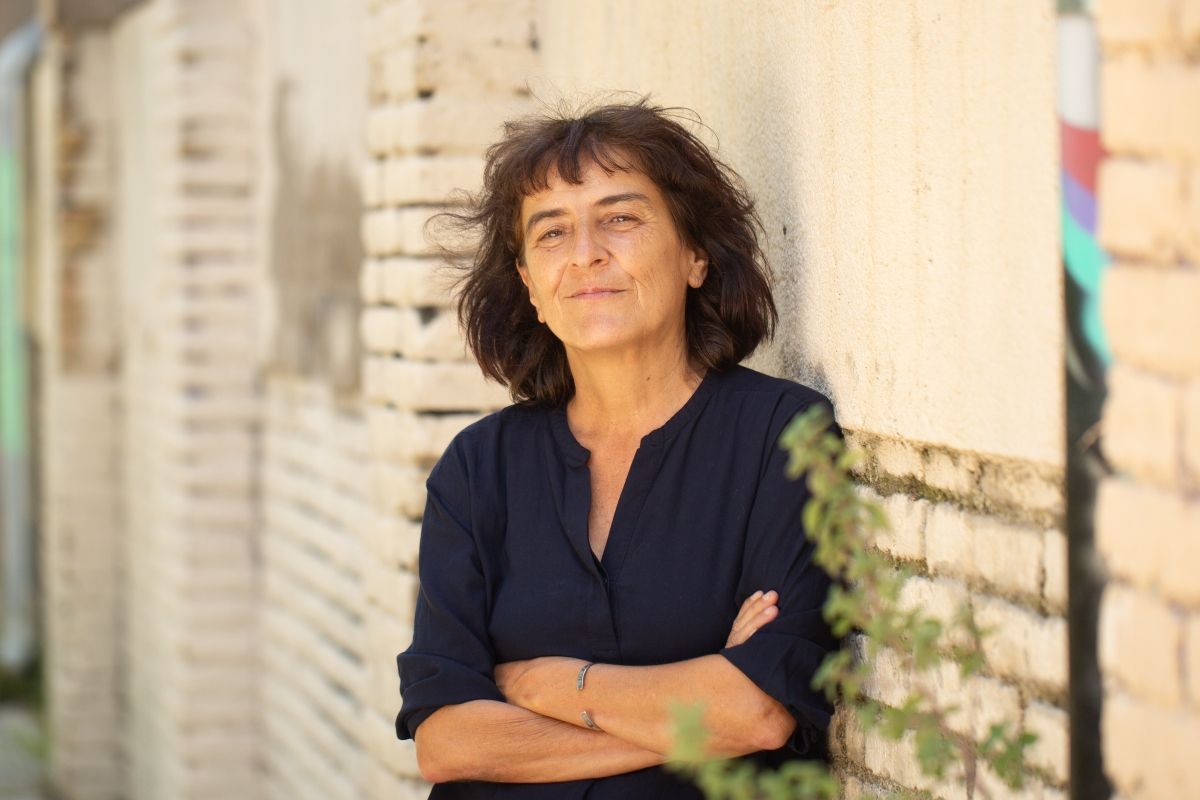
Bego Arretxe briefly returned to Barcelona in 2011, "in the midst of the crisis, with the idea of working as a freelancer, but the situation was very difficult, and I went back to Mexico." She spent two years working in a department of sociocultural projects at the Universidad Veracruzana. There the novel began to take shape, "but I didn't get to it until 2018, when I had already been in Barcelona for five years, and I started writing it while attending Lolita Bosch's literary campus." There she shaped the first eighty pages, "the rest I finished on my own, thinking that there only my criteria should prevail."
Ashamed city
For the writer Bego Arretxe, and as can be gathered from the pages of her novel, there is a before and after 1992 for Barcelona. "The official history has been in charge of shaming that city which certainly wasn't perfect, it had its many flaws, but it was for its inhabitants, it was for the citizens, whereas now it is for investors and tourists. A city that is becoming very uniform, full of franchises like those of any other city, where it is impossible to walk through the center because of how crowded it is with tourism and where Barcelonians are forced to live a nomadic life and move apartments every three years, due to rising rents."
She confesses that she fled all of this a year ago, to go live in Cunit, "because I no longer recognize it as a diverse, creative, thousand-layered city," she explains, "although I am still in love with its spring light and its neighborhood terraces." And she glances at the Bar's terrace, to finish her beer and smoke the cigarette she just rolled "with organic Manitou, yes, that way it seems to poison me less," she laughs.
--- If after the cigarette you're going to have something else, you could accompany it with something to eat. We have everything and it's delicious: tapas, portions, à la carte, sandwiches, menu…
Something shines brightly in Bego Arretxe's quick and lively gaze. "I haven't found absolutely anything, no type of food in the world, that I don't like, so tell me what you recommend," she replies.
--- To start, that you have two stomachs.
And the writer laughs heartily again, while the notes of Running back by Thin Lizzy accompany the moment and then she knows she has a good while left, still, here at the Bar.
Add The New Barcelona Post as your preferred Google source for free
Stay informed with the latest news.
