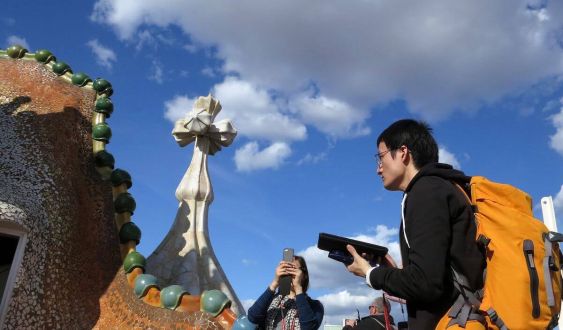
The successive waves of coronavirus have been slowing down the reactivation that was predicted last year for the tourism sector, which has stopped earning 2,500 million euros since the beginning of the pandemic. With the recurrent affectations that occurred in 2021, the Gremi d'Hotels de Barcelona has not wanted to give a balance figure for the entire year, which closed December with 73% of hotels open, 46% occupancy and an average price per room of 106 euros, figures comparable to other tourist capitals where business and leisure visitors predominate, such as Tokyo, New York, Milan or Amsterdam. "We are not alone and we have not fared much worse or much better," remarked its president, Jordi Clos.
The business association did evaluate 2021 according to the different stages it experienced. Specifically, between January and April, activity in the sector was almost nil, taking into account perimeter confinements and other restrictions. The summer season, affected by the explosion of the fifth wave, achieved an occupancy of 50%, with only half of the hotels active and prices lower than usual to attract national tourists in the absence of international tourists, who represent 85% of the Barcelona market. The good trend started in summer continued past September, but was abruptly halted by the sixth wave, leading to a Christmas campaign with an occupancy of between 20% and 30%.
After the arrival of a less aggressive variant of the coronavirus and with the continuous advance of the vaccination campaign, Barcelona hotels expect recovery to intensify this year, unless the pandemic brings some new surprise and with an eye on the recovery of American tourists, who will be the ones to allow this crisis to be completely left behind.
"We are not alone and we have not fared much worse or much better," remarks Clos, with the Catalan capital registering occupancies similar to those of Tokyo, New York or Milan.The return of the Mobile World Congress (MWC) at the end of February must serve as the starting gun,just as hoteliers predicted last summer. With 10,000 reserved rooms that can no longer be canceled, Clos is optimistic: "It will be a starting point this 2022, although it will not be, by any means, like 2019". With the Mobile, it is expected that almost 80% of all the city's hotel capacity will be open, after a dozen hotels that had reopened last year have closed again in January awaiting the arrival of the congress. With the sixth wave and January and February traditionally being among the worst months of the season, hotel occupancy is currently between 8% and 15%.
In addition, after the MWC, more congresses will come. "We want to resume activity," said Clos, who was at FITUR in Madrid and confirmed that desire to return to in-person congresses to do business. In the fair calendar for this year in Barcelona, the Integrated Systems Europe (ISE) is expected to be held, which, like the Mobile, will leave behind its summer and more reduced version of last year (May 10-13); Alimentaria (April 4-7); Seafood (April 26-28); the Congress of the European Society of Cardiology (August 26-29), or IBTM (November 29-December 1). "This gives us hope that we are getting out," Clos defended. For the coming years, Turisme de Barcelona is working with 90 candidacies to attract more congresses, with 150 fairs and professional meetings already confirmed.
Alongside the gradual and progressive recovery of congress attendees will come that of leisure tourism, ensuring that reopenings continue from March until all hotels are open again by late spring, with a more positive Holy Week than that of 2021, marked by perimeter confinements. The Gremi d'Hotels predicts that hotel occupancy this summer will be between 65% and 70%, between 10% and 15% below that of a normal year. Another sign that the crisis caused by the pandemic is being left behind is that its worst moment has already been overcome, which forced some owners to sell their hotels, Clos indicated, with a balance of between ten and 15 establishments that have changed hands, without that having meant that the city's hotel capacity has been reduced.
"We cannot keep saying no"
Clos has criticized the city for rejecting projects such as the Hermitage, the expansion of El Prat Airport, or the Four Seasons, which ended up going to the capital of Madrid. "We cannot keep saying no," he stated, especially when it has been seen what happens to the city when it has no tourist activity. "We have to seize all the opportunities that come our way," he added. Despite the crisis caused by the pandemic and the city's exit from the ranking of the top ten tourist destinations, the president of the Gremi d'Hotels has stressed that the Catalan capital maintains an intangible quality that makes locations like Barceloneta continue to attract visitors and manage to be full in the middle of January. "Barcelona is still the Barcelona of five years ago," he defended.
Add The New Barcelona Post as your preferred Google source for free
Stay informed with the latest news.
