
Now, the Catalan capital has just climbed to third position worldwide in the annual ranking of the International Congress and Convention Association (ICCA), presented this Tuesday during the IMEX fair in Frankfurt. The result places Barcelona only behind Lisbon and Paris and consolidates its role as one of the main cities in the world for attracting international congresses. With this new classification, Barcelona also strings together 25 consecutive years within the world top 5 of the ICCA ranking, a continuity that no other city has managed to maintain until now.
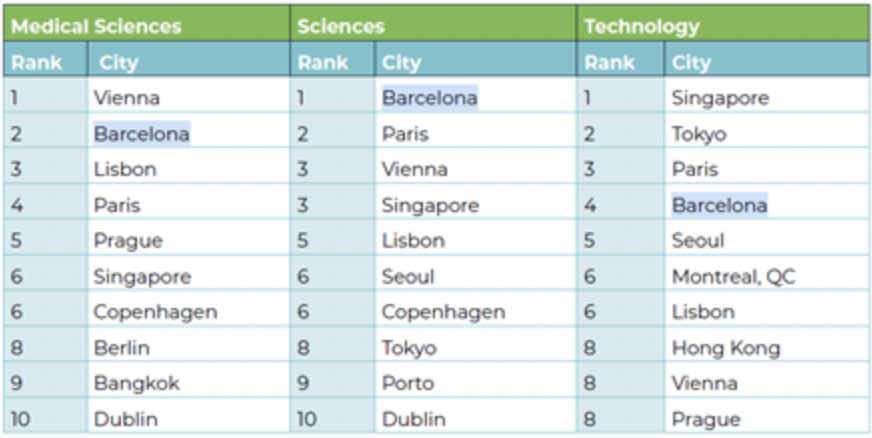
Beyond the general classification, the report also reinforces Barcelona's weight as an international hub of knowledge, research, and technology. The city currently holds the first position worldwide in scientific congresses, second in medical sciences, and fourth in technology, reflecting the strength of Barcelona's university, research, and business ecosystem.
However, Barcelona's leadership within the MICE sector —an English acronym for Meetings, Incentives, Conferences and Exhibitions— is not solely explained by global events such as the Mobile World Congress (MWC), the Integrated Systems Europe (ISE) or the Smart City Expo. A large part of the congress business also involves hundreds of corporate meetings, medical congresses, professional conferences, and sectoral gatherings held throughout the year in hotels, exhibition centers, and specialized venues spread across the city and the metropolitan area.
The sector's importance is also reflected in the figures. According to the annual report of the Barcelona Convention Bureau, the city hosted a total of 1,992 meetings during 2025, a 1.2% increase from the previous year. In total, these gatherings brought together nearly 684,000 delegates and generated an estimated economic impact of 1.24 billion euros.
Tourism linked to congresses, conventions, and fairs currently represents around 20% of visitors who stay overnight in Barcelona throughout the year. Outside of the high summer season, this percentage already approaches 25%. "These results are excellent news and ratify the strategic commitment that the Barcelona City Council has made to promote this type of tourism," said the Deputy Mayor for Economy, Housing, Finance, and Tourism, Jordi Valls, who defended the role of congress tourism as a tool to diversify the city's economy and reduce some of the externalities associated with mass tourism.

An international and highly qualified visitor
The MICE visitor profile continues to consolidate as one of the most strategic segments for Barcelona. According to the report Profile and habits of congress tourism 2025, 94.4% of attendees have university studies and accumulate an average of almost 16 years of professional experience. The average age is 43 years and nearly 75% of delegates come from outside Spain, especially from European Union countries.
The impact of the sector also goes far beyond congress venues. More than three-quarters of attendees voluntarily extend their stay in the city, generating additional activity in restaurants, culture, commerce, and leisure. Many of them also take the opportunity to travel to other municipalities in the province, reinforcing the territorial impact of this type of tourism. In fact, the sector itself has been progressively decentralizing. Currently, almost one in four meetings is already held outside the Catalan capital, extending to other points in the province of Barcelona.
Barcelona's international positioning is also supported by a joint strategy between public institutions and private actors to continue attracting large international events. In this context, Barcelona City Council, Consorci de Turisme de Barcelona, Fira de Barcelona, and Gremi d'Hotels have reinforced their commitment this year to the so-called MICE Fund, aimed at boosting the city's international competitiveness within the congress sector, for which the City Council has decided to contribute 2.8 million euros only between 2026 and 2027.
The strategy also coincides with a moment of transformation of the infrastructures linked to business tourism. Among the main projects are the remodeling of the historic Fira de Barcelona venue in Montjuïc on the occasion of its centenary or the expansion of the Gran Via venue with the future Hall Zero, designed to increase the capacity to host large international events and allow the simultaneous celebration of new events.
Meanwhile, Barcelona continues to secure new events for the coming years. Among the already confirmed congresses are the UIA World Congress of Architecture, the FENS Forum, the congress of the European Respiratory Society or the UEG Week, consolidating an agenda that keeps the city within the international circuit of major professional and scientific meetings.
Add The New Barcelona Post as your preferred Google source for free
Stay informed with the latest news.