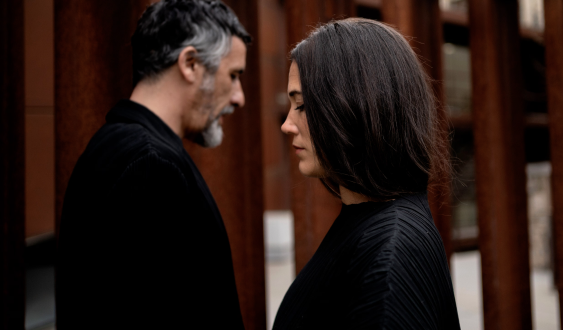
There are moments when poetry abandons paper and filters through other channels. It vibrates, resonates, disfigures, and rebuilds itself. This Friday, at CASA SEAT, the word will cease to be only read to be heard, traversed, and even danced, with the second edition of Poetrónica.
But this week, before the verse arrives, the gesture will arrive. This Thursday, CUPRA presents in the space the new CUPRA Raval, a 100% electric model that points towards a new way of understanding the city.
It may seem that we are talking about two different scenes —mobility and poetry—, but they share the same underlying question: how does that which seemed fixed transform? The Raval, which will be the first electric vehicle produced in Martorell, marks a turning point in the industrial transition of SEAT & CUPRA and places Barcelona within the European map of urban electrification. It is not only a technological question, but also a narrative one: how the future is built from here.
According to André Kleb, Chief Production Officer (CPO) for the Iberian Peninsula for the Volkswagen Group's Brand Group Core, "through the urban electric car family project, we will manufacture four electric models in Spain, starting with the CUPRA Raval, making electric mobility accessible from the Iberian Peninsula for customers across Europe." The Raval thus inaugurates a new industrial and also symbolic stage: that of mobility conceived from here but designed to circulate throughout Europe.
And it is in this same space where, the next day, the future adopts another form —less tangible, but equally revealing—. The second edition of Poetrónica kicks off, a festival that does not want to define poetry, but rather to put it in crisis —and on stage— through electronic music and contemporary performance. For two days, the Paseo de Gracia space will become a laboratory where the voice becomes sound matter and the verse, an expanded architecture.
The inaugural day will open with Ecografía, the piece by Greta Sibling and Xevi GaTa, an exploration where the voice does not explain: it resonates. Next, Pablo Macho Otero will strip bare his universe with ZOE, Antílogia in "A Pèl" format, a radical commitment to unfiltered words, without scenography, without refuge.

But it will be at the end of the night when this hybridization will find one of its most delicate forms. Blanca Ross closes the first night of Poetrónica with a poetic concert in an intimate format, where music and words merge into a single language. Composer, producer, and DJ, she will perform a live piano and ambient electronic set that accompanies the poetic prose of writer and philosopher Ivan Rohe. The texts, extracted from The Erotics of Creation, open a crack in accelerated time to reconnect with a more essential and sensitive dimension.
The next day, the festival shifts towards reflection without abandoning experimentation. In an often-accelerated cultural scene, Poetrónica asks: what place does poetry occupy today? Is it a refuge or a mirror? Does it inhabit a bubble or does it increasingly infiltrate other languages? The round table will bring together two key voices of contemporary Catalan literature, Andrea Genovart and Gemma Casamajó, moderated by Núria Juanico, in a dialogue that raises more questions than answers.
The afternoon will continue with the raw intensity of Blanca Llum Vidal in a new "A Pèl" recital, before the energy changes register with a Poetry Jam that will put word and rhythm in tension: Dafnis Balduz and Paula Blanco will dialogue with the electronic base of Thirty DJ in a duel that is simultaneously play, combat, and live composition.
And like every experience that wants to be more than a program, Poetrónica does not close: it culminates. The festival will conclude with an electronic session by St. Void & TEODUDE, the final culmination of two days in which CASA SEAT has explored the limits between poetry and sound. The duo —Àlex Abad and Teo Blanc— proposes an immersive journey marked by the contrast between light and darkness, structure and intuition, where soundscapes evolve into moments of physical, almost visceral intensity.
Add The New Barcelona Post as your preferred Google source for free
Stay informed with the latest news.
