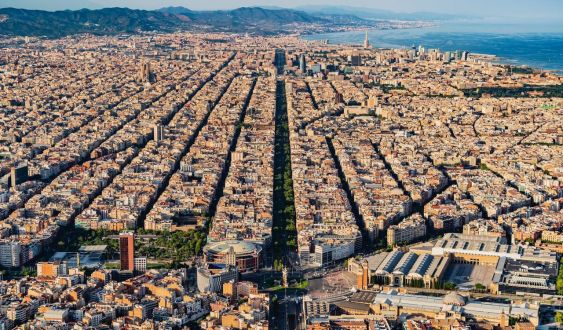
A new year begins. And, as always happens at this time of year, it is time to make lists of challenges, projects, wishes, and dreams for this new year that has just been born. Barcelona finds itself at one of those crossroads that define its character. A global city, which seeks to play a prominent role in global debates, but which, at the same time, cannot afford to have its personality diluted among avocado toast brunches and international franchises. After an intense 2025, marked by major urban projects, mobility challenges, and debates about the future of tourism and housing, 2026 is shaping up to be a key year to consolidate a new stage driven by the ambition of wanting to be global and the vindication of a historical, cultural, and linguistic legacy that fights not to disappear.
This 2026 will be a year of consolidation of old projects, of the start of new ones, and, in the political sphere, of the beginning of an electoral pre-campaign that, for now, presents more unknowns than certainties. Barcelona moves. Fortunately, now it no longer just rethinks, but acts and builds. And it does so with very prominent projects. From the new MNAC (and the remodeling of Montjuïc) to the new Coastal Plan, passing through La Sagrera or major events such as the World Capital of Architecture, the inauguration of the Jesus Tower of the Sagrada Familia (within the Gaudí Year), the gradual opening of the surroundings of the new Camp Nou or the future Carmen Thyssen Barcelona Museum, to name just a few examples.
But it will also be a relevant year to continue deepening a new tourism model, the redefinition of metropolitan mobility (and all its joint policies) and, above all, to make it viable for Barcelona, a city that wants to be global, to be designed so that young people (and not so young) of the city can stay and live in it.
"After years of records, questions arise about the balance between economic benefit and urban sustainability"
We are the city of startups in Southern Europe, we are leaders in scientific research, and we are a reference in the creation of musical, trade fair, and sports events. We know it, we must make it our banner and defend it. But that should not make us neglect some of the main challenges the city faces.
Tourism remains, paradoxically, both a source of wealth and one of the main sources of social tension. After years of records, with visitor numbers that have placed Barcelona in the elite of world destinations, questions arise about the balance between economic benefit and urban sustainability.
It is not surprising, therefore, that the City Council has launched a battery of initiatives to transform the tourism model —moving from a promotion-based strategy to one of sustainable visitor management— with measures ranging from the reorganization of tourist accommodation to the spatial redistribution of visitor flows and the use of taxation to mitigate unwanted effects."Barcelona must not choose between being a global city or being a local city"2026 must be the year in which Barcelona consecrates this transformation. It must be the year to demonstrate thatit is possible to reconcile international projection with a city experience that respects the daily life of its residents. Without it, any major event or investment will be empty of meaning for those who live in and love this city. Mobility has also been one of the great urban debates of the last decade. In 2025, the culmination of various phases of the new Metropolitan Urban Mobility Plan saw the light. But now it is necessary to move from the roadmap to concrete action: investments, real integration with commuter trains, bicycles, public transport, and accessibility.
 But the big issue, as Mayor Collboni himself has acknowledged, is housing. Perhaps no other issue has polarized the agenda so much. Cities like Barcelona are inaccessible for many young families and essential professionals. And this problem, far from being resolved, has become a catalyst for neighborhood protests and electoral regulations with dubious effects. Barcelona should not choose between being a global city or being a local city. It must be (and can be) both.Globalization should reinforce, not hide, what makes us unique: language, culture, traditions, diverse communities, and a rich social fabricBarcelona arrives in 2026 with an agenda full of big projects and high expectations. The great challenge—and also the great opportunity—of 2026 (and the years to come) will be to demonstrate that Barcelona can be a city that progresses, innovates, welcomes, and, above all, is inhabited by people.
Add The New Barcelona Post as your preferred Google source for free
Stay informed with the latest news.