[dropcap letter="L"]
he names of streets are called hodonyms, what a term. And those in Barcelona are regulated by the Barcelona Street Nomenclator Committee. According to a recent count, there are 4,518 streets in the city, and the nomenclator includes public spaces and thoroughfares of all kinds: streets, alleys, plains, squares, small squares, promenades, avenues, roads, ring roads, passages, lanes, descents, stairs, ramblas, cross streets, viewpoints, paths and highways, in addition to docks, breakwaters, beaches, parks and gardens.
While there are streets whose name has not changed since the Middle Ages, those that pay homage to people or political regimes are, naturally, more controversial. La Diagonal has had eight names to this day since the day it opened in the mid-19th century.In the more remote past, when the city was a more manageable size, most streets did not even have names, and people often referred to them with terms related to the activity carried out there or to what was physically present. Many medieval names still survive in the historic neighborhoods, referring to the owners of the main houses or to the established guilds: Carders, Assaonadors, Basses de Sant Pere (for the water ponds of the flour mills that were there), Tapineria, Agullers… It was not until the mid-19th century that signs with the official name began to be installed. And here the problems began.
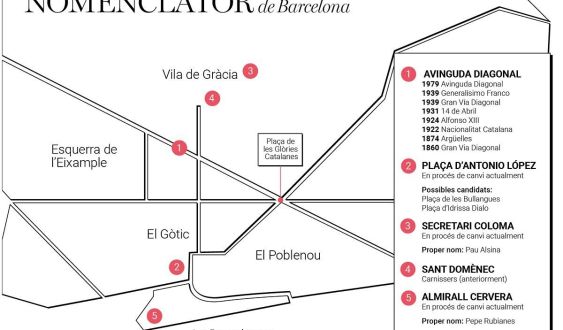
While there are streets whose name has not changed since the Middle Ages, those that pay homage to people or political regimes are, naturally, more controversial. La Diagonal has had eight names to this day since the day it opened in the mid-19th century: Gran Vía Diagonal (1860), Argüelles (1874), Nacionalitat Catalana (1922), Alfonso XIII (1924), 14 de Abril (1931), Gran Vía Diagonal (1939), Generalísimo Franco (1939) and Avinguda Diagonal (1979). A succession of denominations that contains a sufficiently precise subtext about the political vicissitudes of the last century and a half in Barcelona.
The latest and much-commented case is that of the removal of the statue dedicated to Antonio López y López. López was born in Cantabria into a humble family, emigrated to Seville as a child and then went to Cuba to flee justice after an obscure street fight.Thus unstable is modern urban toponymy, which mutates according to political, social, and ideological changes. Against the utilitarian vision of current toponymy, the symbolic power of naming public space seduces politicians, which in recent years has unleashed successive controversies in their eagerness to reflect parliamentary majorities, majority values, or social consensuses in the name of streets or the presence of monuments. And to all this has been added a growing citizen participation in decisions to name new streets or to change the name of existing ones.
The latest and much-commented case is the removal of the statue dedicated to Antonio López y López. López was born in Cantabria into a humble family, emigrated to Seville as a child, and then went to Cuba to escape justice after an obscure street battle. There he started as a modest merchant on the ground floor of a building owned by a prosperous Catalan merchant, Andre Bru Punyet. He ended up marrying his daughter, which allowed him to use his in-laws' fortune to undertake large-scale business projects. He made a fortune by creating the Compañía Transatlántica Española in 1850, and then became immensely rich thanks to companies such as the Compañía General de Tabacos de Filipinas and the Banco Hispano Colonial. A close friend of King Alfonso XII, his son-in-law was Eusebi Güell, and his descendants played a preeminent role during the golden years of Barcelona's expansion. He was a patron of the arts, an indefatigable entrepreneur, and accumulated a fabulous fortune for the time.
However, his alleged activities as a slave trader when he was still in Cuba, which we know about mainly thanks to the testimony of his brother-in-law, Francesc Bru (better known as Pancho Bru), who dedicated the furious pamphlet called "The True Life of Antonio López y López" to him, have ended up causing the defenestration of his monument. The now-removed sculpture is a work by the prominent sculptor Frederic Marès (there was an earlier one, which was destroyed at the beginning of the Civil War) that now rests in the warehouse of the Barcelona History Museum (MUHBA). The Plaça de Antonio López, where the pedestal of his statue has been left bare, provisionally retains its name. A participatory process will be necessary to have a new name, and among the possible candidates are Plaça de les Bullangues (in homage to the popular revolts that received this name) or Plaça de Idrissa Diallo, an immigrant who died in 2012 in the Foreigners Internment Center (CIE) of the Zona Franca.
Although during the transition the names of most streets that paid homage to the Franco regime were changed, others remain that commemorate more remote but also questioned historical figures. This is the case of the street dedicated to Secretari Coloma, a fierce inquisitor and promoter of the expulsion of Jews from the peninsula.The case of López is not unique. Many of the city's most distinguished surnames have ancestors in their family tree with behaviors that would not pass any contemporary political correctness filter. We can remember, for example, that in 1872, two decades after López abandoned his Caribbean businesses and settled in Barcelona, a group of Barcelona patricians signed a manifesto against the abolition of slavery in Cuba. Among the signatories were two future bishops, Morgades and Casañas; intellectuals such as Rubió i Ors and Duran i Bas; doctors such as José de Letamendi and industrialists and bankers such as Güell, Arnús and Ferrer i Vidal. All of them are represented in the current Barcelona street directory. It should be said that it was not until 1880 that Spain approved the law establishing the abolition of slavery in Cuba, and that there were anti-abolitionist leagues and demonstrations in different Spanish cities during the same period.
There are more controversial cases. Although during the transition the names of most streets that paid homage to the Franco regime were changed, others remain that commemorate more remote but also questioned historical figures. This is the case of the street dedicated to Secretari Coloma, a fierce inquisitor and promoter of the expulsion of Jews from the peninsula, which will soon recover its original name: Pau Alsina, in memory of a textile worker who ended up being a senator in the Spanish Cortes. The decision was made by the residents after a consultation with the City Council.
The desire to settle historical scores can go very far: the CUP has formally and repeatedly requested the removal of the statue of Christopher Columbus, an emblem of the Barcelona skyline but questioned for his role in the colonization of America. There are also streets, such as Sant Domènec del Call, that go more unnoticed but that, if we pay attention, turn out to be problematic. On August 5, 1391, a massacre of more than 300 Jews took place in the Jewish quarter of Barcelona, the largest pogrom on record in Barcelona, which practically marked the end of the Jewish community in the city. The massacre happened around Sant Domènec's day, and in his honor the street was named, which was previously known as Carnisseries street (not in the mournful sense of the term but because kosher meat could be bought there). Commemorating a pogrom by paying homage to a Catholic saint can be, at least, aesthetically questionable.
Just two years ago, an old train station in Paris, Halle Freyssinet, was transformed into a large incubator for start-ups, and the promoters came up with the idea of naming one of the new streets after Steve Jobs. Soon the mayor faced opposition from some political groups, who accused Jobs of being a modern Antonio López due to the conditions of the Chinese workers who manufacture Apple devices.Other changes generate less controversy. Soon, on April 15, the name of the comedian Pepe Rubianes will replace Admiral Cervera on the plaques of one of the widest streets in the Barceloneta neighborhood. Cervera was a prominent military officer of the Spanish navy who fought in the wars of the Philippines and Cuba, where his performance as an officer was not particularly brilliant. Few people seem to miss him, and Rubianes is more familiar and likable to most residents.
But let's not think that the controversy over the naming of streets and public spaces is unique to our city. It happens everywhere, and not only in relation to figures from the past: just two years ago, an old train station in Paris, Halle Freyssinet, was transformed into a large incubator for start-ups, and the promoters decided to name one of the new streets after Steve Jobs. Soon the mayor faced opposition from some political groups, who accused Jobs of being a modern Antonio López due to the conditions of the Chinese workers who manufacture Apple devices. Also, of practicing a corporate policy of tax fraud in Europe. In return, they proposed the name of Ada Lovelace, a pioneer of information technology and creator of the first computer program. The solution was Solomon-like: the already transformed station is called Station F, and the street has finally been dedicated to Alan Turing, a British scientist, pioneer of computer science and artificial intelligence, who was persecuted for his homosexuality and ended up committing suicide.
Perhaps the only way to resolve the conundrum of the street names and save it from constant controversy would be to adopt a radical decision and replace all names with numbers, following the model of Manhattan and other American cities, and forever erase from public spaces the traces of a history not always worthy. Or, even better, entrust ourselves to new technologies and refer to places according to geographical coordinates, so aseptic and indisputable.
Add The New Barcelona Post as your preferred Google source for free
Stay informed with the latest news.