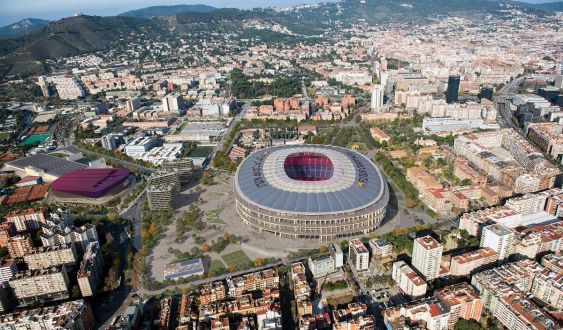
Anyone who has gone to Camp Nou in recent years will have realized that it needed a deep update. They may even have feared that a piece of the stadium would fall on their head, which has forced the club to patch up its structure before work could begin to remedy all the pathologies. And, if someone has gone up in its old-fashioned elevators, they may have been trapped more than once.
After many years, with a process that has been intended to be carried out since 2004, Camp Nou already has a plan and a schedule to start the works, with the building permit approved this Thursday by the City Council. They will begin this very month of June, when the sports season ends, but it will not be until September 2023 when the bulk of the actions will arrive, which will force the matches to be moved to the Lluís Companys stadium in Montjuïc. To finance the entire reform and expansion project, the club has resources for the start of the works and is awaiting to close an agreement that covers its entirety, with a budget that cannot exceed 1,500 million euros.
"It is a very good agreement for the club and for the city," defends the mayor of Barcelona, Ada Colau, highlighting that the stadium will open to the city and a large green square will be gained around it, adding more than 111,000 square meters. "It will be the best stadium in the world in the best city and in the best country," stressed the president of FC Barcelona, Joan Laporta.
According to the work schedule, in a few months, work will begin on the first and second stands, with the demolition of the additional structure of the south goal, where the medical center is located. The works inside the stadium, which will last for a year, will also include restoring the stands, subjecting them to an anti-carbonation and waterproofing process, making the structural finishes, and improving and renovating the broadcasting systems. The actions in this first year will be complemented with the installation of new telecommunications connections, the transfer of the data processing center and the creation of a technical room for recording internal telecommunications infrastructures.
Outside the stadium, the actions until June 2023 will consist of containment works for the Lateral parking lot and the construction of a new central warehouse and an information space for members to explain how the works are progressing. Menéndez i Pelayo street will also be urbanized, and trees affected by the works around the field will be transplanted. In this first year, the opportunity will be taken to begin the procedures to demolish the building that FC Barcelona owns on Travessera de les Corts, the old Picadero.
The works inside the stadium in the first year of construction will include restoring the first and second standsAll of this will be combined with sports activity, with a capacity that will be close to 100%, Laporta details. When the works cannot be made compatible with the matches and they will have to move to Lluís Companys will be in the 23/24 season, which will be when the third tier and the roof, which will have to be demolished, are acted upon.This phase of the works has been delayed until the summer of 2023, the club points out, due to the price increase caused by the war in Ukraine, adding one or two quarters to the construction schedule. This also avoids playing next season with 50% capacity. After the season in Montjuïc, the culés will see their team again at Camp Nou, where the works will continue and only half of the capacity will be allowed. All in all, it is estimated that the works will be finished by the 2025/26 season.
The Camp Nou renovation plan also includes improvements to make it more sustainable, for example, facilitating arrival by public transport, electric cars, bicycles and scooters, allowing charging in 60% of parking spaces and creating exclusive spaces to store personal mobility vehicles during matches. In the same vein, 18,000 square meters of photovoltaic panels will be installed on the new stadium roof and a geothermal system and cold and heat distribution that will reduce contracted energy by 30%, as well as systems designed to reuse rainwater from the roof.
Add The New Barcelona Post as your preferred Google source for free
Stay informed with the latest news.
