
The celebration of International Climate Change Day this October 24, 2026, a day promoted by the United Nations, reminds us of the urgency to act in the face of the greatest environmental challenge of our time.
The year 2026 has been a direct witness to this climate acceleration: a summer plagued by forest fires and intense heat waves has been followed, more recently, by episodes of torrential rains and floods, situations that test the resilience capacity of the metropolitan territory.
In this scenario, Aigües de Barcelona works with an integral approach. The company promotes measures to decarbonize its activity and value chain, make better use of resources, and strengthen the system's resilience against water scarcity and extreme weather phenomena.
A new paradigm in decarbonization: beyond CO₂
This year 2026, Aigües de Barcelona has published its Decarbonization Plan for the period 2026-2030, which acts as the central roadmap for reducing greenhouse gas emissions. This plan is based on science-based targets, formally validated by the Science Based Targets initiative (SBTi) in 2024, and on a multi-level internal governance model designed to ensure rigorous monitoring and achievement of the established milestones at all levels of the organization.
The company's operational decarbonization addresses its own emissions with direct actions, such as promoting sustainable mobility through the use of zero-emission vehicles and advanced management of fugitive emissions of other greenhouse gases different from CO₂. The company has focused on methane (CH₄) and nitrous oxide (N₂O), two gases that have a global warming potential 27 and 273 times higher than that of CO₂, respectively.
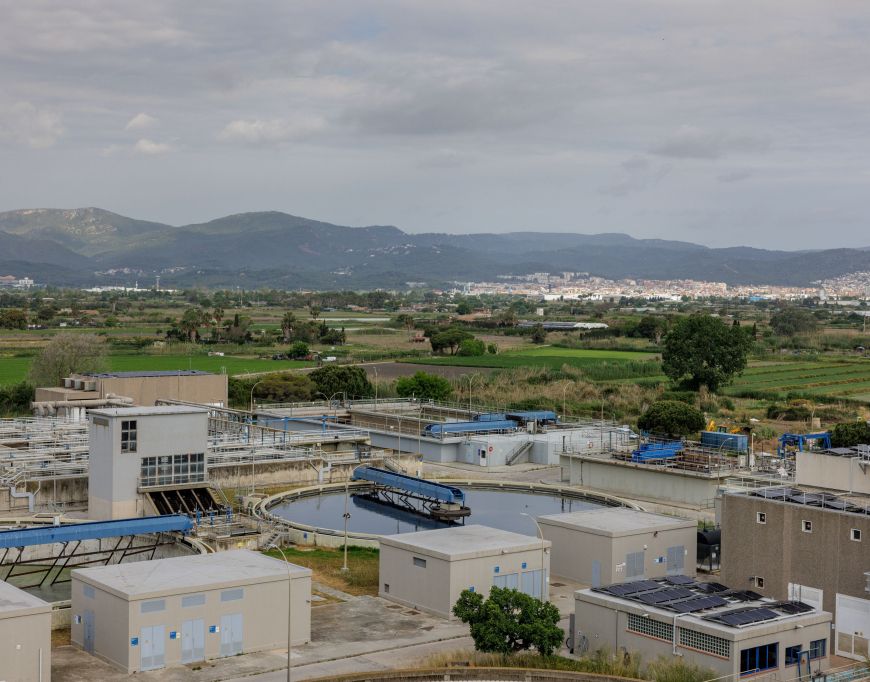
During 2026, actions have been promoted to valorize waste and transform it into biogas, with the aim of increasing the self-sufficiency of the treatment plants. Regarding N₂O, the development at the Vallvidrera treatment plant of an intelligent control model integrated into the plant's operations to mitigate these emissions stands out. This model is being evaluated for future replication in other facilities.
In the scope of the value chain, the company promotes indirect decarbonization through the Climate Action Hub, active since 2021 to energize the supplier ecosystem, and the inclusion of sustainability criteria in tenders. Among the milestones achieved in 2026, it stands out that 98% of the liquid CO₂ acquired for water treatment in drinking water plants is of renewable biogenic origin. Likewise, the analysis of emissions derived from works has made it possible to identify the materials with the greatest impact, such as concrete and steel, and to incorporate specific environmental clauses to reduce their footprint in future actions.
The systematic reduction of emissions from operational processes directly links with the need to transform the management of treatment waste and allows taking the definitive step towards valorization within a circular economy model.
Circular economy and energy sovereignty: from wastewater treatment plants to ecofactories
The transition from the traditional linear model to a circular approach constitutes a structural axis of the company's strategy. Through reuse, waste reduction, and systematic valorization of by-products, wastewater treatment plants are transformed into ecofactories capable of generating resources and promoting the energy sovereignty of the metropolitan area.
An example of this circular management was achieved in 2025 with the full valorization of more than 230,000 tons of sludge generated in the wastewater treatment plants managed by Aigües de Barcelona. These resources were mainly channeled towards composting (70%) and agricultural and gardening use (28%). The remaining fraction was treated through external anaerobic digestion —a process in which microorganisms decompose organic matter in the absence of oxygen to generate biogas— and thermal drying. These practices allowed saving the emission of more than 13,500 tons of CO₂ into the atmosphere. In addition, in the case of treatment sands —the second largest waste by volume—, more than 70% valorization has been achieved, and the inorganic fraction has been transformed into usable aggregates.
To consolidate this model, the company deploys key infrastructure actions, such as the sludge platform at the Baix Llobregat wastewater treatment plant, a new reception and rehydration facility where works have been completed. From 2027, the platform will treat more than 40,000 tons of sludge per year from the Besòs wastewater treatment plant, which will allow a 50% increase in biogas production at the Baix Llobregat plant. In Montcada i Reixac, an anaerobic digestion system is being built that will be able to produce up to 3.2 million m³ of biogas. This facility will reduce the volume of sludge to be managed and will provide the plant with 60% energy self-sufficiency, which will avoid the emission of more than 7,600 tons of CO₂.
Solar energy is added to this model. At the beginning of 2026, the photovoltaic installation of the Gavà-Viladecans wastewater treatment plant was put into operation. In addition, Aigües de Barcelona has been awarded four grants requested in the second call for competitive aid from the Institute for the Diversification and Saving of Energy (IDAE), within the framework of the Program of Incentives for Innovative Projects of Renewable Energies, Storage and Renewable Thermal Systems, financed by the European Union through the NextGenerationEU funds.
Four photovoltaic projects with storage will be promoted at the wastewater treatment plants of Baix Llobregat, Besòs, Montcada and Sant Feliu.
These grants will contribute to promoting four photovoltaic projects with storage at the wastewater treatment plants of Baix Llobregat, Besòs, Montcada and Sant Feliu, which will add close to 5 MWp of power and produce more than 7.2 GWh annually. With these installations and biogas production actions, the company expects to achieve 73% energy self-sufficiency by 2030.
The company expects to achieve 73% energy self-sufficiency by 2030.
Adaptation infrastructures: diversification of resources and water independence
Aigües de Barcelona is carrying out various actions, included in the Catalan government's drought plan, aimed at taking advantage of all available water resources and increasing the resilience of the infrastructures of the integral water cycle. In coordination with the administration, the company promotes the transformation of the Besòs river basin to optimize the use of its resources.

In this sense, the company is finalizing the expansion works of the Besòs drinking water treatment plant, with the aim of increasing drinking water production up to a treatment capacity of 1,000 l/s. These actions constitute the first phase of a plan to decouple the metropolitan supply from the rainfall regime, by incorporating regenerated water as a strategic resource.
The company is finalizing the expansion works of the Besòs drinking water treatment plant, with the aim of increasing drinking water production.
Protection and integration of local biodiversity: nature as a strategic ally
Biodiversity conservation has consolidated as a transversal and central pillar in water management. Beyond responding to a corporate commitment to environmental responsibility, the preservation of ecosystems is understood as a direct application of Nature-based Solutions (NbS) to the very engineering and operational resilience of the facilities.
Biodiversity conservation has consolidated as a transversal and central pillar in water management.
During 2026, the company has deployed its Biodiversity Plan, which establishes a common framework for action to protect the natural environments where it operates. The plan promotes the use of native plants, the fight against invasive species, the creation of refuges for fauna, and the integration of biodiversity criteria in the design of new facilities.
A firm commitment to the metropolitan future
Tackling climate change requires progress on many fronts at once. Decarbonizing, reusing, generating renewable energy, and protecting water and nature are part of the same response. With these actions, Aigües de Barcelona consolidates itself as an indispensable transformation agent to lead the ecological transition in the metropolitan area.
Add The New Barcelona Post as your preferred Google source for free
Stay informed with the latest news.