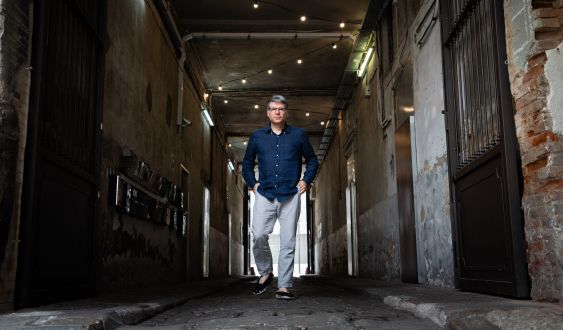
He has been at a table in the bar all morning, drawing and writing in a large notebook, pausing in the composition of images and text only to look around and imbue his inspiration with the faces, voices, and colors of the surroundings. Half-eaten, a croissant and a now lukewarm coffee with milk. And, in the background, the notes of Sugar Magnolia by Grateful Dead overlapping with the ambient noises. Now he has stopped drawing and closed his notebook. Agustín Comotto is ready to chat.
"All my life I have tried to think for myself, so that others don't think for me," begins this Buenos Aires native, settled in Barcelona since 1999, who uses image and word to earn a living and express himself. His childhood took place in an environment very sensitive to culture and politics. "My father was a militant of the Revolutionary Workers' Party, so we fled Videla's dictatorship in 1976 and settled in Madrid until 1982." In his house there was not only politics, but a lot of culture: "books, comics and a lot of music, from Hendrix to Charlie Parker."
In that environment he learned a fundamental lesson: "culture is the antidote to the era we have had to live in, it is the antidote against dictators and influencers. It is the tool that saves us from alienation, from feeling crazy in a crazy world. The one that allows us to seek beauty and, when we find it, to be aware that we have found it."
At the age of ten, hepatitis confined him to bed for two months. They were decisive in feeding his vocation, "not so much to draw, but to tell stories through drawing." During that convalescence, Agustín received many comics —"Franco-Belgian line and, very importantly, Hugo Pratt"— and materials for drawing: "pencils, colors and India ink." From then on, there was no turning back. There was all the beauty: the one he sought and the one he knew he would be able to create.
Life of a cartoonist
Agustín Comotto did not pursue formal studies, but rather worked as an apprentice and became entirely self-taught. "I studied with Leopoldo Durañona and learned many things from Alberto Breccia and his son, Enrique." In the late 80s, he began publishing in the magazine Fierro and started the life he had always sought: that of a storyteller through drawing and words, publishing in various countries and receiving various recognitions and awards such as the "A la orilla del viento" prize, granted by the Fondo de Cultura Económica de México, for his book Siete millones de escarabajos.
"27 years ago I came to Barcelona because the publishers that interested me were here." His first years in the city focused on children's illustration, working for publishers like La Galera, "but this market changed and transformed into something I don't like, so in 2010 I decided to return to adult comics." For the next six years, he worked on the graphic novel 155, a biography of the Argentine anarchist Simón Radowitzky, published with notable international success.

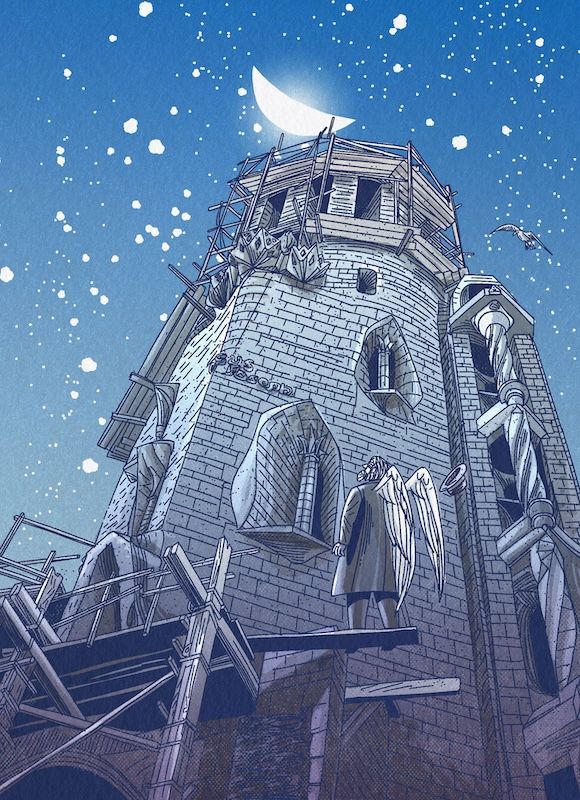
Since then, the local has not stopped. He has published El peso de las estrellas, about the life of the anarchist Octavio Alberola; graphic novel biographies of Antonio Nebrija, Lenin or Joan Salvat-Papasseit; the comic Stein (stone), in which he narrates his family's story, or the illustration of books like Exilio, by Clara Obligado. Scripted by Salva Rubio, and halfway between a comic and an illustrated biography, his new work, Gaudí, la Sagrada Família i l'èxtasi (Comanegra), immerses the reader in a journey through the life, dreams, and aspirations of the genius who revolutionized architecture. The mystical hermit who defined that Catalan Modernisme that transformed the essence and form of Barcelona, largely defining its beauty.
Sold City
After more than a quarter century in Barcelona, the artist confesses that he now experiences it from its margins: "I live in Corbera, and that allows me not to have to endure the pressure of thousands of tourists spat out every day of the high season from the unsustainably numerous cruise ship docking points."
This is how he sees this city, "extraordinary, home to beautiful libraries and bookstores, and dotted with a unique history, marked by anarchism and workers' revolts, but which now the powers have sold and turned into a store." He sips the last drop of the already cold café con leche and finishes the last piece of croissant, before concluding: "they have dehumanized it," which is the same as lamenting that its beauty has been snatched away.
—What they cannot dehumanize or sell to tourists is this bar. Here we cook homemade food at prices in line with the local salary range…
Agustín Comotto catches the hint. Noia de porcellana, by Pau Riba, plays, while the artist announces, with a wide smile: "I'm quite versatile and I like to eat well, so I think I'll opt for a good esmorzar de forquilla!".
—Good choice!
Add The New Barcelona Post as your preferred Google source for free
Stay informed with the latest news.