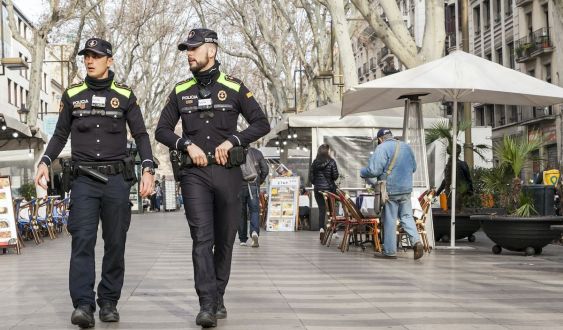
How many eyes does a mother or father need to watch over a newborn? How are accidents avoided? How long does it take to resolve an incident? And another important question: Who takes care of the caregivers? Couples with young children are experts in emergency management and in setting priorities when several events occur at the same time. But who takes care of us when we grow up and become just another human being walking or driving through the big city? Who takes care of us in the impersonal and hyperactive city of the 21st century? Where does the spirit of protection and the attention we all need when something happens to us go?
A more human city is possible thanks to the new tools that technology provides us. Specifically, 5G networks can help services like the Urban Guard, whose agents become our guardian angels when fate crosses our path. The new mobile phone technology helps prevent critical situations, facilitating the rapid intervention of emergency teams. In addition, it allows access to multiple sources of information to optimize and speed up decision-making in situations where the time factor and access to all relevant data are decisive in minimizing damage.
The new mobile phone technology helps prevent critical situations, facilitating the rapid intervention of emergency teamsThe 5G Catalunya pilot has anticipated the future with a use case, led by Cellnex TelecomandNearby Computingon technologyLenovo, in which the Barcelona Urban Guard, the Municipal Institute of Informatics of the Barcelona City Council, and variousstartupsfinal application providers. The demonstration, which took place at the confluence of Diagonal Avenue and Pere IV and Lope de Vega streets in Barcelona, in the Poblenou neighborhood, allowed experiencing different advances at the same time:
- Real-time vision
- Real-time alert management
Thanks to automated video analytics, cameras can also detect emergencies and generate alerts
- Improved communication between security forces
- Monitoring of agents' physical condition
The collected data allows knowing the agent's physical activity status and detecting, for example, when this person is running or is in a stressful situation
- Extension of information to involved vehicles
The use case has made it possible to verify the operation of 5G Stand Alone (end-to-end) and Open Ran (with open standard) networks in a complex fabric of devices and applications that will allow, thanks to the characteristics offered by this new technology of wide bandwidth and real time, to improve emergency and traffic management and monitor the safety of agents in the exercise of their work. Technology at the service of a city that protects and cares, as all of us who live in it need.
Seven use cases in Barcelona
The 5G Catalunya Pilot, co-financed by FEDER funds and awarded by Red.es, has been developed by a consortium of eight companies led by Cellnex Telecom and the MASMOVIL Group, in which Lenovo, Parlem Telecom, Nearby Computing, Aumenta Solutions, Atos and Nae have also participated. It has developed seven use cases in the city of Barcelona aimed at developing solutions in the environment of urban mobility, remote education, the industrial sector, distance shopping, audiovisual transmission, security and emergency management in the urban environment, and the construction of a neutral multi-operator network aimed at offering connectivity in areas with high seasonal occupation.
At the last Mobile World Congress (MWC), the 5G Catalunya project has received has received the GSMA Foundry Excellence Award, a foundation dedicated to solving the most pressing challenges of connected technology and focused on the creation of next-generation services and infrastructures, including 5G monetization, digital transformation and operational efficiency. "I am very pleased that the 5G Catalunya project has been recognized with the GSMA Foundry Excellence Award. This consortium has developed seven remarkable use cases that show the benefits of 5G technology in real life and how it can be used in everyday life. With this high-impact initiative, they have demonstrated outstanding innovation and achievements," said Richard Cockle, director of the GSMA Foundry.
Add The New Barcelona Post as your preferred Google source for free
Stay informed with the latest news.
