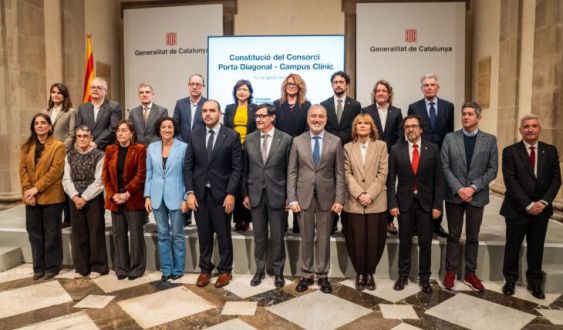
With the purchase for 135 million euros of the University of Barcelona's land at the entrance of Diagonal, the Generalitat activates the countdown for the future Campus de Salut Clínic – UB, one of the largest healthcare, urban, and knowledge operations of the next decade. The project, which foresees an international architecture competition in 2026 and a global investment of 1.7 billion euros, aims to transform this metropolitan area into a new European biomedical hub with a horizon of 2035.
The decisive step has been formalized with the constitution of the Porta Diagonal – Campus Clínic Consortium, the body that will assume the governance and coordination of the project, in which the Generalitat de Catalunya, the Consorci Hospital Clínic de Barcelona, the University of Barcelona, CatSalut, the Diputació de Barcelona, the Barcelona Metropolitan Area, and the city councils of Barcelona, L'Hospitalet de Llobregat, and Esplugues de Llobregat participate.
A new generation campus at the city's entrance
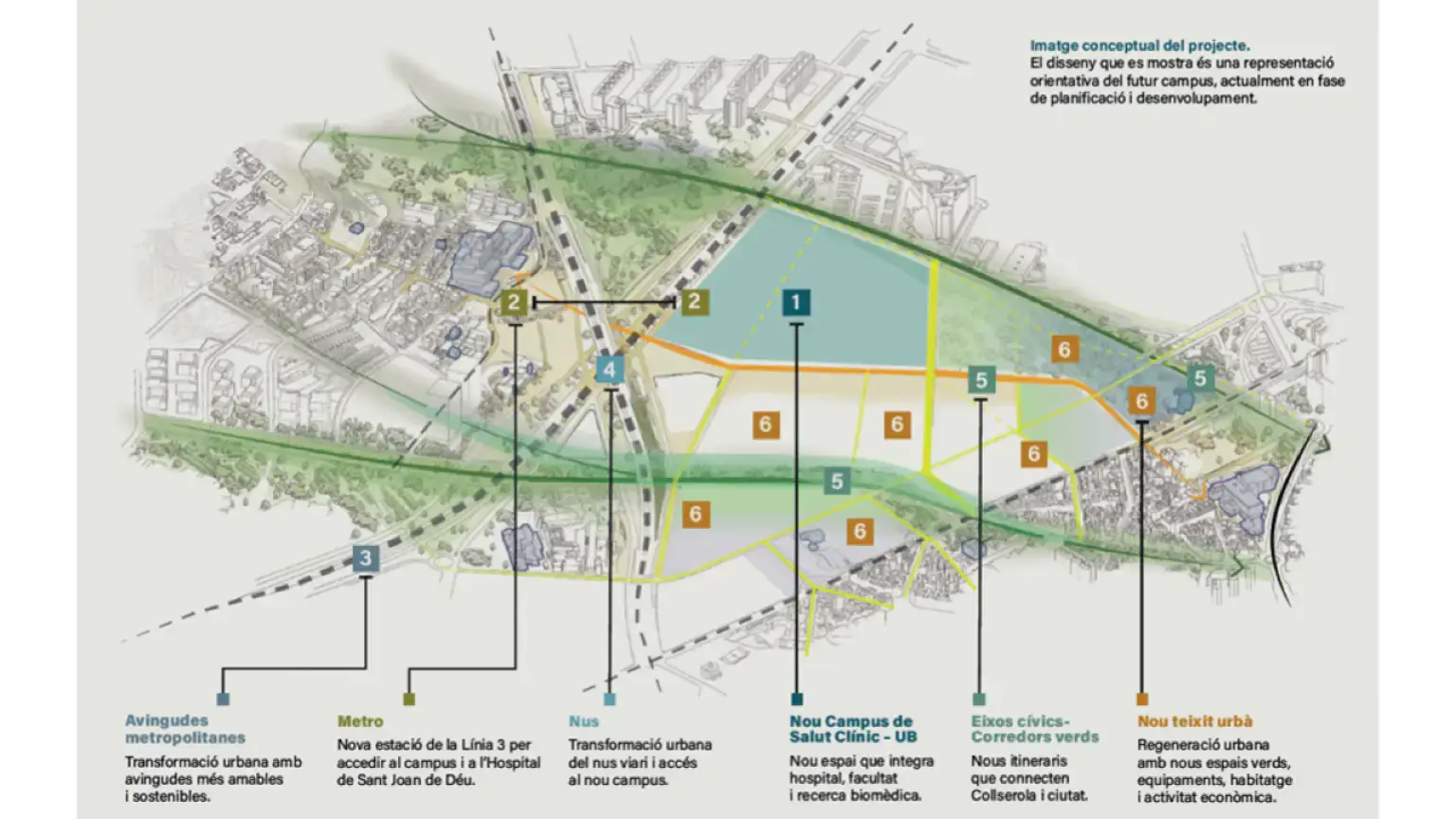
The future campus will be located on the current UB sports grounds on Avenida Diagonal, 695-797, an entrance to Barcelona that will be radically transformed. Although the physical area occupies about 10 hectares, the buildable area will reach 300,000 square meters, where the new hospital —oriented to the most complex tertiary activity—, the Faculty of Medicine and Health Sciences, and various healthcare, university, and research facilities will be concentrated.
The UB will maintain sports activities on these grounds until 2030, when construction is scheduled to begin. In parallel, the Government will grant a direct subsidy of up to 17.5 million euros to partially finance the new Faculty of Pharmacy, a project valued at more than 150 million that will be located outside the premises but very close to the future campus.
Global architecture for a global project
One of the key elements of the calendar is the advancement of the international architecture competition, which will be called in July 2026, coinciding with the year Barcelona will be World Capital of Architecture. The process aims to attract top-level multidisciplinary teams to design a state-of-the-art hospital and university complex, capable of integrating sustainability, technology, energy efficiency, and a new way of understanding the healthcare experience.
The winner of the contest, which will be decided in 2028 after several elimination phases, will assume a contract of about 109 million euros for the development of the architectural project.
City, health and knowledge economy
The Clínic Campus is not only a healthcare project, but an urban and economic transformation operation. The Urban Master Plan (PDU), which must be drafted and processed between 2026 and 2027, will organize a total area of 70 hectares, including the campus and its surroundings. The objective is to create a mixed urban environment, with housing, facilities, green spaces and economic activity linked to life sciences.
This new hub aims to reinforce the Diagonal Health Axis and connect it with the Bellvitge biocluster and other strategic nodes such as Sant Joan de Déu, the Barcelona Science Park or the Barcelona Supercomputing Center. The aim is to consolidate an innovation ecosystem capable of attracting talent, investment and companies in one of the sectors with the greatest growth projection at a European scale.
Metro, accessibility and horizon 2035
Connectivity will be one of the determining factors of the project. The campus will have a new Line 3 metro station, as part of the extension from Zona Universitaria to Esplugues Centre. The metro works, with an estimated investment of about 500 million euros, are expected to begin in 2028 and end in 2033, so that the station will come into service coinciding with the commissioning of the campus.
"The new Campus de Salut Clínic is expected to open in 2035"
The overall calendar points to the start of the main works in 2030 and the inauguration of the new Campus de Salut Clínic – UB in 2035. Until then, the Hospital Clínic on Villarroel street will continue to adapt progressively, maintaining healthcare activity and redefining its role within the metropolitan healthcare system.
A project with economic and institutional return
With a total planned investment of 1,700 million euros over the next decade, the future Clínic Campus is presented as a structural commitment for the country. The Government defends that every euro invested will return in the form of better healthcare, excellent research, technology transfer and high value-added economic activity.
Add The New Barcelona Post as your preferred Google source for free
Stay informed with the latest news.
