[dropcap letter="H"]
Just five years ago, almost no one had heard of Real Estate Investment Trusts, or SOCIMIs. Today they are the queens of the resurging real estate sector in Spain, with billions in assets and almost the exclusive right to make significant investments in a business that until recently was synonymous with ostracism and bankruptcy. Their weight has become so great that SOCIMIs have also managed to sneak into negotiations between the Spanish Government and Podemos to push through the 2019 General State Budgets. The purple party is asking for a change in the tax regime of these investment companies – now exempt from paying corporate tax – which it also accuses of playing a leading role in the rise of rental prices. But why have they become the crown jewels of the real estate market in such a short time?
In 2013 the scenario changed, the real estate sector had already hit rock bottom, banks had cleaned up thanks to the 60,000 million euros of the bailout, and the most toxic assets had already gone to Sareb or the bad bank. With this basis, the new government of the popular Mariano Rajoy decided to give SOCIMIs a new opportunity.Let's go back to 2009. The Spanish economy is immersed in one of the worst crises in recent history and its real estate sector, until recently the owner of the 'Spanish miracle', is taking on water. The then President of the Government, José Luis Rodríguez Zapatero, pushes forward a law to create a local version of what is known worldwide as REITs, (Real Estate Investment Trust), created in the United States as financial vehicles to channel real estate investment through publicly traded companies. The business is simple: invest in real estate assets, from offices, industrial warehouses, hotels, or homes, and manage them under a rental regime.
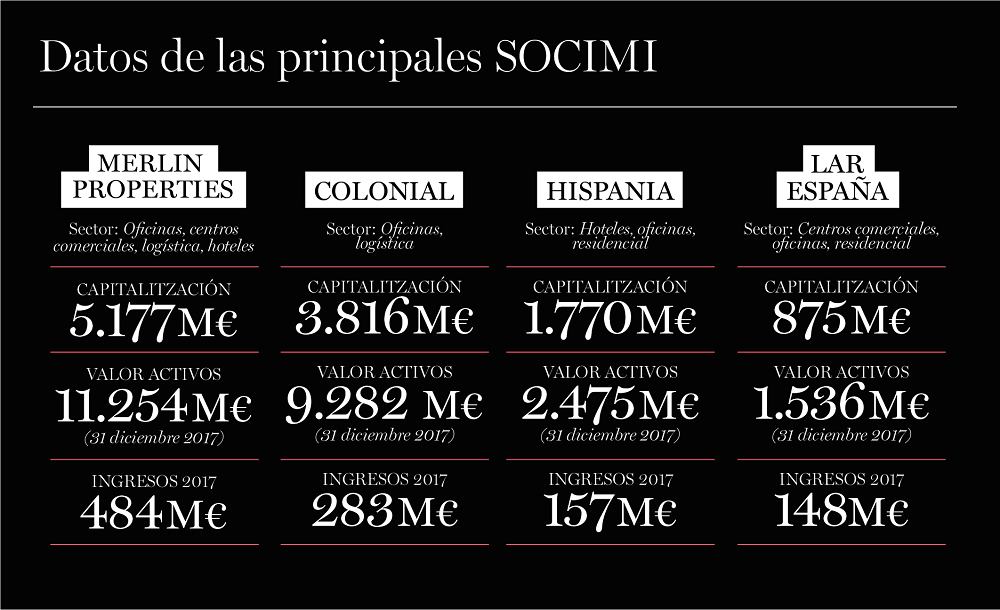
The invention, however, does not quite take hold. The real estate sector is too weakened to generate business, and the only ones daring to step in at this moment are vulture funds. Furthermore, going public amidst global financial chaos does not seem like the best option either. But in 2013, the scenario changed, the real estate sector had already hit rock bottom, banks had cleaned up thanks to the 60 billion euros from the bailout, and the most toxic assets had already gone to Sareb or the bad bank. With this foundation, the new government of the popular Mariano Rajoy decided to give SOCIMIs a new opportunity. It relaxed the requirements and established the tax treatment that is now in question, to incentivize investors to enter the game. And it worked. Boy, did it work. Five years later, the four main SOCIMIs –Merlin, Colonial, Hispania, and Lar España– accumulated more than 27 billion in assets in the market.
The sector argues that the main value of SOCIMIs is precisely that they bring transparency to the rental business and that these large owners invest in maintaining properties in optimal conditions to prevent them from losing value.For the director of Advisory Services of the Gesvalt consultancy, Sergio Espadero, the rapid growth of these companies is explained by what they have been able to contribute as a boost to the Spanish real estate market: "they have brought professionalism, dynamism, transparency to the sector and an increase in investment volume. On the other hand, they cover a current need in the Spanish real estate market, which is the professionalized management of housing for rent." In this sense, for Espadero, it is out of place to think that SOCIMIs contribute to the rise in rental prices since the approximately 20,000 homes they have in their portfolio represent, he argues, less than 5% of the total rental stock. In fact, the sector defends that the main value of SOCIMIs is precisely that they bring transparency to the rental business and that these large owners invest in keeping the flats in optimal conditions to prevent them from losing value. A step that individual owners who put their flats on the rental market do not always do or can do.
[separator type="thin"]
THE BET TO GET OUT OF THE HOLE
In 2013, the Rajoy Government approved changes to some of the main requirements of the SOCIMI regime approved a few years earlier by Zapatero's socialist government. It lowered the minimum amount to launch this type of company from 15 to 5 million euros, and allowed them to list on the Alternative Stock Market (MAB), where information requirements are less strict than in the continuous market and where the costs to start trading are also lower. The minimum number of years to maintain the investment was also reduced to three (it was five before) and the exemption from paying Corporate Tax was established (although shareholders do pay tax on the dividends obtained), and a 95% bonus was approved for taxes derived from the purchase and sale of real estate (the Documented Legal Acts Tax and the Property Transfer Tax). It was a way to make the real estate market attractive again for foreign investors, the bet to get out of the hole.
[separator type="thin"]
And SOCIMIs go far beyond the residential market. Today there are about forty such companies listed on the Spanish stock exchange, most of them through the MAB, the Alternative Stock Market (where they account for almost half of the market's capitalization). A significant portion of the investors behind these SOCIMIs are international funds (close to 50%), capital that was attracted to the Spanish real estate market by the conditions approved for SOCIMIs, but which would have looked at any other market if it had not been so. At least that is what Merlin's CEO (the queen of SOCIMIs), Ismael Clemente, recently explained at a real estate forum. The executive recalled that these companies "have brought 20,000 million euros of capital," pointing out that if the Spanish real estate sector has been able to raise its head, it has been thanks to this impetus.
The truth is that SOCIMIs have institutional and professional investors behind them interested in juicy dividends (SOCIMIs are obliged by law to pay their shareholders annually), but unlike the operation of vulture funds, here the business is not based on buying cheap hoping to sell later more expensive. Here what counts is the profit extracted from the sustained exploitation of assets under a rental regime.
The new queens of the real estate sector also do not much resemble those giants with feet of clay from the boom years like Martinsa Fadesa, Astroc, or Habitat, and are very, very far from El Pocero's Seseña. Espadero explains that SOCIMIs "provide transparency and traceability in management" and beyond tax advantages, their success, he highlights, is also due to the advantages they offer their shareholders: "Real estate assets are transposed into listed shares of a vehicle that allows for total or partial liquidity of an asset, without the need to make a global investment or divestment." That is why Espadero is convinced that SOCIMIs "have come to stay and to be the great protagonists of the Spanish real estate market."
According to the consultancy Gesvalt, 70.52% of the assets in the portfolio of Spanish SOCIMIs are concentrated in the residential sector, although if calculated by the value of the assets, housing does not reach 50% of the total. Shopping centers, offices, industrial and logistics warehouses, commercial premises... The list of investment profiles that complete the asset portfolio is very varied, and although for now a single SOCIMI can have interests in different sectors, analysts expect that in the coming years the trend will be towards concentration and specialization. But on this path towards consolidation, the sector is closely watching the pressures to change the tax regime of SOCIMIs. For Espadero, if an agreement is finally reached to eliminate tax advantages, the price to pay would be very high: "This will definitely affect Spain's credibility again, because international funds were invited to enter Spain with a REIT format, standardized in other countries, and if there were now an alteration of the tax regime, the country would be called into question for the reliability of its fiscal and legal decisions," he emphasizes.