Last year the number of European patent applications initiated in Spain grew by 7.4% to a total of 1,676, according to data from the European Patent Office (EPO). Spain was one of the countries with the largest increase and almost doubled the global increase in activity registered compared to 2016 (3.9%). But despite this improvement, the EPO's annual report also shows that the country continues to be at the bottom of Europe in this activity, far below countries like Sweden, Holland or Denmark, and that the 1,676 files initiated here represented only 1% of the nearly 166,000 registered at the EPO, and originated both in European countries and the rest of the world.
But also in Spain there are locomotives and tail cars. Catalonia, followed by Madrid and the Basque Country, are the territories that registered the most European patent applications, together accounting for more than 65% of the activity. This is a concentration that is repeated, to a greater or lesser extent, year after year. In fact, Catalonia alone was responsible for 37.6% of the total patents (with a volume of 633 applications and an increase of 15.7% compared to 2016). The explanation for this concentration is closely related to the significant weight that industry has in these territories, since it is precisely the need of these factories to export their products that has accompanied the patent application. That is why it is not strange that the USA, Germany and Japan are the countries of origin that lead the EPO ranking. The three together accounted for more than 50% of the total.
If the picture is broadened to global patent applications, and according to data from the Spanish Patent and Trademark Office (OEPM), during 2017 Spain registered 1,407 files via PCT (the international system), which represents less than 1% of the total. In addition, this figure was lower than in 2016 (6.44% less). A possible explanation for this decrease is that companies focused mainly on European patents, which is where the vast majority of Spanish exports are concentrated.
The number of national patents also fell, that is, those that are only valid to protect a certain invention in Spanish territory. According to the OEPM, it went from 2,849 in 2016 to 2,286 in 2017, a 20% decrease. This decline is partly explained by the change in Spanish law, which restricted their application. Previously, the procedure for granting did not provide for an examination of the innovation that the invention actually contributed, but rather it was granted by default. With the regulatory change, which came into force in April of last year, Spain took a definitive step to adapt its legislation to the conditions and requirements prevailing in most advanced countries. And incidentally, it made many applicants now opt directly for a European patent.
But beyond the global data on files, other conclusions can be drawn from the OEPM statistics. One of the most obvious is that patenting, in Spain, is a matter for a few, and this concentration also explains why the figures do not quite take off to assimilate more to the volume of other countries in the environment. It is enough to look at the list of institutions, universities and companies that lead the statistics, year after year, of the Spanish Patent Office. The Higher Council for Scientific Research (CSIC), Seat, BSH Electrodomésticos España, Airbus, Laboratorios del Dr. Esteban, Repsol, Fundación Tecnalia, and polytechnic universities such as those of Valencia, Catalonia or Madrid, are always at the forefront of the lists and their names are repeated again and again.
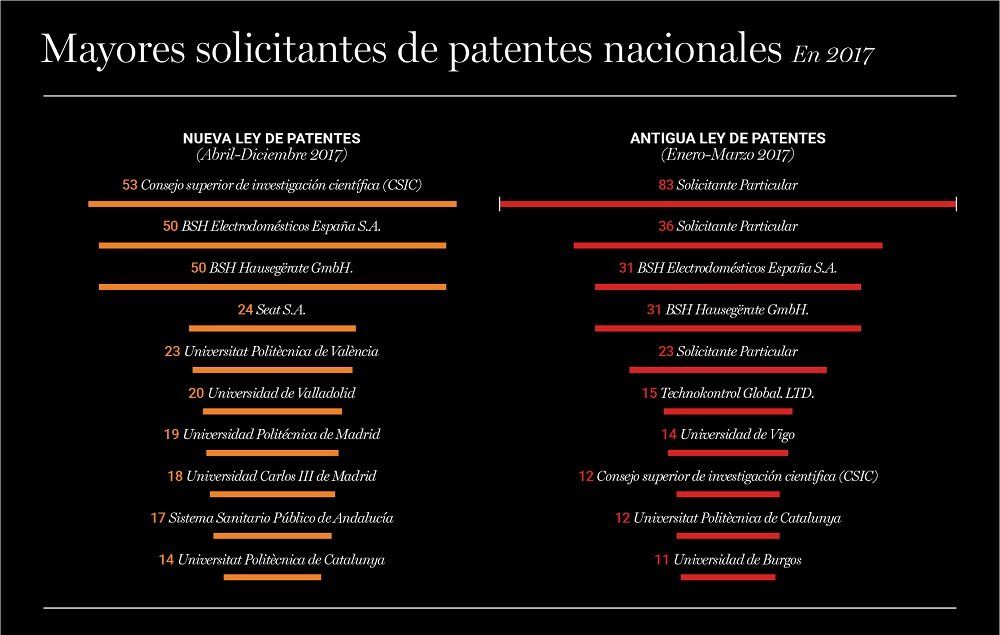
By applicant profiles, companies still do not exceed 50% of applications (they remain at 43.6% of the total) while universities account for 16%, the CSIC and public bodies close to 4%, and the rest (36.7%) remains in the hands of individuals. As for companies, and as is the case with those that export regularly, the group of names that is repeated in the OEPM statistics each year is rather small. And this also explains why it is difficult to improve Spain's position in the global innovation ranking.
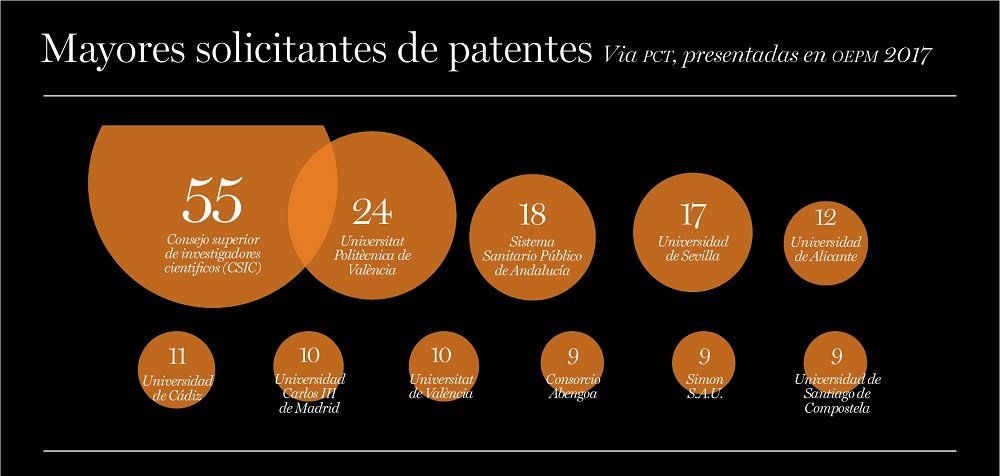
Another interesting element of analysis is that if one focuses only on international patents requested before the OEPM, the ranking is led almost exclusively by universities and public institutions. Here, companies are relegated to a much smaller presence. The data tells us in some way that multinationals present in Spain do their major research in other countries and that what is done here is much more focused on the local market, or at most on the European market.
We now focus the analysis on Catalonia. According to a recent study by the Generalitat, the number of innovative companies in Catalonia has remained quite stable in recent years. In the 2014-2016 period, the Catalan government counted 7,933, almost the same as in the period between 2013 and 2015 (7,901) and relatively similar to those registered in 2010-2012 (7,318). This is regarding non-technology-based companies. In this case, the number of companies with a high innovation component remains more or less stable at around 4,000 in the different periods since 2010. According to the same data from the Generalitat, Catalonia leads the positioning within Spain, with a weight of around 22% of the total business fabric, ahead of Madrid (18%).
Regarding other European countries, according to this report, Catalonia is in twelfth position with respect to the weight of the workforce dedicated to R&D&I activities, with 1.46% of the total number of workers. The average for the European Union is 1.34%. And as for the number of patent applications, the Catalan Government's report emphasizes precisely the fact that the number of applications to protect innovations with international patents is growing more and more, while the volume of national patents is decreasing. Thus, while European patents have grown by 30% between 2014 and 2017, those limited to Spanish territory have decreased by 31.6%.
Given the data, it seems easy to be at least moderately optimistic and think that innovation is moving in the right direction. But at the same time, a certain caution also prevails because different statistics tell us that the speed is still slow and that Spain—despite the good performance of territories like Catalonia, Madrid, or the Basque Country—still has a long way to go. The strong concentration in a few innovation-generating actors also highlights that R&D&i activity is not sufficiently widespread in the business fabric. It is to be assumed that the increase in exports accompanies a greater need to patent. But for the moment, it can still be said that in Spain, inventing is a matter for a few.