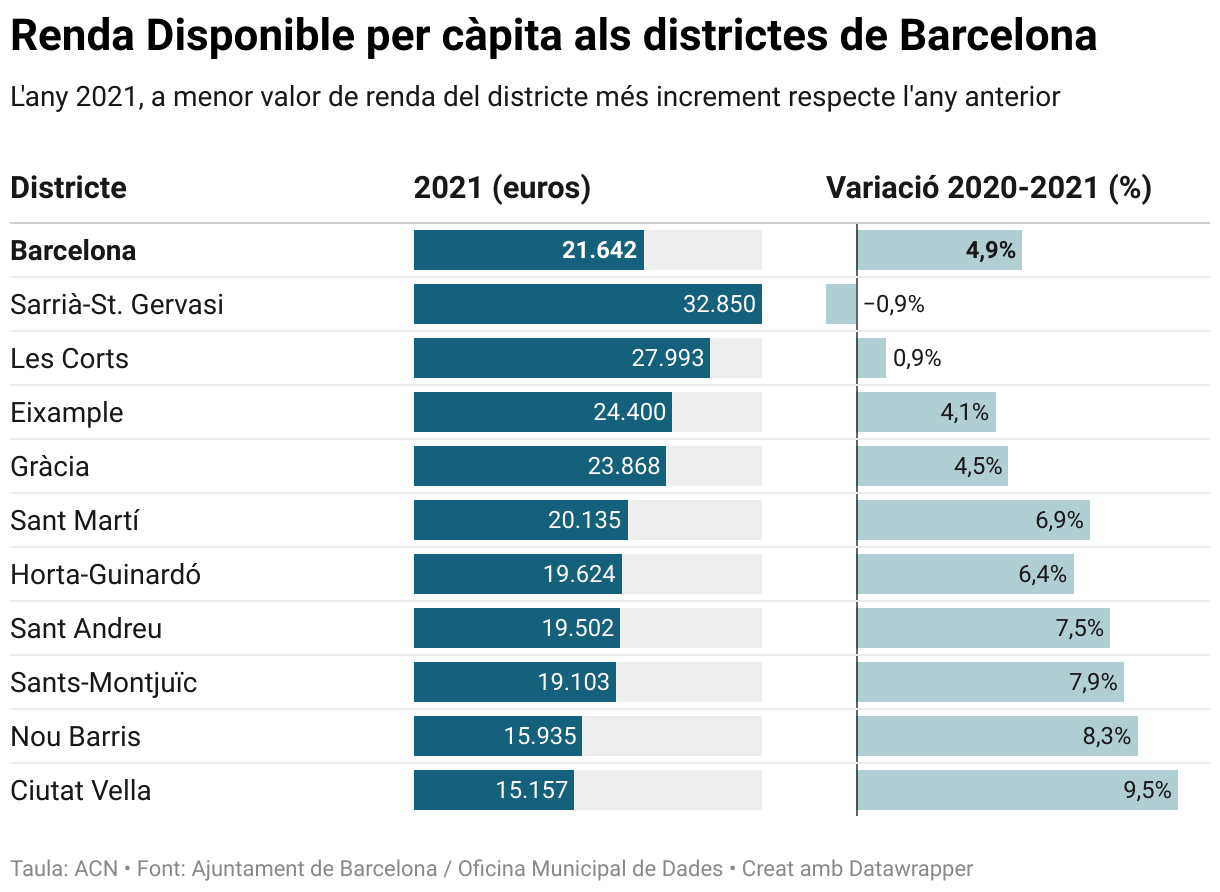
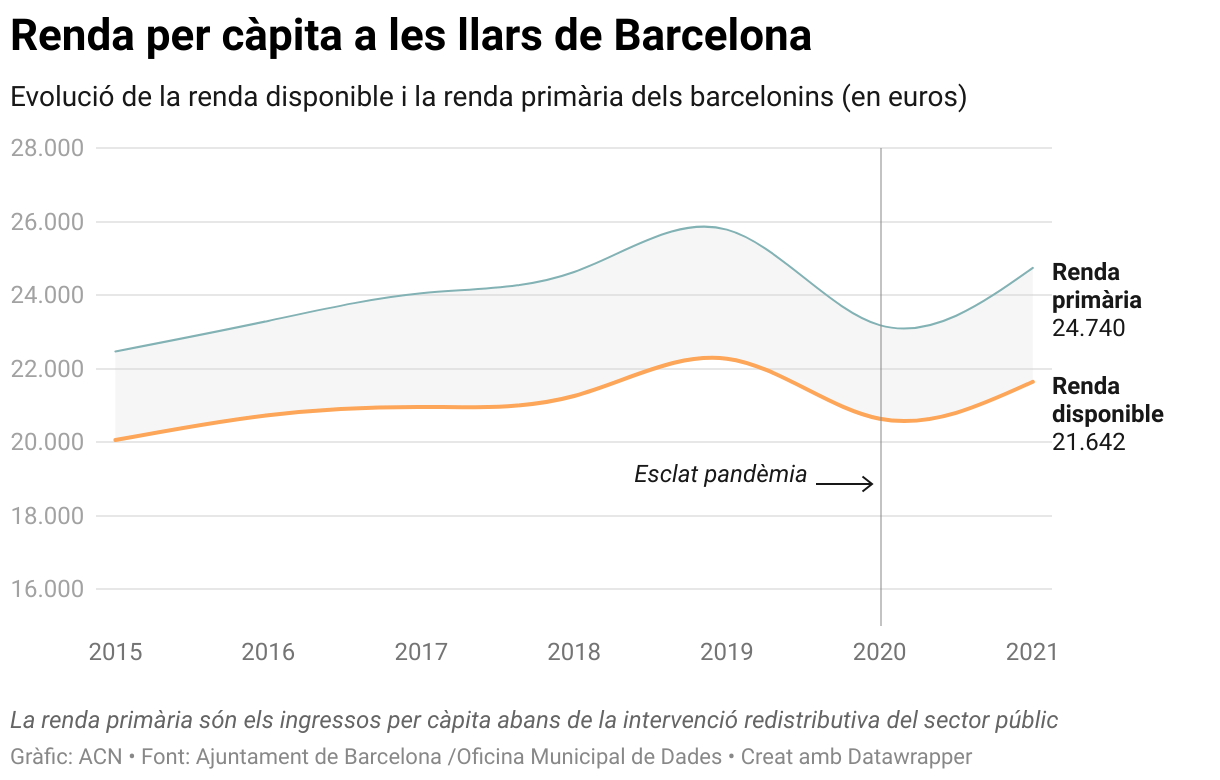
The disposable income per capita of Barcelona households increased by 4.8% in 2021 and partially recovered from the previous year's slump due to the pandemic. This is according to the annual report from the Municipal Data Office published by the City Council. The indicator stood at 21,642 euros, 18% more than the Catalan value. The increase was notable in all districts, except in Sarrià-Sant Gervasi, where it decreased by 0.9%. The most significant increases were recorded in areas with lower purchasing power, such as Ciutat Vella (9.5%) or Horta-Guinardó (6.4%). According to the council, this trend is the result of an increase in wages among the lowest levels, which in turn allowed for a reduction in inequalities between districts and neighborhoods.
The report from the Analysis Department of the Municipal Data Office of the Barcelona City Council has shown that in 2021, household income per capita (RDLpc) increased by 4.8% compared to 2020. "The data confirms that after the shock of the pandemic in 2020, there has been some recovery in household income," said Jordi Valls, Deputy Mayor for Economy, Finance, Economic Promotion, and Tourism. In this regard, an improvement has been detected in all districts except Sarrià-Sant Gervasi. These results contrast with those of 2020, when the indicator decreased by an average of 7.1% across the city compared to 2019, reports ACN.
Valls assured that this positive trend is related "to salary improvement for the lowest levels," which from his point of view is "good news that helped reduce existing differences between districts and neighborhoods." In fact, the report indicated that areas with an income below the average had higher growth rates. These were 9.5% in Ciutat Vella and 6.4% in Horta-Guinardó. Conversely, districts with higher incomes recorded lower increases. For example, Gràcia registered an increase of 4.5% and Sarrià-Sant Gervasi experienced a 0.9% reduction in income. Nevertheless, the district with the highest income level continues to be Sarrià-Sant Gervasi, which with 32,850 euros exceeded Barcelona's average value by 52%. In contrast, the district with the lowest per capita income is Ciutat Vella (15,157 euros).
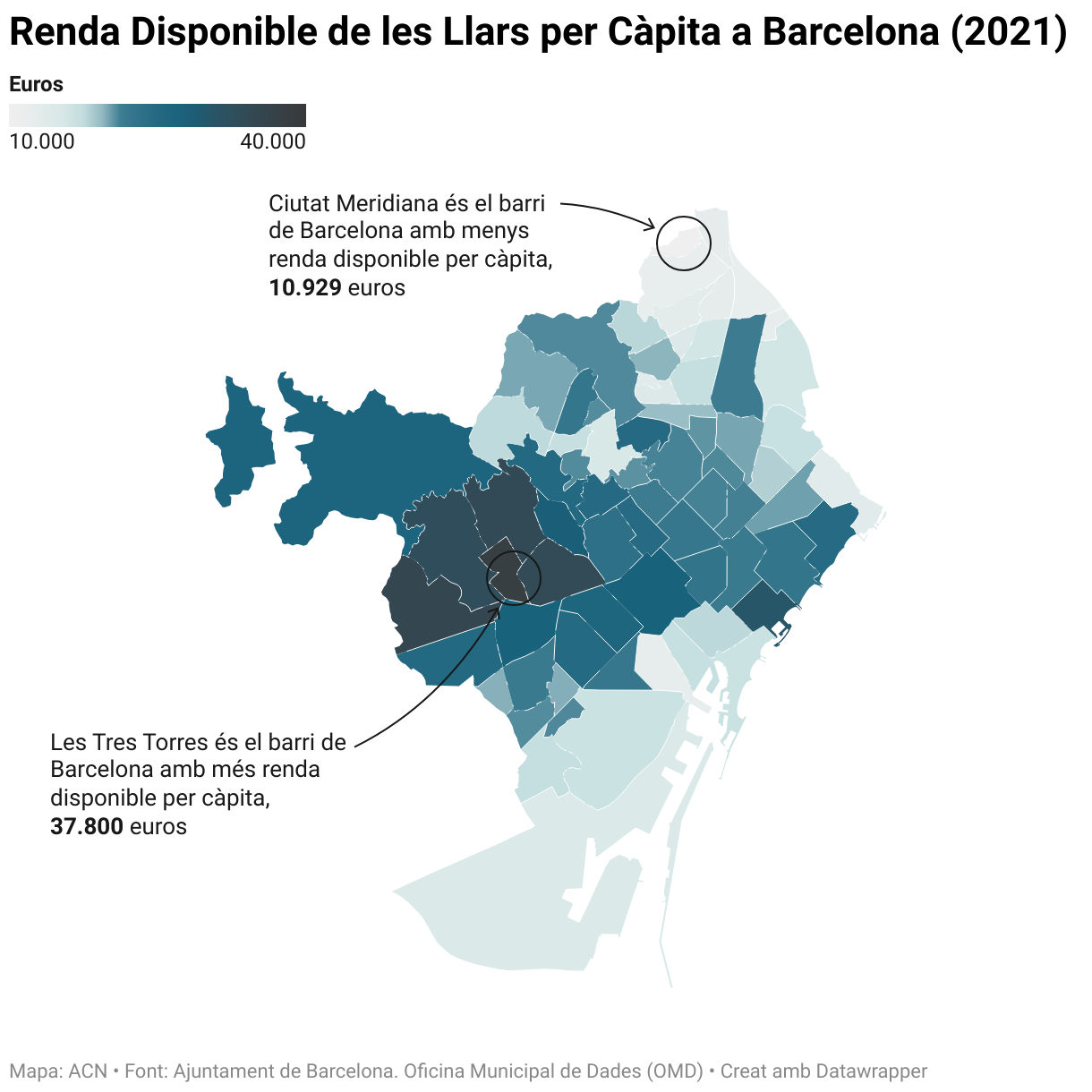
On the other hand, although the income level in Les Tres Torres, the area with the highest purchasing power (37,800 euros), was three and a half times that of the neighborhood with the lowest per capita income, which was Ciutat Meridiana (10,929 euros), this differential was much smaller in 2021 than in previous years.
Salary improvement in neighborhoods with higher benefits
The data also showed that before public aid was applied, the differentials between districts were higher. Sarrià-Sant Gervasi had an income that exceeded the Barcelona average by 84%, while the district with the lowest index, Nou Barris, had a value of 63% of the average.While in terms of disposable income the district with the lowest value was Ciutat Vella, in primary income the one with a lower value was Nou Barris. This is explained by the effect of benefits, which in Nou Barris were much more significant than in Ciutat Vella. In addition, Sarrià-Sant Gervasi was the district with the highest proportion of mixed incomes (35%), from work and capital jointly, and less from benefits (14%), with Nou Barris being the other extreme, with the minimum value of mixed incomes (18%) and maximum of benefits (28%).
If the results are analyzed by neighborhoods, the resources with the least positive evolution were mixed incomes. In this line, the salary improvement mainly affected the lowest salaries that were precisely detected in the areas that received the highest benefits. "There has been a redistributive effect of the public sector that, through social benefits, taxes or contributions, has helped to reduce the differences in income that families finally have to consume or save," commented Jordi Valls, who pointed out that these data confirm "the importance of applying progressive, redistributive and social policies that contribute to the objective of having a more just, cohesive city with fewer social differences." However, he warned that "there is still work to be done to continue reducing the social or wage gap."
All this justifies a "negative correlation" between the level of income and its variation from 2020 to 2021. Thus, the neighborhoods where income increased the most are Torre Baró, Raval, Besós y Maresme, Ciutat Meridiana and Can Peguera, while those that had a negative dynamic were Pedralbes, Tres Torres, Sant Gervasi and Sarrià.